Which syllabus statements does this cover?
What are isotopes?
Isotopes are different atoms of the same element: they have identical proton numbers but different neutron numbers. Because the proton number is the same, they are the same element and sit in the same box of the Periodic Table. Because the neutron number differs, their nucleon numbers differ, and so do their masses.
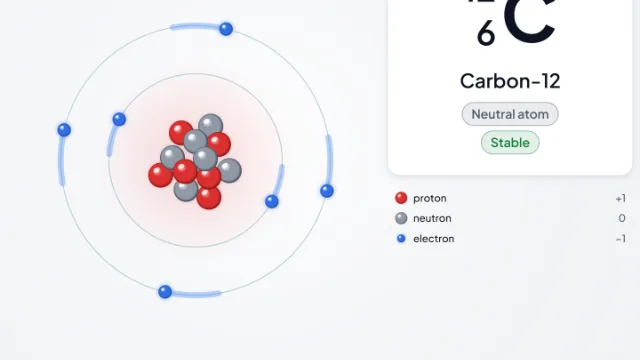
Carbon is a good example. Every carbon atom has 6 protons, yet carbon atoms come with 6, 7 or 8 neutrons:
| Isotope | Protons | Neutrons | Electrons (atom) | Nucleon number |
|---|---|---|---|---|
| Carbon-12 | 6 | 6 | 6 | 12 |
| Carbon-13 | 6 | 7 | 6 | 13 |
| Carbon-14 | 6 | 8 | 6 | 14 |
The name "carbon-14" simply gives the element followed by the nucleon number. Hydrogen's isotopes are hydrogen-1 (no neutrons at all), hydrogen-2 and hydrogen-3.
How do you read a nuclide symbol?
The element symbol carries two numbers on its left. The upper one is the nucleon number (protons plus neutrons); the lower one is the proton number. For chlorine-35 the symbol is
which tells you 17 protons and 35 − 17 = 18 neutrons. A neutral atom also has 17 electrons.
For an ion, the charge is written at the top right, and it changes only the electron count:
- : 17 protons, 18 neutrons, 18 electrons (one gained).
- : 12 protons, 12 neutrons, 10 electrons (two lost).
- : 13 protons, 14 neutrons, 10 electrons (three lost).
The lower number and the element symbol always agree with each other, so the lower number is sometimes left out: Cl always means 17 protons.
Why do isotopes react in the same way? (Supplement)
Chemical reactions involve electrons, mainly those in the outer shell, which are lost, gained or shared when bonds form. Isotopes of one element have the same number of protons, so their atoms carry equal numbers of electrons and the same electronic configuration. Chlorine-35 and chlorine-37 are both 2,8,7, so both gain one electron to form a chloride ion and both make sodium chloride with sodium. The extra neutrons sit in the nucleus and take no part. Isotopes do differ in mass, so a physical property that depends on mass, such as density, can be slightly different.
How do you calculate relative atomic mass from isotopes? (Supplement)
A sample of an element is a mixture of its isotopes, so its relative atomic mass, Ar, is a weighted mean of the isotope masses. For each isotope, multiply its mass by its percentage abundance, add the results, then divide by 100:
At IGCSE the mass of each isotope is taken as its nucleon number.
Worked example: chlorine
Question: Natural chlorine is 75% chlorine-35 and 25% chlorine-37. Calculate the relative atomic mass of chlorine.
- Chlorine-35: 35 × 75 = 2625.
- Chlorine-37: 37 × 25 = 925.
- Total = 2625 + 925 = 3550.
- Ar = 3550 ÷ 100 = 35.5, the value printed for chlorine in the Periodic Table on the data sheet.
Worked example: magnesium, with three isotopes
Question: A sample of magnesium contains 79% magnesium-24, 10% magnesium-25 and 11% magnesium-26. Calculate Ar to one decimal place.
- (24 × 79) + (25 × 10) + (26 × 11) = 1896 + 250 + 286 = 2432.
- Ar = 2432 ÷ 100 = 24.32, which is 24.3 to one decimal place.
Sense check: the answer must lie between the lightest and heaviest isotopes, and close to the most common one. Here 24.3 is between 24 and 26 and nearest 24, as expected. If the answer falls outside that range, an abundance or a multiplication has gone wrong.
Compare isotopes in the simulation
In the atom builder, choose Compare to see two atoms of one element side by side. Use the Element control to pick chlorine, then set Atom 1 isotope to chlorine-35 and Atom 2 isotope to chlorine-37. The table shows equal protons and electrons but two more neutrons in atom 2, and the note under it explains why both react alike. Change the neutrons with Neutrons 1 and Neutrons 2 to explore other isotopes; some combinations are marked radioactive, which goes beyond this chemistry topic. Back in Build, the Nuclide notation card writes the symbol for whatever you build, including ions.
Relative atomic mass is used everywhere in calculations: see relative masses of atoms and molecules next, and the blog guide to reading isotope symbols. The chapter quiz tests this topic alongside bonding.