Skip to content

Cambridge IGCSE Chemistry (0620) · Stoichiometry

Relative atomic and molecular mass

3.2.13.2.23.2.3

Ar compares the average mass of the atoms of an element, isotopes included, with a carbon-12 atom taken as exactly 12. Add the Ar values of every atom in a formula to get Mr. A balanced equation then gives the masses that react in proportion. Core, no moles needed.

Loading simulation…

Symbols match your course. Open the full balancing chemical equations (atom counts and state symbols) simulation for more presets and teacher tools.

Which syllabus statements does this cover?

What is relative atomic mass?

Atoms are far too light to weigh one at a time in grams, so chemists compare them with a standard: the carbon-12 atom. The unit of comparison is 1/12 of that atom's mass.

The relative atomic mass, Ar, of an element is the average mass of its isotopes, taking into account how common each one is, measured against 1/12 of the mass of a carbon-12 atom. Because it is a ratio, Ar has no units.

  • Hydrogen atoms are about 1/12 as heavy as a carbon-12 atom, so Ar(H) = 1.
  • Magnesium atoms are, on average, about twice as heavy as a carbon-12 atom, so Ar(Mg) = 24 in the Cambridge table.
  • Chlorine is a mixture of chlorine-35 and chlorine-37, and its average is 35.5. Working averages like this out from abundances is a Supplement skill shown on the isotopes page.

You never need to memorise Ar values: they are printed in the Periodic Table you are given. The Cambridge table rounds them to whole numbers, apart from chlorine (35.5); copper is given as 64.

What is relative molecular mass?

The relative molecular mass, Mr, of a substance is found by adding up the relative atomic masses of all the atoms in its formula. For an ionic compound, which has no molecules, the same total is called the relative formula mass, and it also uses the symbol Mr.

Method: count the atoms of each element in the formula, multiply each count by its Ar, then add.

  • Water, H₂O: (2 × 1) + 16 = 18
  • Carbon dioxide, CO₂: 12 + (2 × 16) = 44
  • Sulfuric acid, H₂SO₄: (2 × 1) + 32 + (4 × 16) = 98

Worked example: brackets

Question: Calculate Mr of magnesium nitrate, Mg(NO₃)₂. (Ar: Mg = 24, N = 14, O = 16)

  1. The bracket doubles everything inside it: 2 nitrogen atoms and 2 × 3 = 6 oxygen atoms, with 1 magnesium.
  2. Mg: 1 × 24 = 24.
  3. N: 2 × 14 = 28.
  4. O: 6 × 16 = 96.
  5. Mr = 24 + 28 + 96 = 148.

Two more to check yourself: calcium carbonate, CaCO₃, is 40 + 12 + 48 = 100; ammonium sulfate, (NH₄)₂SO₄, is (2 × 18) + 32 + 64 = 132.

How do you calculate reacting masses?

In a balanced equation, the Mr values multiplied by the numbers in front show the masses that react in proportion. Because mass is conserved, the combined mass of the reactants equals the combined mass of the products. Once you know one pair of masses, you can scale it up or down.

Worked example 1: calcium carbonate decomposes when heated.

CaCOX3(s)→CaO(s)+COX2(g)\ce{CaCO3(s) -> CaO(s) + CO2(g)}

What mass of calcium oxide is made from 25 g of calcium carbonate?

  1. Mr values: CaCO₃ = 100, CaO = 40 + 16 = 56, CO₂ = 44.
  2. Check conservation: 100 = 56 + 44.
  3. So 100 g of CaCO₃ gives 56 g of CaO.
  4. 25 g is a quarter of 100 g, so it gives a quarter of 56 g: 56 ÷ 4 = 14 g of calcium oxide (and 11 g of carbon dioxide escapes as gas).

Worked example 2: in the blast furnace, iron(III) oxide is reduced to iron.

FeX2OX3(s)+3 CO(g)→2 Fe(l)+3 COX2(g)\ce{Fe2O3(s) + 3CO(g) -> 2Fe(l) + 3CO2(g)}

What mass of iron can be made from 1000 g of iron(III) oxide?

  1. Mr of Fe₂O₃ = (2 × 56) + (3 × 16) = 160. The equation shows 2Fe, whose mass is 2 × 56 = 112.
  2. So 160 g of iron(III) oxide gives 112 g of iron.
  3. Scale up: 1000 ÷ 160 = 6.25, and 6.25 × 112 = 700 g of iron.

Units are your choice: the same ratio works for grams, kilograms or tonnes, so 1000 tonnes of the oxide gives 700 tonnes of iron.

Why does a balanced equation matter here?

If the equation were unbalanced, the masses would not add up: atoms are never created or destroyed, so the total mass of the products must equal the total mass of the reactants. In an open container a gas product can escape, which makes a reaction look as if it loses mass. Heating calcium carbonate in an open crucible loses mass for exactly this reason: the carbon dioxide leaves.

Check the masses in the simulation

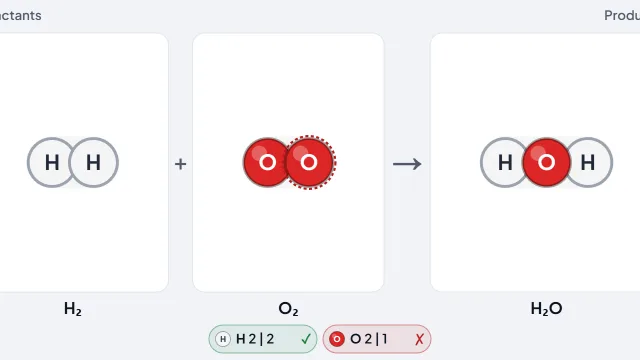
Relative masses are built into the equation balancer. Pick an equation under Equation, balance it with the − and + buttons, and press Check. Once it is balanced, the Mass is conserved table lists the Mr of every formula and the totals for the reactants and the products, which come out equal. Try the iron(III) oxide and carbon monoxide equation from the Harder level to see the 160 and 112 from the worked example. The note under the table names the periodic table the values come from.

The same skill runs through writing and balancing equations, and the atom builder shows the isotopes behind each Ar.
Common mistakes

  • Giving Ar or Mr units such as grams. They are ratios against carbon-12, so they have no units.
  • Forgetting to multiply everything inside a bracket: in Ca(OH)₂ there are 2 oxygen and 2 hydrogen atoms, so Mr = 40 + 2 × 17 = 74.
  • Using the proton number instead of Ar. For sodium the value to use is 23, not 11.
  • Ignoring the numbers in front of formulae when calculating reacting masses. In 2Mg + O₂ → 2MgO, 48 g of magnesium makes 80 g of magnesium oxide.
  • Rounding chlorine to 35 or 36. The Cambridge Periodic Table gives 35.5, and that value should be used.
  • Thinking mass is lost when a gas forms. The gas escapes from an open container, but the total mass of all the products still equals that of the reactants.

Exam practice

Exam-style questions

Original questions written in the style of Cambridge IGCSE Chemistry. Try each one before you reveal the answer.

  1. 1.Use these relative atomic masses: H = 1, C = 12, N = 14, O = 16, Na = 23, S = 32, Ca = 40.

    1. (a)Calculate the relative formula mass of sodium carbonate, Na₂CO₃.

      1 mark
      Show the answer

      Answer: (2 × 23) + 12 + (3 × 16) = 106

      Marking points

      • 106
    2. (b)Calculate the relative molecular mass of ethanol, C₂H₅OH.

      1 mark
      Show the answer

      Answer: (2 × 12) + (6 × 1) + 16 = 46

      Marking points

      • 46
    3. (c)Calculate the relative formula mass of calcium nitrate, Ca(NO₃)₂.

      2 marks
      Show the answer

      Answer: 40 + (2 × 14) + (6 × 16) = 40 + 28 + 96 = 164

      Marking points

      • Brackets used correctly: 2 N and 6 O
      • 164
  2. 2.Relative atomic masses are measured against an atom of carbon-12.

    1. (a)Describe what is meant by the relative atomic mass of an element.

      2 marks
      Show the answer

      Answer: How heavy the element's atoms are on average, allowing for its isotopes, compared with one twelfth of the mass of an atom of carbon-12.

      Marking points

      • Average mass of (the isotopes of) an atom
      • Measured relative to carbon-12 (1/12 of its mass as the unit)
    2. (b)Explain why relative atomic masses have no units.

      1 mark
      Show the answer

      Answer: They compare one mass with another (carbon-12), so they are ratios.

      Marking points

      • It is a ratio / comparison of masses
  3. 3.Copper(II) oxide can be reduced to copper by heating it in hydrogen: CuO + H₂ → Cu + H₂O. (Ar: Cu = 64, O = 16, H = 1)

    1. (a)Calculate the relative formula mass of copper(II) oxide.

      1 mark
      Show the answer

      Answer: 64 + 16 = 80

      Marking points

      • 80
    2. (b)Calculate the mass of copper produced from 20 g of copper(II) oxide.

      2 marks
      Show the answer

      Answer: 80 g of CuO gives 64 g of Cu. 20 g is a quarter of 80 g, so 64 ÷ 4 = 16 g of copper.

      Marking points

      • Ratio 80 : 64 used
      • 16 g
    3. (c)State the mass of copper(II) oxide needed to make 160 g of copper.

      1 mark
      Show the answer

      Answer: 200 g (160 is 2.5 × 64, and 2.5 × 80 = 200).

      Marking points

      • 200 g

Quiz

Quick check

6 questions

  1. 1.What is the relative molecular mass of carbon dioxide, CO₂? (C = 12, O = 16)
  2. 2.Which atom is the standard for relative atomic masses?
  3. 3.What is Mr of ammonium sulfate, (NH₄)₂SO₄? (H = 1, N = 14, O = 16, S = 32)
  4. 4.In 2H₂ + O₂ → 2H₂O, 4 g of hydrogen reacts with 32 g of oxygen. What mass of water forms?
  5. 5.Calcium carbonate (Mr 100) decomposes to calcium oxide (Mr 56) and carbon dioxide. What mass of calcium oxide comes from 50 g of calcium carbonate?
  6. 6.Magnesium has an accurate Ar of 24.3. What does the decimal part show?

Related articles

Next step

Now see it move

Open the full balancing chemical equations (atom counts and state symbols) simulation for every preset, graphs and the teacher tools, then test yourself.

Balancing chemical equations simulation: pick an equation, change only the numbers in front of each formula