What syllabus 1.1 expects
How do solids, liquids and gases differ? (Core)
| Property | Solid | Liquid | Gas |
|---|---|---|---|
| Shape | Fixed | Takes the shape of its container | Fills the whole container |
| Volume | Fixed | Fixed | Changes to fill the container |
| Can it flow? | No | Yes | Yes |
| Can it be compressed? | Hardly at all | Hardly at all | Easily |
| Particle separation | Very close, touching | Close, mostly touching | Far apart |
| Particle arrangement | Regular, in a lattice | Irregular | Irregular, random |
| Particle motion | Vibrate about fixed positions | Move past one another | Move quickly in random directions |
The particle descriptions explain the properties. Gases can be compressed because there is plenty of empty space between their particles; solids and liquids cannot, because their particles are already touching.
What are the changes of state? (Core)
- Melting: solid to liquid, at the melting point.
- Freezing: liquid to solid, at the same temperature as the melting point.
- Boiling: liquid to gas, throughout the liquid, at the boiling point.
- Evaporating: liquid to gas, only from the surface, and at any temperature below the boiling point.
- Condensing: gas to liquid.
The difference between boiling and evaporating is a favourite question. A puddle evaporates on a cool day without ever reaching 100 °C, because the fastest-moving particles at its surface escape one at a time.
How does kinetic particle theory explain changes of state? (Supplement)
Particles are always moving, and they attract one another. Heating gives them more kinetic energy.
- Melting: the particles in a solid vibrate harder until they have enough energy to overcome some of the attractive forces and leave their fixed positions. They can now move past one another.
- Boiling: the particles in a liquid gain enough energy to overcome the remaining attractive forces completely and escape as a gas.
- Freezing and condensing are the reverse: as the substance cools, the particles lose kinetic energy and the attractive forces pull them back together.
How do you read a heating or cooling curve? (Supplement)
A heating curve plots temperature against time as a substance is heated steadily. It has sloping parts and flat parts.
- On the sloping parts, one state is warming up: the energy supplied increases the kinetic energy of the particles.
- On the flat parts, the state is changing. The heat put in goes into overcoming the forces of attraction between particles, not into speeding them up, so the temperature stays constant until the change is complete.
A cooling curve shows the same thing in reverse. While a liquid freezes, the temperature stays level, because energy is released as the particles form attractions again.
Worked example. A liquid, Z, is cooled from 90 °C and its temperature recorded every minute: 90, 78, 67, 58, 52, 52, 52, 52, 45, 38 °C.
- Freezing point: the temperature stays at 52 °C for several minutes, so this is where Z freezes.
- State at 90 to 58 °C: above 52 °C, so liquid.
- State during the 52 °C plateau: liquid and solid together, as freezing happens.
- State at 45 °C and below: all solid.
- Why the temperature stays level: new attractions between particles give out energy as they form, making up for the energy lost to the surroundings.
A sharp, level plateau also suggests that Z is a pure substance; an impure substance freezes over a range of temperatures.
How do temperature and pressure change the volume of a gas? (Core and Supplement)
| Change (the other kept constant) | Effect on gas volume (Core) | Particle explanation (Supplement) |
|---|---|---|
| Temperature increases, pressure constant | Volume increases | Particles move faster and hit the walls harder and more often, so the gas pushes outwards and expands until its pressure falls back to the starting value |
| Pressure increases, temperature constant | Volume decreases | A greater outside pressure pushes the particles closer together, into a smaller space |
That is why a balloon placed in a freezer shrinks, and why the air in a syringe squashes into a smaller volume when you push the plunger with your thumb over the end.
Watch the states form in the simulation
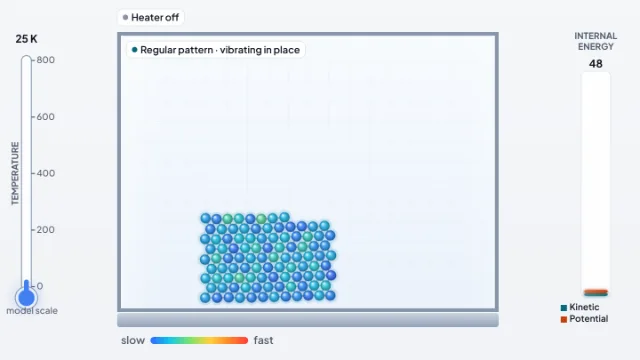
Begin with the cold Solid in the particle box above: press Play, then Heat, and watch the regular lattice break up into a liquid and finally a gas. Look at the temperature graph: it flattens while the state is changing, which is the plateau on a heating curve. Press Track to follow a single particle through each state. Then set Start from to Gas and press Cool to watch condensing and freezing. For gas pressure and volume with moving particles, try the gas laws simulation.