Where this sits in AQA chemistry
What are the halogens?
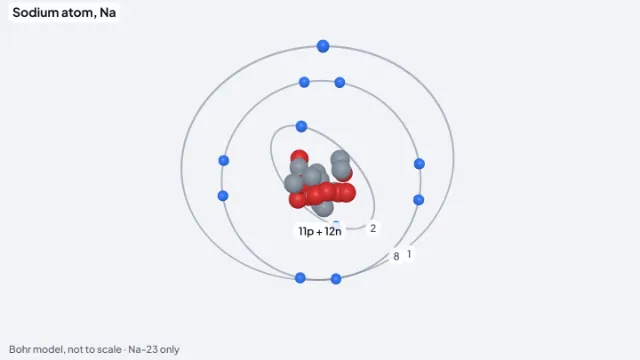
Group 7 is a column of non-metals: fluorine, chlorine, bromine, iodine and astatine. Each one is made of molecules containing two atoms, joined by a single covalent bond: F₂, Cl₂, Br₂ and I₂. Their atoms all have seven electrons in the outer shell (fluorine 2,7, chlorine 2,8,7), which is one short of a full shell, and that shared feature is why their reactions are so alike.
How do the properties change down Group 7?
| Halogen | Relative molecular mass | At room temperature | Melting point / °C | Boiling point / °C |
|---|---|---|---|---|
| Fluorine, F₂ | 38 | Pale yellow gas | −220 | −188 |
| Chlorine, Cl₂ | 71 | Yellow-green gas | −101 | −34 |
| Bromine, Br₂ | 160 | Red-brown liquid | −7 | 59 |
| Iodine, I₂ | 254 | Grey-black solid that gives a purple vapour | 114 | 184 |
Each step down the column brings a heavier molecule, a higher melting point and a higher boiling point, and a darker colour. The molecules get bigger, so the weak forces between molecules get stronger and melting or boiling them takes more energy. From the trend you can predict that astatine, below iodine, would be a dark solid with an even higher melting point.
Reactivity does the opposite: it decreases down the group. Fluorine tops the reactivity order of every non-metal; iodine reacts far more gently.
Why does reactivity decrease down Group 7?
When a halogen reacts it picks up one electron to fill its outer shell, either completely (forming a 1− ion) or by sharing.
- Each element down has one more shell than the one above, which moves the outermost shell away from the nucleus.
- More inner electrons sit between the nucleus and that outer shell.
- So an incoming electron is attracted less strongly by the nucleus.
- The atom gains an electron less easily, so the element is less reactive.
This is the mirror image of Group 1, where losing an electron gets easier down the group. Keep the two straight by asking: does this element need to lose an electron or gain one?
What compounds do the halogens form?
With metals: ionic compounds. The metal atoms pass electrons to the halogen atoms, which become halide ions with a 1− charge: chloride Cl⁻, bromide Br⁻, iodide I⁻. These compounds are salts, usually white or colourless crystalline solids such as sodium chloride and potassium iodide.
With non-metals: covalent molecules. Here the halogen shares a pair of electrons instead. Hydrogen and chlorine combine to give hydrogen chloride, a gas made of HCl molecules, which dissolves in water to make hydrochloric acid.
How do halogen displacement reactions work?
In a displacement, a more reactive halogen pushes a less reactive one out of a solution of its salt. Chlorine, for example, takes the place of bromide ions in potassium bromide, leaving bromine in the solution:
| Halogen added | Potassium chloride solution | Potassium bromide solution | Potassium iodide solution |
|---|---|---|---|
| Chlorine water | No change | Turns orange (bromine forms) | Turns brown (iodine forms) |
| Bromine water | No change | No change | Turns brown (iodine forms) |
| Iodine solution | No change | No change | No change |
Chlorine displaces two halogens, bromine one and iodine none, which puts them in order of reactivity: chlorine, then bromine, then iodine.
Higher tier only: the potassium ions take no part, so the change can be written as an ionic equation. Chlorine gains the electrons (it is reduced) and bromide ions lose them (they are oxidised).
Worked example: predicting a displacement
Question: Bromine water is added to sodium iodide solution. Predict what you would see, and write a balanced equation.
- Bromine is above iodine in Group 7, so it is more reactive and will displace iodine.
- The solution turns from pale orange to brown as iodine forms.
- Sodium stays with the new halide, so the products are sodium bromide and iodine:
If the question had been iodine solution added to sodium bromide, the answer would be "no reaction": iodine is less reactive than bromine.
Safety
Halogens are toxic and harmful to breathe in. School displacement experiments use dilute chlorine water, bromine water and iodine solution, only a few cm³ at a time, wearing eye protection in a well-ventilated lab. Chlorine gas and liquid bromine are handled only by a teacher in a fume cupboard, because bromine also causes painful burns on skin.
See seven outer electrons in the simulations
In the 3D electron shells simulation, choose fluorine and then chlorine: the Group card shows Group 7 for both, while the Period card changes. Press Make ion and an electron arrives, turning each atom into a 1− ion with the arrangement of a noble gas. To see the covalent side, open the covalent molecules simulation, choose chlorine or hydrogen chloride under Choose a molecule, and switch to Pairs 2D for the dot-and-cross diagram. For the metals that halogens pair up with, see the alkali metals.