Which syllabus statements does this cover?
How is the Periodic Table arranged?
The elements are lined up by proton number (atomic number), from the smallest to the largest, starting with hydrogen at 1. Two kinds of line run through the table:
- A period is a horizontal row. Each step to the right means one more proton. The period number equals the number of electron shells that are occupied.
- A group is a vertical column. Cambridge numbers the main groups I to VIII, with Group VIII on the far right holding the noble gases. Between Groups II and III, in Period 4 and below, sits the block of transition elements.
Hydrogen is a special case: it has one electron, like the Group I metals, but it is a non-metallic gas, so the Periodic Table that Cambridge prints sets it on its own at the top.
How does metallic character change across a period?
Every period starts with reactive metals on the left and ends with non-metals on the right, finishing with a noble gas. Period 3 shows the pattern clearly:
| Period 3 element | Its group | Character |
|---|---|---|
| Sodium | I | Metal |
| Magnesium | II | Metal |
| Aluminium | III | Metal |
| Silicon | IV | Metalloid (in between) |
| Phosphorus | V | Non-metal |
| Sulfur | VI | Non-metal |
| Chlorine | VII | Non-metal |
| Argon | VIII | Non-metal (noble gas) |
Silicon, in the middle, has some properties of each: it looks shiny and conducts a little, yet forms a giant covalent structure. A dividing line between metals and non-metals runs diagonally down the table, so the metals take up most of it, to the left and below the line.
How does the group number give the charge on an ion?
Atoms form ions by losing or gaining electrons until they reach a full outer shell. The number of outer electrons equals the group number, so the group tells you the charge:
| Group | Electrons in outer shell | Charge on the ion | Example |
|---|---|---|---|
| I | 1, lost | 1+ | Na⁺ |
| II | 2, lost | 2+ | Mg²⁺ |
| III | 3, lost | 3+ | Al³⁺ |
| IV | 4, shared instead | no simple ion | — |
| V | 5, three gained | 3− | N³⁻ |
| VI | 6, two gained | 2− | O²⁻ |
| VII | 7, one gained | 1− | Cl⁻ |
| VIII | already full | no ion | — |
Metals on the left lose electrons and become positive ions. Non-metals on the right gain electrons and become negative ions, with charge equal to 8 minus the group number. Carbon and silicon, in Group IV, share electrons instead of forming simple ions, and the noble gases already have a full shell.
Why do members of one group behave alike?
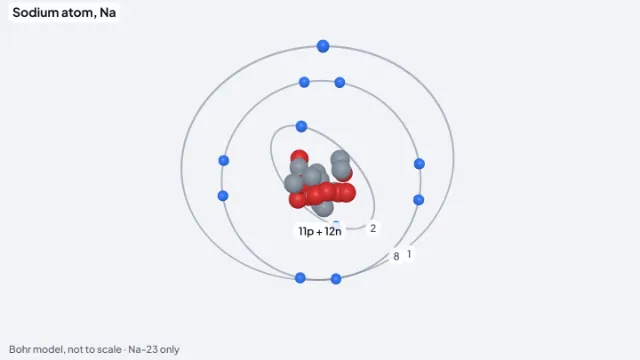
Chemical reactions are about what happens to an atom's outer electrons. All elements in a group have the same number of outer-shell electrons, so they react in similar ways and form compounds with similar formulae. Lithium, sodium and potassium are arranged 2,1 then 2,8,1 then 2,8,8,1, so each has a single outer electron: each loses it to form a 1+ ion, each reacts with water to make hydrogen and an alkaline hydroxide, and each forms a chloride with the formula MCl. What changes down the group is how strongly that electron is held, which is why reactivity follows a trend.
How can you predict properties from an element's position?
Its position tells you three things at once:
- Metal or non-metal: left of the dividing line means a metal (conducts, forms a basic oxide, gives positive ions); right of it means a non-metal.
- Ion charge and formulae: from the group number. Strontium is in Group II, so it forms Sr²⁺ and its chloride is SrCl₂, just like magnesium chloride.
- Trends: an element continues the trend of its group. Rubidium sits below potassium, so expect it to be even more reactive with water.
Worked example: spotting a trend from data (Supplement)
Question: The table gives the boiling points of the first four Group VII elements. Describe the trend and predict whether astatine, the next element down, is a solid, liquid or gas at room temperature (about 20 °C).
| Element | Fluorine | Chlorine | Bromine | Iodine |
|---|---|---|---|---|
| Boiling point / °C | −188 | −34 | 59 | 184 |
- Trend: the boiling point increases down the group, by about 90 to 155 °C at each step.
- Prediction: astatine should boil well above 184 °C, so it will not be a gas at 20 °C. Iodine is already a solid, and the trend points to astatine being a solid too.
- How to write it: state the direction of the trend first, then use it to justify the prediction. A good answer also quotes the data.
Explore the table in 3D
Open electron shells in 3D and use the mini table, The first 20 elements: tap an element and its group and period are shaded while the 3D atom builds its shells. Tap sodium to argon in turn: the Period card stays at 3 while the Group card counts up. Then tap lithium, sodium and potassium to see a column with the same outer electrons. Press Make ion on each element in Period 3 and compare the charges with the table above: silicon and argon give no simple ion. The panel Shells and the periodic table explains each result in words.
Next, see the detailed trends for the alkali metals and the halogens, or revise electron shells with the blog guide to the first 20 configurations.