Skip to content

Cambridge IGCSE Chemistry (0620) · The Periodic Table

Noble gases

8.5.1

The noble gases in Group VIII are unreactive and monatomic: they exist as single atoms. Their outer shells are already full (2 for helium, 8 for neon and argon), so their atoms have no need to lose, gain or share electrons and do not bond. Core.

Loading simulation…

Symbols match your course. Open the full electron shells in 3d (atoms and ions up to calcium) simulation for more presets and teacher tools.

Which syllabus statement does this cover?

What are the noble gases?

Group VIII, the far right-hand column of the Periodic Table, holds the noble gases: helium, neon, argon, krypton, xenon and radon. At room temperature every one of them is a colourless gas. They make up nearly 1% of the air, almost all of it argon.

Two words describe them in the syllabus:

  • Unreactive: they hardly take part in chemical reactions at all. Under school conditions they form no compounds; compounds of xenon, and a very few of krypton, have been made only in research laboratories.
  • Monatomic: they exist as single atoms, He, Ne, Ar, not as molecules. Compare oxygen, O₂, or chlorine, Cl₂, where two atoms are bonded together.

Why are the noble gases so unreactive?

An atom reacts by losing, gaining or sharing outer electrons until its outer shell is full. A noble gas atom already has a full outer shell, so it has no tendency to do any of these.

Noble gasProton numberElectronic configurationOuter shell
Helium22Full with 2 (the first shell holds only 2)
Neon102,8Full with 8
Argon182,8,8Full with 8

The same full shell explains why they are monatomic. Two chlorine atoms share a pair of electrons because each is one short of a full shell, but a noble gas atom gains nothing by bonding, so the atoms stay separate.

Helium is a frequent trap: it has only 2 outer electrons, yet it belongs in Group VIII, not Group II, because 2 is the most that the first shell can hold. Its outer shell is full, and it is as unreactive as neon.

How do other elements relate to the noble gases?

The noble gas arrangements are the stable target that other atoms reach when they react. When sodium loses one electron, Na⁺ is left as 2,8, the arrangement of neon. When chlorine gains one electron, Cl⁻ becomes 2,8,8, like argon. In covalent molecules such as water, sharing electrons gives each atom a noble-gas shell as well. So the noble gases explain the charges of ions across the whole table.

Is there a trend down Group VIII?

Their chemistry stays the same down the group, but physical properties change smoothly. Boiling point rises as the atoms get bigger and heavier:

Noble gasHeNeArKrXeRn
Boiling point / °C−269−246−186−153−108−62

Every value is far below room temperature, which is why all six are gases. Density increases down the group as well.

Why are noble gases useful?

Their lack of reactivity makes them useful wherever a reaction must be prevented (background, not a syllabus statement):

  • Argon fills the space around a hot filament in older light bulbs and shields hot metal during welding, because it will not react with the metal the way oxygen would.
  • Helium is used in weather balloons and party balloons: it has a very low density and, unlike hydrogen, it cannot burn.
  • Neon glows red-orange in advertising signs when electricity passes through it.

Worked example: explaining unreactivity

Question: Explain, in terms of electrons, why argon is unreactive and exists as single atoms. (3 marks)

  1. State the configuration: argon is 2,8,8.
  2. Link it to the full shell: its outer shell is full (8 electrons).
  3. Draw the conclusion: it does not need to lose, gain or share electrons, so it does not bond with other atoms, not even with another argon atom, which is why it is monatomic.

Three linked points earn three marks; "argon is a noble gas" on its own earns none, because it only restates the question.

Explore the full shells in 3D

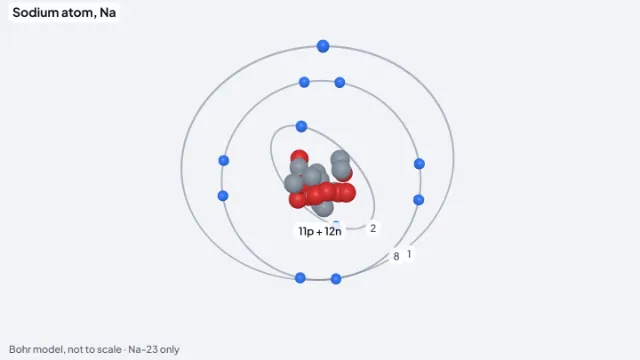
Open the 3D shell model and tap helium, neon and argon in turn in The first 20 elements. The note on the Group card says "Full outer shell of 2" for helium and "Full outer shell of 8" for the others. Now press Make ion on argon: instead of making an ion, the panel explains that a full outer shell means it forms no simple ion. Try Make ion on sodium and chlorine next, and see each ion end up with a noble-gas arrangement.

The other ends of the table are covered on Group VII halogens and groups and periods pages.
Common mistakes

  • Saying noble gases are unreactive because they are gases. Plenty of gases, such as oxygen and chlorine, are very reactive; the reason is the full outer shell.
  • Writing noble gases as molecules such as Ar₂ or He₂. They are monatomic: Ar, He.
  • Placing helium in Group II because it has two electrons. Its only shell is full with two, making it a Group VIII noble gas.
  • Stating that every noble gas has 8 outer electrons. Helium has 2; neon and argon have 8.
  • Writing that a full outer shell makes noble gases lose electrons easily. With a full shell the atom neither loses, gains nor shares electrons.
  • Explaining monatomic as having one electron shell. Monatomic means the element exists as separate single atoms, not molecules.

Exam practice

Exam-style questions

Original questions written in the style of Cambridge IGCSE Chemistry. Try each one before you reveal the answer.

  1. 1.Neon is a Group VIII element. Its proton number is 10.

    1. (a)Give the electronic configuration of neon.

      1 mark
      Show the answer

      Answer: 2,8

      Marking points

      • 2,8
    2. (b)Neon is described as monatomic. State what this means.

      1 mark
      Show the answer

      Answer: It exists as single, separate atoms (not bonded into molecules).

      Marking points

      • Exists as single atoms
    3. (c)Explain, in terms of electrons, why neon is unreactive.

      2 marks
      Show the answer

      Answer: Its outer shell is full, so the atom is already stable without transferring or sharing any electrons.

      Marking points

      • Full outer shell
      • So no electrons are transferred or shared
  2. 2.The boiling points of three noble gases are: helium −269 °C, argon −186 °C, xenon −108 °C. Krypton lies between argon and xenon in the group.

    1. (a)Describe the trend in boiling point down Group VIII.

      1 mark
      Show the answer

      Answer: The boiling point increases down the group.

      Marking points

      • Increases down the group
    2. (b)Predict a boiling point for krypton.

      1 mark
      Show the answer

      Answer: Any value between −186 °C and −108 °C (the real value is −153 °C).

      Marking points

      • A value between −186 and −108 °C
    3. (c)Explain why all the noble gases are gases at room temperature.

      1 mark
      Show the answer

      Answer: Their boiling points are all far below room temperature (about 20 °C).

      Marking points

      • Boiling points are below room temperature
  3. 3.Argon is used to fill the space around the hot filament in some light bulbs. Air is not used.

    1. (a)Suggest why argon is used instead of air.

      2 marks
      Show the answer

      Answer: Argon is unreactive, so the hot filament does not react with it. Air contains oxygen, which would react with the filament and make it burn away.

      Marking points

      • Argon is unreactive
      • Oxygen in air would react with the hot filament
    2. (b)Explain why helium is placed in the same group as argon even though it has only two electrons.

      2 marks
      Show the answer

      Answer: Helium's outer (first) shell is full with two electrons, so, like argon, it has a full outer shell and is unreactive.

      Marking points

      • First shell holds a maximum of two / helium's shell is full
      • Same full-shell behaviour (unreactive) as argon

Quiz

Quick check

6 questions

  1. 1.Which describes the noble gases at room temperature?
  2. 2.Why is argon unreactive?
  3. 3.A helium atom has how many outer-shell electrons?
  4. 4.Which formula correctly represents neon gas?
  5. 5.Which ion has the same electronic configuration as argon?
  6. 6.Why do noble gas atoms not join together to form molecules?

Related articles

Next step

Now see it move

Open the full electron shells in 3d (atoms and ions up to calcium) simulation for every preset, graphs and the teacher tools, then test yourself.

Electron shells in 3D simulation: a 3D Bohr model of the first 20 elements3D