Skip to content

Cambridge IGCSE Chemistry (0620) · Metals

Properties of metals

9.1.19.1.2

Metals usually conduct heat and electricity well, are malleable and ductile, and have high melting points; non-metals usually do not. Chemically, metals give a salt and hydrogen with dilute acids, a hydroxide or oxide and hydrogen with water or steam, and an oxide with oxygen. Core.

Loading simulation…

Symbols match your course. Open the full giant structures in 3d (sodium chloride, diamond, graphite and metals) simulation for more presets and teacher tools.

Which syllabus statements does this cover?

How do metals and non-metals compare physically?

PropertyTypical metalTypical non-metal
Thermal conductivityGood: heat passes through quicklyPoor: most are insulators
Electrical conductivityGood, as a solid and when moltenPoor (graphite is the main exception)
Malleability and ductilityMalleable (hammered into shape) and ductile (drawn into wires)Brittle when solid: they shatter
Melting and boiling pointsUsually highUsually low; many are gases at room temperature

Metals are also usually shiny when freshly cut and dense, but those are not in the list you must compare. The words "typical" and "usually" matter: mercury is a metal that is liquid at room temperature (it melts at −39 °C), sodium melts at only 98 °C, while diamond, a non-metal, has an extremely high melting point.

Why do metals behave like this? (Supplement)

Inside a metal, the atoms have released their outer electrons, leaving a giant lattice of positive ions within a mobile "sea" of delocalised electrons. The moving electrons carry charge, so metals conduct electricity, and they also pass on energy quickly, which helps metals conduct heat. The attraction between the ions and the electron sea is strong and acts in every direction, so lots of energy is needed to melt most metals. When a force is applied, rows of ions slide past one another, yet the electron sea keeps holding them together, which is why metals bend and stretch instead of shattering. The details are in the electron-sea model (Supplement).

How do metals react with dilute acids?

Metals above hydrogen in the reactivity series react with dilute acids to give a salt and hydrogen:

metal + acid → salt + hydrogen

Zn(s)+HX2SOX4(aq)→ZnSOX4(aq)+HX2(g)\ce{Zn(s) + H2SO4(aq) -> ZnSO4(aq) + H2(g)}

Hydrochloric acid gives chlorides and sulfuric acid gives sulfates. You see fizzing, the metal gradually disappears, and the gas pops when a burning splint is brought near. Copper, silver and gold give no reaction.

How do metals react with cold water and steam?

  • With cold water, the most reactive metals (potassium, sodium, calcium) form a metal hydroxide and hydrogen.
  • With steam, metals such as magnesium, which barely react with cold water, form a metal oxide and hydrogen.

2 K(s)+2 HX2O(l)→2 KOH(aq)+HX2(g)\ce{2K(s) + 2H2O(l) -> 2KOH(aq) + H2(g)}

Mg(s)+HX2O(g)→MgO(s)+HX2(g)\ce{Mg(s) + H2O(g) -> MgO(s) + H2(g)}

Metals low in the series, such as copper, do not react with water or steam at all.

How do metals react with oxygen?

Many metals react with oxygen when heated to form a metal oxide:

metal + oxygen → metal oxide

  • Magnesium burns brilliantly white, leaving white magnesium oxide powder behind.
  • Iron filings sprinkled into a flame burn with bright sparks, forming iron oxide.
  • Copper does not burn, but heating it in air coats it with black copper(II) oxide.

2 Cu(s)+OX2(g)→2 CuO(s)\ce{2Cu(s) + O2(g) -> 2CuO(s)}

2 Mg(s)+OX2(g)→2 MgO(s)\ce{2Mg(s) + O2(g) -> 2MgO(s)}

Metal oxides are usually basic, so those that dissolve give alkaline solutions; the oxides of non-metals are usually acidic.

Worked example: metal or non-metal?

Question: Element E is a dull yellow solid that melts at about 115 °C and breaks into powder when hammered. It does not conduct electricity. Its oxide dissolves in water to give an acidic solution. Is E a metal or a non-metal? Give three pieces of evidence.

  1. Low melting point (about 115 °C): typical of a non-metal.
  2. Brittle, not malleable: typical of a non-metal.
  3. Does not conduct electricity, and its oxide is acidic: both point to a non-metal.

E is a non-metal (it fits sulfur). Use at least three separate properties, and say for each one which kind of element it points to.

Explore a metal's structure in 3D

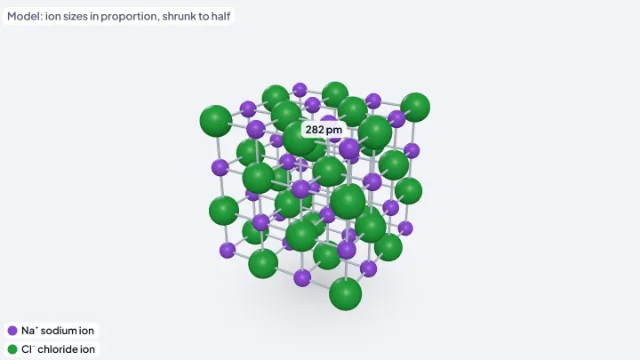
In giant structures in 3D, set Structure to Magnesium (a metal). The Particles card shows Mg²⁺ ions and electrons. Press Apply p.d.: the delocalised electrons start drifting towards the positive side, which is why the metal conducts, and press Slide layers to see the rows of ions move past each other while the electron sea keeps holding them, which is why metals are malleable. Then switch to Diamond or Sodium chloride and apply a p.d. again to compare with a non-metal and an ionic solid.

How metals are used because of these properties is the next topic in the chapter; electron arrangements behind the reactions are in arranging the Periodic Table.
Common mistakes

  • Saying all metals have high melting points. Mercury is liquid at room temperature and sodium melts below 100 °C; the rule is only typical.
  • Confusing malleable with ductile. Malleable: it can be hammered flat or into a new shape. Ductile: it can be pulled out to form a wire.
  • Giving water as a product of a metal reacting with an acid. The products are a salt and hydrogen gas.
  • Writing a hydroxide as the product of a metal with steam. Steam gives the metal oxide and hydrogen.
  • Saying copper reacts with dilute acids or water. It is too unreactive; it only forms an oxide when heated in air.
  • Calling graphite a metal because it conducts electricity. It is a form of carbon, a non-metal, and an exception to the usual pattern.

Exam practice

Exam-style questions

Original questions written in the style of Cambridge IGCSE Chemistry. Try each one before you reveal the answer.

  1. 1.Copper is used for electrical wiring. Sulfur is a yellow non-metal.

    1. (a)State two physical properties of copper that make it suitable for electrical wiring.

      2 marks
      Show the answer

      Answer: It is a good electrical conductor, and it is ductile (can be drawn into wires).

      Marking points

      • Good conductor of electricity
      • Ductile
    2. (b)Give two physical properties in which sulfur differs from copper.

      2 marks
      Show the answer

      Answer: Any two: sulfur does not conduct electricity; it is a poor conductor of heat; it is brittle, not malleable or ductile; it has a low melting point.

      Marking points

      • First valid difference
      • Second valid difference
  2. 2.Zinc reacts with dilute hydrochloric acid.

    1. (a)Name the two products of the reaction.

      2 marks
      Show the answer

      Answer: Zinc chloride and hydrogen.

      Marking points

      • Zinc chloride
      • Hydrogen
    2. (b)Give the symbol equation for this reaction, balanced and with state symbols.

      2 marks
      Show the answer

      Answer: Zn(s) + 2HCl(aq) → ZnCl₂(aq) + H₂(g)

      Marking points

      • ZnCl₂ and H₂ correct, with 2HCl
      • (s), (aq), (aq), (g)
    3. (c)Describe a test to show that the gas is hydrogen, and give the result.

      2 marks
      Show the answer

      Answer: Bring a burning splint near the gas: it ignites with a squeaky pop.

      Marking points

      • Lighted splint
      • (Squeaky) pop
  3. 3.A student heats three metals in air: magnesium ribbon, copper foil and iron filings.

    1. (a)What is observed as the magnesium burns in air? Name the product too.

      2 marks
      Show the answer

      Answer: It burns with a very bright white flame, leaving a white powder: magnesium oxide.

      Marking points

      • Bright white flame / white powder
      • Magnesium oxide
    2. (b)Write the balanced symbol equation for copper reacting with oxygen.

      1 mark
      Show the answer

      Answer: 2Cu + O₂ → 2CuO

      Marking points

      • 2Cu + O₂ → 2CuO
    3. (c)State the general word equation for a metal reacting with oxygen.

      1 mark
      Show the answer

      Answer: metal + oxygen → metal oxide

      Marking points

      • metal + oxygen → metal oxide

Quiz

Quick check

6 questions

  1. 1.Which property is typical of metals but not of non-metals?
  2. 2.What does it mean when a metal is described as ductile?
  3. 3.What forms when calcium reacts with cold water?
  4. 4.Which metal does not react with dilute sulfuric acid?
  5. 5.Which particles allow a solid metal to carry an electric current?
  6. 6.Which statement about the oxides of metals is usually true?

Related articles

Next step

Now see it move

Open the full giant structures in 3d (sodium chloride, diamond, graphite and metals) simulation for every preset, graphs and the teacher tools, then test yourself.

Giant structures in 3D simulation: the sodium chloride lattice, diamond, graphite, a metal and silicon dioxide3D