Which syllabus statements does this cover?
What is the reactivity series?
The reactivity series lists metals from the most reactive to the least reactive. Cambridge includes two non-metals, carbon and hydrogen, as reference points: a metal above carbon cannot be extracted by heating its oxide with carbon, and a metal above hydrogen gives off hydrogen with dilute acids.
| Position | Element | Symbol | A reminder |
|---|---|---|---|
| 1 (most reactive) | Potassium | K | Violent with cold water |
| 2 | Sodium | Na | Vigorous with cold water |
| 3 | Calcium | Ca | Steady fizzing with cold water |
| 4 | Magnesium | Mg | Reacts with steam |
| 5 | Aluminium | Al | Protected by its oxide layer |
| 6 | Carbon | C | Non-metal, for comparison |
| 7 | Zinc | Zn | Steady bubbles with acid |
| 8 | Iron | Fe | Slow bubbles with acid |
| 9 | Hydrogen | H | Non-metal, for comparison |
| 10 | Copper | Cu | No reaction with dilute acid |
| 11 | Silver | Ag | No reaction with dilute acid |
| 12 (least reactive) | Gold | Au | Found as the metal itself in rocks |
A memory sentence helps, but make up your own: the first letters you need are K, Na, Ca, Mg, Al, C, Zn, Fe, H, Cu, Ag, Au.
How do metals react with water and steam?
A reactive metal with water gives a metal hydroxide and hydrogen; with steam, a less reactive metal gives a metal oxide and hydrogen.
- Potassium and sodium react with cold water fast and dangerously (see the alkali metals page). Potassium's hydrogen catches fire.
- Calcium sinks and fizzes steadily in cold water, and the water turns cloudy because calcium hydroxide is only slightly soluble:
- Magnesium reacts only very slowly with cold water, but heated magnesium in steam glows a brilliant white and leaves white magnesium oxide:
The further down the list, the more energy the metal needs to react: cold water is enough for the top three, magnesium needs steam.
How do metals react with dilute hydrochloric acid?
A metal above hydrogen in the series reacts to give a salt (a metal chloride) and hydrogen. A metal below hydrogen does not react at all.
| Metal | What you see with dilute HCl | Products |
|---|---|---|
| Magnesium | Fast fizzing; the tube gets warm | Magnesium chloride + hydrogen |
| Zinc | Steady stream of bubbles | Zinc chloride + hydrogen |
| Iron | Slow bubbling, faster when warm | Iron(II) chloride + hydrogen |
| Copper, silver, gold | Nothing happens | No reaction: they are below hydrogen |
To confirm the gas is hydrogen, bring a burning splint close to it: a squeaky pop is the positive result.
Worked example: an order from results
Question: A student puts four metals, W, X, Y and Z, into dilute hydrochloric acid and into cold water. Deduce the order of reactivity.
| Metal | Cold water | Dilute hydrochloric acid |
|---|---|---|
| W | No reaction | A few bubbles, slowly |
| X | Fizzes steadily | Very fast fizzing |
| Y | No reaction | No reaction |
| Z | No reaction | Rapid bubbling |
- Only X reacts with cold water, so X is the most reactive.
- Of the others, Z reacts faster with acid than W, so Z is above W.
- Y reacts with neither, so it is the least reactive and is below hydrogen.
- Order, most reactive first: X, Z, W, Y. (They could be calcium, magnesium, iron and copper.)
Judge "faster" from the rate of bubbling only when the pieces are the same size and the acid has the same concentration and temperature.
How does displacement show reactivity? (Supplement)
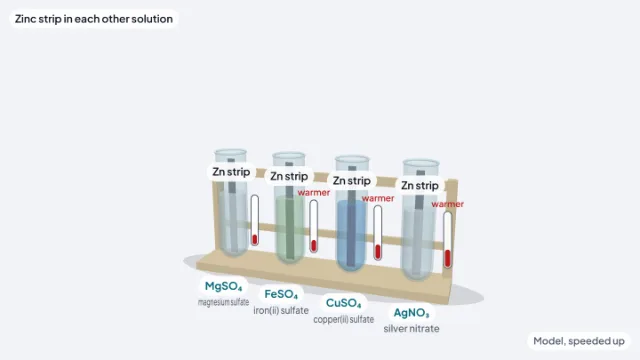
Metals react by losing electrons to form positive ions. The more readily a metal does this, the more reactive it is. So a more reactive metal will push a less reactive metal out of a solution of its ions, giving its electrons to them. A piece of zinc in blue copper(II) sulfate solution becomes coated with red-brown copper as the blue colour fades:
Here each zinc atom gives up two electrons and is oxidised, while each copper(II) ion accepts two and is reduced. Sulfate ions are spectators. Copper in zinc sulfate does nothing, because copper is the less reactive of the two. Testing every pair of magnesium, zinc, iron, copper and silver places them in the order Mg > Zn > Fe > Cu > Ag.
Why does aluminium seem unreactive? (Supplement)
Aluminium is high in the series, yet saucepans, cans and window frames made of it do not corrode away. Its surface is covered with a thin, tough layer of aluminium oxide that forms as soon as it meets air. The layer sticks firmly and stops water, air and acids from reaching the metal underneath, so aluminium often appears to react very little until the layer is removed.
Build the order in the simulation
In the reactivity series in 3D, choose One metal, every solution, pick a Metal strip such as zinc, and press Add the metal. Each tube shows whether a coating forms, the colour changes and the tube warms. Switch to Every metal, one solution and choose silver nitrate to see that four metals displace silver. The Results grid fills as each test finishes, and Order from your results builds the series from your own data; Fill the whole grid completes it at once. Open the Equations panel after a reaction to see the word, symbol and ionic equations with the oxidation and reduction labelled.
To revise the formulae and balancing used here, see formulae and equations.