Physics7 min read
The Memory Palace (Method of Loci) for Science Revision: How to Use It
How the memory palace works, where the legend of Simonides comes from, and what brain scans of memory champions showed. Then three worked palaces for science lists: the electromagnetic spectrum, the reactivity series and the first 20 elements, with the method's honest limits.
Published
On this page
- Where does the memory palace come from?
- Does the method of loci really work?
- How do you build a memory palace?
- Palace 1: the electromagnetic spectrum
- Palace 2: the reactivity series
- Palace 3: the first 20 elements
- What are the limits of a memory palace?
- Common mistakes
- Is the memory palace scientifically proven?
- Can I use a memory palace for physics equations?
- Is it better than a mnemonic sentence?
In short
A memory palace is a route through a place you know well, such as your home, where you leave one vivid picture at each stop and later walk the route in your head to read the pictures back in order. For science revision it works best on ordered lists, such as the electromagnetic spectrum, the reactivity series and the first 20 elements, and it helps you remember facts rather than understand them.
The technique is also called the method of loci (Latin for "places"). Roman teachers of public speaking described it over 2000 years ago, and memory champions still rely on it.
Where does the memory palace come from?
The story belongs to Simonides of Ceos, a Greek poet of around 500 BC. It was written down centuries later by the Roman statesman Cicero, so treat it as a legend, not history.
Simonides was hired to perform a poem at a feast given by a nobleman called Scopas. Part of the poem praised the twin gods Castor and Pollux, so Scopas paid only half the fee and told him to ask the twins for the rest. Soon a message came: two young men were waiting outside for the poet. Simonides went out and found nobody. Behind him the roof of the hall fell in, crushing every guest beyond recognition. Yet Simonides could name each body, because he remembered where everyone had been lying at the table.
The vanished visitors are meant to be the twins, paying their share by saving his life. The Roman teacher Quintilian, retelling the tale, noted that the sources disagreed and said he did not believe the part about the gods. The lesson drawn from it was useful all the same: store what you need to remember in an orderly set of places. Roman handbooks for speakers went on to teach exactly that.
Does the method of loci really work?
The best-known modern test is Dresler and colleagues (2017, Neuron). They scanned the brains of 23 memory athletes from the top 50 of the world memory sports rankings and of matched controls. Twenty minutes after studying 72 words, the athletes recalled about 71 on average; the controls about 40.
Next, 51 people with no memory training were split into three groups. One practised the method of loci for 30 minutes a day for 40 days, about six weeks; one did working-memory training; one did nothing. Before training, people recalled 26 to 30 of the words on average. According to the university's press release, the loci group then recalled about 35 more words, against 11 more for the working-memory group and 7 more for the group that did nothing. Four months later the loci group still recalled over 22 more than at the start. The paper also reports that the trained group's brain networks had shifted towards the athletes' pattern.
Two cautions: everyone trained was a young man of about 24, and the test was a list of unrelated words, not an exam paper. The method is learnable; it is not a grade booster on its own.
How do you build a memory palace?
- Pick a route you know without thinking: your home, your walk to school.
- Fix the stops in order: gate, door, shoe rack, sofa. Always walk the same way.
- Make one picture per item. Odd, loud, moving pictures stick; plain labels fade.
- Leave each picture at its stop, doing something: burning, flooding, bouncing.
- Walk it from memory, then write the list without looking. Repeat the next day and a few days later.
Palace 1: the electromagnetic spectrum
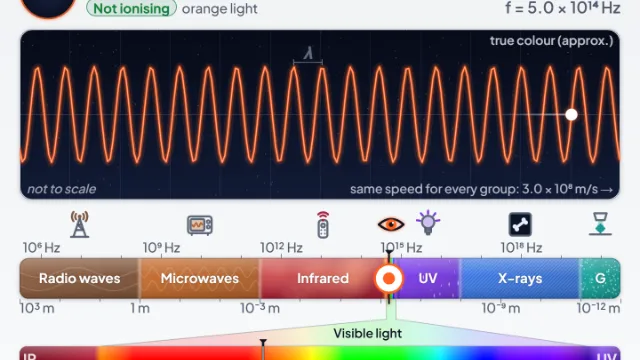
Seven stops, longest wavelength first:
- Gate: an old radio on the post, blaring the news. Radio waves.
- Front door: a microwave oven built in as a letterbox, pinging. Microwaves.
- Hall radiator: glowing hot, with a TV remote (which sends infrared) melting on top. Infrared.
- Hall mirror: a rainbow pouring out onto the floor, red first. Visible light.
- Bathroom: sun cream squirted at a white towel that glows purple. Ultraviolet.
- Stairs: a skeleton climbing them, lit from inside like a hospital scan. X-rays.
- Bedroom: a humming box stamped "sterilised", since gamma rays sterilise medical kit. Gamma rays.
The route carries the physics: deeper into the house, the wavelength shortens and the frequency rises. Check the order with our EM spectrum order guide, test yourself in the electromagnetic spectrum simulation, and see the uses of each group in the AQA notes on the spectrum.
Palace 2: the reactivity series
Use the kitchen, in the AQA order, most reactive first:
- Sink: a banana bursting into a lilac flame. Potassium.
- Draining board: a salt shaker fizzing across a wet plate. Sodium.
- Phone charger: a battery labelled "lithium" fizzing steadily in a glass of water. Lithium.
- Fridge: a milk bottle turning the water round it cloudy. Calcium.
- Toaster: a blinding white flame. Magnesium.
- Cutlery drawer: a pencil of graphite, the non-metal you compare the metals with. Carbon.
- Under the sink: a galvanised bucket. Zinc.
- Cooker: a rusty frying pan. Iron.
- Ceiling: a hydrogen balloon bumping the light. Hydrogen.
- Tap: copper pipes that barely corrode in decades. Copper.
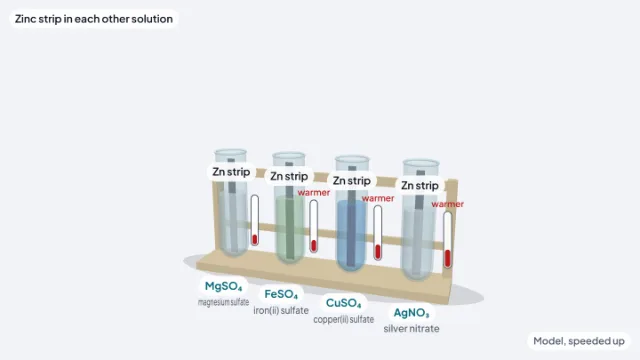
Cambridge IGCSE students leave out lithium, add aluminium after magnesium, and add silver and gold after copper: a foil tray, a spoon, a ring. Compare the AQA reactivity series page, then predict which strips gain a copper coat in the displacement reactions in 3D simulation.
Palace 3: the first 20 elements
Shape this palace like the periodic table: four rooms with 2, 8, 8 and 2 stops, one room per period.
| Room | Elements | Sample pictures |
|---|---|---|
| Porch (2 stops) | H, He | A hydrant (H), a helium balloon tied to it |
| Living room (8) | Li to Ne | A lion (Li), a bee (Be), a borosilicate glass dish (B), a coal fire (C), a nitrogen-filled crisp packet (N), an oxygen mask (O), fluoride toothpaste (F), a neon sign (Ne) |
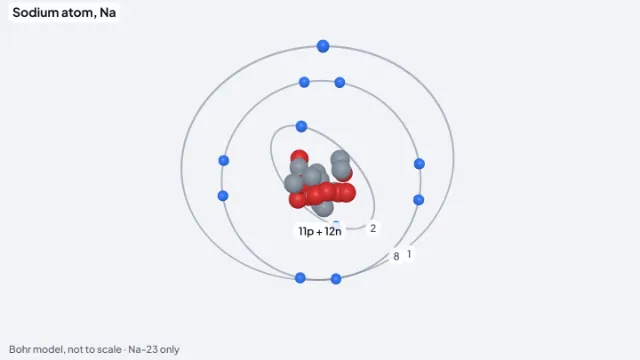
| Kitchen (8) | Na to Ar | Salt (Na), a magnesium flare (Mg), foil (Al), sand, which is silicon dioxide (Si), a matchbox striking strip (P), a rotten egg (S), pool bleach (Cl), a welder's argon cylinder (Ar) |
| Garden (2) | K, Ca | A banana tree (K), a chalk path (Ca) |
The building now holds extra meaning. The porch has two stops, just as the first shell holds two electrons, and neon and argon stand by the far wall of their rooms because noble gases end each period. Walk the same 20 in electron shells in 3D and in our shell arrangements guide.
What are the limits of a memory palace?
It is great for ordered lists and weak for understanding. Knowing that gamma comes after X-rays will not tell you why gamma rays ionise atoms, and a lilac banana does not explain why potassium loses its single outer electron more readily than sodium does.
The big 2013 review of study methods by Dunlosky and colleagues (Psychological Science in the Public Interest) rated picture-based memory tricks such as the keyword mnemonic as low in usefulness for most school learning, since they take effort to set up and suit only some material. Self-testing and spacing came top; our guide to which revision methods work explains why. So build palaces for the few lists you must know cold, and spend most of your time answering questions, such as the AQA energy chapter MCQs.
Common mistakes
- Several items on one stop. One item, one place.
- Dull pictures. "A radio" fades; "a radio blaring on the gatepost" sticks.
- Pictures that plant wrong science. A banana's potassium is in compounds, not the metal: the banana only hooks the name.
- One route for two lists in the same week. Old pictures get in the way of new ones.
- Never testing. Write the list from memory, or you will not know the palace works.
Is the memory palace scientifically proven?
For word lists, the evidence is good: memory champions depend on it, and in the 2017 Neuron study ordinary people trained for six weeks remembered far more. That was one small lab study, though, and there is much less evidence that it improves understanding or exam grades.
Can I use a memory palace for physics equations?
You can, but using equations is a better way to learn them: rearrange and substitute until they stick. Start with our equations list for GCSE physics.
Is it better than a mnemonic sentence?
For seven items a sentence works fine. A palace wins for long lists, because you can jump to any stop and spot what is missing.