Physics6 min read
Retrieval Practice: Why Testing Yourself Beats Rereading for Physics and Chemistry
What the testing effect is, the experiments behind it, why you should keep testing facts you already know, and four ways to use retrieval practice in physics and chemistry: exam-style questions, flashcards, blurting and chapter MCQ quizzes.
Published
On this page
- What is the testing effect?
- Should you stop testing yourself once you know something?
- How can you do retrieval practice for physics and chemistry?
- A 20-minute retrieval session
- Common mistakes
- Is blurting a good revision method?
- Do multiple-choice questions count as retrieval practice?
- What if I get most of the answers wrong?
- How often should I test myself?
In short
Testing yourself beats rereading because the effort of pulling an answer out of memory makes that memory stronger, so more of it is still there days later. Rereading only makes the page feel familiar. Psychologists call this the testing effect, and the practice of using it on purpose is retrieval practice.
The best-known demonstration is a 2006 experiment by Henry Roediger and Jeffrey Karpicke at Washington University in St. Louis, published in Psychological Science. Students learned a short science passage, either "The Sun" or "Sea Otters". One group read it four times. Another group read it once and then wrote down everything they could remember, three times over, with no feedback.
Five minutes later, the readers did better. A week later, the picture flipped: the self-testers remembered 61% of the ideas and the readers only 40%. The readers had been through the passage about 14 times on average, the self-testers about 3 times. Yet the readers were the more confident group when asked how much they would remember.
What is the testing effect?
The testing effect is the finding that taking a test on something helps you remember it later more than spending the same time studying it again. A test is not just a way to measure what you know. It changes what you know.
The 2006 paper ran two experiments. Here are the results from the second one, as the percentage of the passage's ideas each group recalled.
| Group | Read the passage | Recalled it from memory | Score after 5 minutes | Score after 1 week |
|---|---|---|---|---|
| Read only | 4 times | 0 times | 83% | 40% |
| Read 3, recall 1 | 3 times | 1 time | 78% | 56% |
| Read 1, recall 3 | 1 time | 3 times | 71% | 61% |
Look at the 5-minute column. Rereading wins in the short term, which is exactly why it feels like it works the night before a test. Exams come weeks or months after you revise, and the 1-week column is the one that matters.
Should you stop testing yourself once you know something?
No. This is one of the most useful findings for flashcard users. In 2008, Karpicke and Roediger published a study in Science in which students learned 40 Swahili–English word pairs. Once a student recalled a pair correctly, it was handled in one of four ways: it stayed in both study and tests, it was dropped from study only, from tests only, or from both.
A week later, the students who kept being tested on pairs they already knew recalled about 80%. The students whose known pairs were dropped from testing recalled only about 36% and 33%, even when they kept studying them. All four groups had predicted they would remember about half.
So when you get a card right, don't throw it away. Test it again later, with a longer gap. That is the idea behind the Leitner box in our spaced repetition timetable.
How can you do retrieval practice for physics and chemistry?
Exam-style questions
Work through questions with your notes closed, then mark them. Calculation questions are retrieval twice over: you must remember the equation and the method. Our AQA GCSE physics practice papers give you full sets to try.
Flashcards
Put a question on the front, not just a word. "What is the unit of specific heat capacity?" works better than "specific heat capacity". Say or write the answer before you turn the card. An equation card can name the quantities on one side and give the formula and units on the other.
Blurting
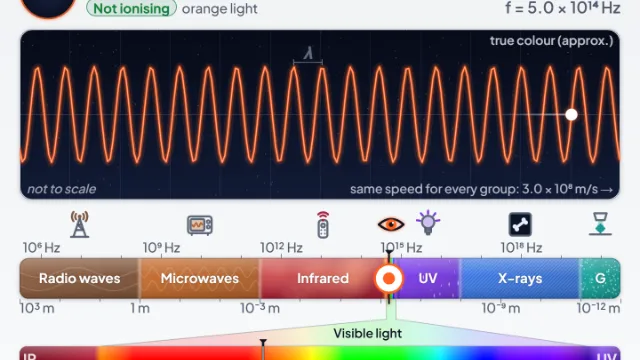
Pick one topic, such as the electromagnetic spectrum. Set a timer for 5 minutes and write everything you know on a blank page: the order from radio to gamma, the uses, the dangers, the link between frequency and wavelength. Then open your notes and fill in what you missed in a different colour. Those gaps are tomorrow's revision. Check your order against our EM spectrum memory sentence, then try placing each wave in the electromagnetic spectrum simulation.
Chapter MCQ quizzes
Our chapter MCQ pages gather the questions from one chapter so you can test a whole unit in one sitting, with an explanation for each answer. Try a chapter you studied a few weeks ago:
- GCSE physics electromagnetic waves MCQs;
- GCSE chemistry chemical changes MCQs;
- IGCSE physics motion MCQs;
- Punjab Class 10 physics electricity MCQs.
Before you choose an option, try to answer the question in your head first. That turns a recognition question into a recall one.
A 20-minute retrieval session
Here is one way to revise electricity, start to finish.
- Blurt (5 minutes). Write what you know about current, potential difference and resistance, including the equations and units.
- Check (3 minutes). Compare with your notes. Add anything missing in another colour.
- Questions (8 minutes). Answer three calculation questions with your notes closed.
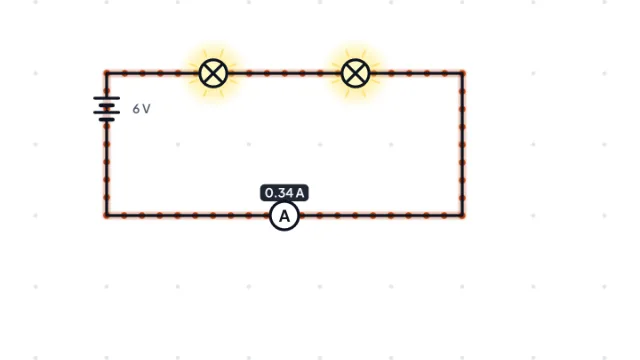
- Explain (2 minutes). Say out loud why a series circuit has one current at every point. Test the idea in the circuit builder simulation.
- Log (2 minutes). Write every mistake on your mistakes list for the next session.
The same pattern works in chemistry: blurt bonding types, check, answer questions on properties, then explain why ionic compounds conduct when molten but not when solid.
Common mistakes
- Peeking too soon. A blank minute of trying is not wasted. Effortful recall is the whole point of the exercise.
- Testing only the easy cards. Cards you always get right teach you little. Shuffle the pack so the hard ones come up too.
- Skipping the check. Self-testing with no marking can leave a wrong answer in place. Always compare with a correct source.
- Treating a test as only a score. A test you take at home is a learning tool, not a judgement on you.
- Dropping cards once you know them. Keep testing them, just less often.
Is blurting a good revision method?
Yes. Blurting is a form of free recall, the same kind of test that the 2006 students took. It works best when you check the page afterwards and come back to the gaps on another day.
Do multiple-choice questions count as retrieval practice?
They do, especially when you read the explanation for every answer. For a stronger effect, answer in your head before you look at the options.
What if I get most of the answers wrong?
That is normal early on, and it is useful. Each wrong answer shows you exactly what to fix. Check the right answer, note it on your mistakes list, and test it again a few days later.
How often should I test myself?
Test yourself on new work within a day or two, then again with longer gaps. The science of revising guide puts self-testing into a weekly plan.