Chemistry11 min read
Electron Configuration of the First 20 Elements: The 2,8,8 Rule, Groups and Periods
A fast method for writing the electron configuration (electronic structure) of the first 20 elements, a complete table from hydrogen to calcium, how to read the group and period from it, how to draw shell diagrams, and why potassium starts a fourth shell.
Published
On this page
- What is an electron shell?
- How do you work out an electron configuration?
- What are the electron configurations of the first 20 elements?
- How does the electron configuration give the group and period?
- Why do elements in the same group react in the same way?
- How do you draw an electron shell diagram?
- Why does the fourth shell start at potassium?
- Common mistakes
- Quick answers
- Key points
In short
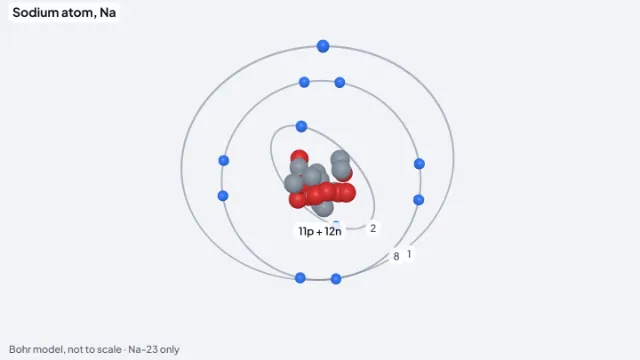
An electron configuration lists how many electrons are in each shell of an atom, starting with the shell closest to the nucleus. For the first 20 elements the rule is short: the first shell takes 2 electrons, the second takes 8, the third takes 8, and anything left over goes into the fourth. Sodium has 11 electrons, so it is 2,8,1.
The same numbers tell you where the element sits in the periodic table. Electrons occupy three of sodium's shells, which places it in Period 3. Its last number is 1, so it has one outer electron and belongs to Group 1. Learn that one method and you can handle every element from hydrogen (1) to calcium (20).
You will also see the names electronic configuration, electronic structure and electron arrangement. They all mean the same thing.
What is an electron shell?
Electrons in an atom can only have certain amounts of energy. At GCSE and IGCSE these allowed energy levels are drawn as circles round the nucleus, called shells. A shell close to the nucleus is low in energy, and its electrons are held tightly. Shells further out are higher in energy.
Picture building an atom one electron at a time. Every new electron drops into the lowest-energy shell with a free space, and a new shell is opened only once the one beneath it has no room left.
| Shell | Letter (Punjab book) | Electrons it holds for elements 1 to 20 |
|---|---|---|
| 1st (closest to the nucleus) | K | up to 2 |
| 2nd | L | up to 8 |
| 3rd | M | 8, then the 4th shell starts |
| 4th | N | 1 for potassium, 2 for calcium |
"Shell" and "energy level" are two names for one idea. AQA lets you use either word in an answer.
How do you work out an electron configuration?
Follow these steps for any element up to calcium:
- Find the atomic number (the proton number) on the periodic table. An uncharged atom contains just as many electrons as protons, so this number is your electron count.
- Fill the first shell with 2 electrons. Hydrogen, with only 1, stops here.
- Fill the second shell with up to 8.
- Fill the third shell with up to 8.
- Put the rest in the fourth shell. Only potassium and calcium get this far.
- Check that your numbers add up to the atomic number.
Write the numbers from the inside out, separated by commas: 2,8,5 means 2 in the first shell, 8 in the second and 5 in the third.
Worked example 1: phosphorus
Phosphorus is used in the striking strip on a matchbox. Its atomic number is 15. Write its electron configuration.
Electrons: a neutral atom has 15
First shell: 2, leaving 13
Second shell: 8, leaving 5
Third shell: the last 5
Answer: 2,8,5
Check: 2 + 8 + 5 = 15
Worked example 2: working backwards
An atom has the configuration 2,8,8,2. Which element is it?
Total electrons: 2 + 8 + 8 + 2 = 20
Atomic number: protons and electrons are equal in an uncharged atom, so Z = 20
Answer: calcium, the metal found in chalk, limestone and bones
What are the electron configurations of the first 20 elements?
Here is every element from hydrogen to calcium. Notice that the last number climbs by one along each row of the periodic table and then drops back to 1 when a new shell begins.
| Z | Element | Configuration | Group | Period |
|---|---|---|---|---|
| 1 | Hydrogen, H | 1 | placed on its own | 1 |
| 2 | Helium, He | 2 | 0 | 1 |
| 3 | Lithium, Li | 2,1 | 1 | 2 |
| 4 | Beryllium, Be | 2,2 | 2 | 2 |
| 5 | Boron, B | 2,3 | 3 | 2 |
| 6 | Carbon, C | 2,4 | 4 | 2 |
| 7 | Nitrogen, N | 2,5 | 5 | 2 |
| 8 | Oxygen, O | 2,6 | 6 | 2 |
| 9 | Fluorine, F | 2,7 | 7 | 2 |
| 10 | Neon, Ne | 2,8 | 0 | 2 |
| 11 | Sodium, Na | 2,8,1 | 1 | 3 |
| 12 | Magnesium, Mg | 2,8,2 | 2 | 3 |
| 13 | Aluminium, Al | 2,8,3 | 3 | 3 |
| 14 | Silicon, Si | 2,8,4 | 4 | 3 |
| 15 | Phosphorus, P | 2,8,5 | 5 | 3 |
| 16 | Sulfur, S | 2,8,6 | 6 | 3 |
| 17 | Chlorine, Cl | 2,8,7 | 7 | 3 |
| 18 | Argon, Ar | 2,8,8 | 0 | 3 |
| 19 | Potassium, K | 2,8,8,1 | 1 | 4 |
| 20 | Calcium, Ca | 2,8,8,2 | 2 | 4 |
The Group column uses AQA's numbers. Cambridge and the Punjab book number the groups differently, as the next section shows.
How does the electron configuration give the group and period?
Two quick readings answer most periodic table questions:
- Period = the number of shells that hold electrons. Take chlorine, 2,8,7: three numbers means three busy shells, so Period 3.
- Group = how many electrons sit in the outermost shell, for the groups numbered 1 to 7. Chlorine has 7 outer electrons, so it is in Group 7.
The noble gases break the counting rule, because each one ends with a complete outer shell. Neon and argon each finish with 8. Helium manages it with just 2, since 2 is all its single shell can take, so helium is grouped with the noble gases rather than with Group 2.
Hydrogen is also special. It has one outer electron, yet it is a gas and a non-metal, nothing like the soft Group 1 metals. Many tables print it by itself above the main block.
Each course names the columns in its own way:
| Outer electrons | AQA | Cambridge IGCSE | 1 to 18 numbering (Punjab book) |
|---|---|---|---|
| 1 | Group 1 | Group I | Group 1 |
| 2 | Group 2 | Group II | Group 2 |
| 3 | Group 3 | Group III | Group 13 |
| 4 | Group 4 | Group IV | Group 14 |
| 5 | Group 5 | Group V | Group 15 |
| 6 | Group 6 | Group VI | Group 16 |
| 7 | Group 7 | Group VII | Group 17 |
| Full outer shell | Group 0 | Group VIII | Group 18 |
In the 1 to 18 system, the ten columns of transition metals (Groups 3 to 12) sit between Group 2 and the rest. That is why aluminium, with 3 outer electrons, lands in Group 13: just add 10 to the outer-electron count for those last columns.
Worked example 3: identify the mystery element
Element X has 17 protons. Give its electron configuration, its group and its period, and name it.
Configuration: 17 electrons fill as 2, then 8, then 7: 2,8,7
Period: three occupied shells, so Period 3
Group: 7 outer electrons, so Group 7 (Group VII for Cambridge, Group 17 in the Punjab book)
Answer: X is chlorine, a halogen
Why do elements in the same group react in the same way?
Reactions happen at the outside of an atom, so the outer electrons decide how an element behaves. Lithium (2,1), sodium (2,8,1) and potassium (2,8,8,1) each have a single outer electron. All three are soft metals that fizz in water, giving off hydrogen and leaving an alkaline solution behind, and all three form ions with a 1+ charge.
Each step down a group adds one more shell. In Group 1 that puts the lone outer electron further from the nucleus, with more inner shells between them, so it is held less tightly and lost more easily. That is why potassium reacts more violently with water than sodium does. In Group 7 the trend runs the other way: the halogens react by gaining an electron, and a bigger atom attracts an extra electron less strongly, so fluorine is the most reactive of them.
The noble gases have full outer shells. With nothing to gain from losing, gaining or sharing electrons, they barely react at all and exist as single atoms. To see what happens when the other elements do lose or gain electrons, read how atoms form ions.
How do you draw an electron shell diagram?
Exam questions often ask for a diagram instead of numbers. Draw it like this:
- Mark the nucleus as a small dot or circle, with the element's symbol beside or inside it.
- Draw a circle round the nucleus for every shell that contains electrons.
- Mark the electrons on those circles as dots or crosses, with the correct count on each one.
Many people place the electrons in pairs around each circle, which makes them quicker to count. The pattern is a matter of taste. What matters is how many electrons sit on each shell.
The electron shells in 3D simulation builds every atom from hydrogen to calcium. Use the ‹ and › buttons to step from lithium to neon and watch the second shell fill one electron at a time, then keep going to see the third shell begin at sodium. Turn on the flat-shells view to get the same layout you would draw in an exam, and tap down a column of the mini periodic table to compare outer shells within a group.
Why does the fourth shell start at potassium?
The Punjab book gives a formula for the most electrons a shell can ever hold: , where n is the shell number. That gives 2 for the first shell, 8 for the second and 18 for the third. So why does potassium not write 2,8,9?
Each shell is really made of smaller subshells, labelled s, p, d and f. The third shell has three of them: 3s, 3p and 3d. After argon, the 3s and 3p subshells are full, holding 8 electrons between them. The 3d subshell is slightly higher in energy than the 4s subshell of the fourth shell, so the 19th electron goes into 4s instead. That gives potassium its 2,8,8,1 arrangement, and calcium adds a second 4s electron.
From scandium (Z = 21), electrons start going into 3d, and the third shell slowly grows towards its limit of 18. Zinc, for example, is 2,8,18,2. GCSE and IGCSE stop at calcium, so the 2,8,8 rule is all you need for the exam.
Common mistakes
- Writing the shells in the wrong order. Start from the nucleus: sodium is 2,8,1, not 1,8,2.
- Using the mass number. Sodium's mass number is 23, but it has 11 electrons. Always use the atomic (proton) number.
- Putting a ninth electron in the third shell. Potassium is 2,8,8,1, not 2,8,9.
- Calling helium a Group 2 element. Two electrons complete its only shell, which makes it a noble gas.
- Swapping group and period. The period counts shells. The group counts outer electrons.
- Giving an atom's configuration for an ion. A sodium ion has lost an electron, so it is 2,8, not 2,8,1.
- Adding 10 in the wrong course. Only the 1 to 18 numbering puts aluminium in Group 13. For AQA it is Group 3, and for Cambridge, Group III.
Quick answers
What is the electron configuration of calcium?
Calcium has 20 electrons, arranged as 2,8,8,2. Its four occupied shells put it in Period 4, and its 2 outer electrons put it in Group 2.
Why is the third shell only given 8 electrons?
For the first 20 elements, the fourth shell begins once the third holds 8, because the 4s subshell needs less energy to fill than the third shell's 3d subshell. The third shell can hold up to 18, but only for elements beyond calcium.
Is electronic structure the same as electron configuration?
Yes. AQA mostly says electronic structure, Cambridge says electronic configuration, and many textbooks say electron arrangement. All three mean the number of electrons in each shell.
Key points
- Fill shells from the nucleus outwards: 2, then 8, then 8, then the rest, for elements 1 to 20.
- The electron count of an uncharged atom equals its atomic number.
- Count the shells that hold electrons to get the period.
- The number of outer electrons gives the group for Groups 1 to 7. Noble gases have a full outer shell.
- Members of a group all have equal numbers of outer electrons, and that gives them similar reactions.
- Cambridge writes Groups I to VIII, AQA writes 1 to 7 and 0, and the Punjab book uses 1 to 18.