Skip to content

Punjab Board Class 9 Chemistry · Chapter 2: Atomic structure

Bohr model, shells and subshells

Section 2.1

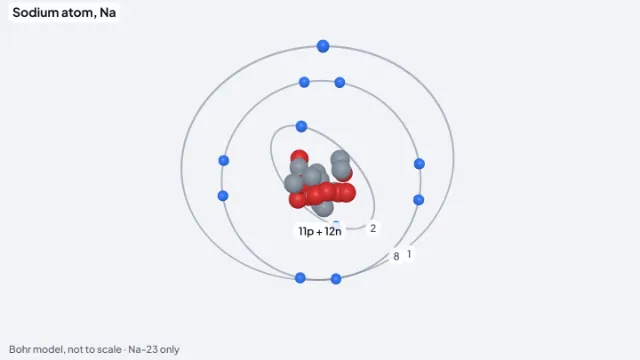
Bohr's model places electrons in fixed shells (energy levels) round the nucleus: K, L, M, N, with energy rising outwards. A shell can hold up to 2n² electrons, split into sub-shells s, p, d and f holding 2, 6, 10 and 14. Sodium is K 2, L 8, M 1.

Loading simulation…

Symbols match your course. Open the full electron shells in 3d (atoms and ions up to calcium) simulation for more presets and teacher tools.

Where this sits in Chapter 2

This page covers the second half of Section 2.1 of Chapter 2 (Atomic structure) in the Punjab Chemistry 9 textbook: Bohr's model of the atom, the shells named K, L, M and N, the 2n22n^2 rule and the sub-shells s, p, d and f. The discovery of the electron, proton and neutron, which comes first in the same section, is a separate topic.

What did Bohr's model say?

In 1913 Niels Bohr suggested a model for the hydrogen atom that was later extended to other atoms. Its main points are:

  1. Electrons move round the nucleus only in certain fixed paths, called orbits or shells.
  2. While an electron stays in one shell, its energy does not change. That is why shells are also called energy levels.
  3. The shell nearest the nucleus has the lowest energy. Shells further out have higher energy: E1<E2<E3<E4E_1 < E_2 < E_3 < E_4.
  4. An electron can be in one shell or another, but never in the space between two shells.

When every electron is in the lowest shells available, the atom is in its ground state.

What are the K, L, M and N shells?

Each shell has a number nn and a letter. The number nn also tells you the most electrons the shell can hold, using the formula 2n22n^2:

ShellnMost electrons, 2n²Sub-shells
K121s
L282s, 2p
M3183s, 3p, 3d
N4324s, 4p, 4d, 4f

The number of sub-shells in a shell equals nn. Each kind of sub-shell has its own capacity: s holds 2, p holds 6, d holds 10 and f holds 14. So the L shell's 8 electrons are 2 in 2s plus 6 in 2p, and the M shell's 18 are 2 + 6 + 10.

How are electrons arranged in the first 20 elements?

Electrons go into the K shell first, then L, then M. There is one catch. The 2n22n^2 rule says M can hold 18, but after argon (K 2, L 8, M 8) the next electrons go into the N shell, because the 4s sub-shell is lower in energy than 3d. So potassium and calcium start the N shell while M still has only 8.

ElementZKLMNWritten as
Carbon6242, 4
Neon10282, 8
Sodium112812, 8, 1
Chlorine172872, 8, 7
Argon182882, 8, 8
Potassium1928812, 8, 8, 1
Calcium2028822, 8, 8, 2

In sub-shell form, sodium is 1s2 2s2 2p6 3s11s^2\,2s^2\,2p^6\,3s^1 and potassium is 1s2 2s2 2p6 3s2 3p6 4s11s^2\,2s^2\,2p^6\,3s^2\,3p^6\,4s^1.

Worked example: magnesium

Question: Magnesium has atomic number 12. Write its electronic configuration in shells and in sub-shells.

  1. Magnesium has 12 electrons.
  2. K shell: 2 (10 left). L shell: 8 (2 left). M shell: 2.
  3. Shell form: K 2, L 8, M 2, or 2, 8, 2.
  4. Sub-shell form: K is 1s21s^2; L is 2s2 2p62s^2\,2p^6; M is 3s23s^2. Together: 1s2 2s2 2p6 3s21s^2\,2s^2\,2p^6\,3s^2.
  5. Check: 2+2+6+2=122 + 2 + 6 + 2 = 12.

What does the modern picture add?

Later work showed that an electron does not travel along a fixed circular track. It behaves more like a cloud of charge, so we can only state the probability of finding it at any given distance from the nucleus. Bohr's shells are still very useful for counting electrons and explaining bonding, which is how Chapter 3 uses them: atoms bond to complete their outer shells, as explained on why atoms form bonds.

Try it in the 3D model

With the shell model in 3D, move the Atomic number slider from 1 to 20 and watch the K shell fill at helium, the L shell at neon, and a new N shell begin at potassium while M stops at 8. The Electron arrangement card gives the shell numbers, and the mini table uses Groups 1 to 18 like the table in your book. The drawing is a Bohr picture and not to scale.
Common mistakes

  • Using the 2n² rule to give potassium 2, 8, 9. The M shell can hold 18 in total, but after 8 the next electrons go into the N shell (4s), so potassium is 2, 8, 8, 1.
  • Saying electrons in outer shells have less energy. The K shell has the lowest energy; energy increases as you move away from the nucleus.
  • Thinking an electron can sit between two shells. In Bohr's model it can only be in one of the allowed shells.
  • Confusing the number of sub-shells with their capacity. The second shell has 2 sub-shells (s and p), which hold 2 and 6 electrons.
  • Giving the K shell sub-shells s and p. The first shell (n = 1) has only one sub-shell, 1s.
  • Writing the sub-shell configuration with the wrong total. The superscripts must add up to the atomic number.

Exam practice

Exam-style questions

Original questions written in the style of Punjab board exams. Try each one before you reveal the answer.

  1. 1.Short questions on Bohr's atomic model.

    1. (a)State two main points of Bohr's atomic model.

      2 marks
      Show the answer

      Answer: Any two of: electrons revolve round the nucleus in fixed orbits (shells); an electron's energy is fixed while it stays in one shell; shells further from the nucleus have higher energy; an electron cannot occupy the space between shells.

      Marking points

      • One correct postulate
      • A second correct postulate
    2. (b)Why are shells also called energy levels?

      1 mark
      Show the answer

      Answer: Because an electron in a particular shell has a fixed amount of energy.

      Marking points

      • Each shell has a fixed energy
    3. (c)Calculate the maximum number of electrons in the M shell.

      2 marks
      Show the answer

      Answer: M shell: n = 3, so 2n² = 2 × 3² = 18 electrons.

      Marking points

      • n = 3 used in 2n²
      • 18
  2. 2.Chlorine has atomic number 17 and calcium has atomic number 20.

    1. (a)Write the electronic configuration of chlorine in K, L, M form.

      1 mark
      Show the answer

      Answer: K 2, L 8, M 7.

      Marking points

      • 2, 8, 7
    2. (b)Write the electronic configuration of chlorine in sub-shell form.

      2 marks
      Show the answer

      Answer: 1s² 2s² 2p⁶ 3s² 3p⁵

      Marking points

      • 1s² 2s² 2p⁶ correct
      • 3s² 3p⁵ correct
    3. (c)Calcium's M shell could hold 18 electrons, yet calcium is 2, 8, 8, 2. Explain why.

      2 marks
      Show the answer

      Answer: After the 3s and 3p sub-shells are filled (8 electrons in M), the 4s sub-shell of the N shell is lower in energy than 3d. So the next two electrons go into 4s in the N shell.

      Marking points

      • 4s (N shell) is lower in energy than 3d
      • So electrons enter N after M has 8
  3. 3.Sub-shells are labelled s, p, d and f.

    1. (a)Give the maximum number of electrons in each of the s, p, d and f sub-shells.

      2 marks
      Show the answer

      Answer: s: 2, p: 6, d: 10, f: 14.

      Marking points

      • s 2 and p 6
      • d 10 and f 14
    2. (b)How many sub-shells does the N shell have? Name them.

      2 marks
      Show the answer

      Answer: Four (n = 4): 4s, 4p, 4d and 4f.

      Marking points

      • Four
      • s, p, d and f

Quiz

Quick check

6 questions

  1. 1.Which shell has the lowest energy?
  2. 2.What is the maximum number of electrons the L shell can hold?
  3. 3.What is the electronic configuration of potassium (Z = 19)?
  4. 4.How many electrons can a p sub-shell hold?
  5. 5.Which sub-shell configuration belongs to sodium (Z = 11)?
  6. 6.According to the modern view, what can we say about an electron's position?

Related articles

Next step

Now see it move

Open the full electron shells in 3d (atoms and ions up to calcium) simulation for every preset, graphs and the teacher tools, then test yourself.

Electron shells in 3D simulation: a 3D Bohr model of the first 20 elements3D