Skip to content

Punjab Board Class 9 Chemistry · Chapter 3: Chemical bonding

Why atoms form bonds

Section 3.1

Atoms form chemical bonds to lower their energy and become more stable. The noble gases suggested the duplet and octet rules: an outer shell of 2 or 8 electrons is stable. Atoms lose, gain or share electrons to reach the arrangement of the nearest noble gas.

Loading simulation…

Symbols match your course. Open the full electron shells in 3d (atoms and ions up to calcium) simulation for more presets and teacher tools.

Your textbook section

This page follows Section 3.1 of Chapter 3 (Chemical bonding) and the opening of Section 3.2: why atoms combine at all, the duplet and octet rules, what a chemical bond is, and the kinds of bond the chapter goes on to describe (ionic, covalent and coordinate covalent in Section 3.2, then metallic in Section 3.3). It builds on the shells from Bohr's model.

Why do atoms combine?

Atoms combine because doing so lowers their energy. A system with lower energy is more stable, in the same way that a ball resting at the bottom of a hill is more stable than one balanced at the top. When two atoms come close, the electrons of each are attracted by the nucleus of the other, while like charges repel. If the attractions win, the energy of the pair falls and a bond forms. If the repulsions win, the atoms simply move apart again.

A chemical bond is therefore the attraction that keeps atoms joined together, whether in a molecule or in a compound.

What clue did the noble gases give?

The noble gases (helium, neon, argon, krypton and xenon) hardly ever combine with other atoms or with themselves. Chemists looked at their electrons and noticed a pattern:

Noble gasConfigurationOuter shell
He2K shell full with 2 (a duplet)
Ne2, 88 in the L shell (an octet)
Ar2, 8, 88 in the M shell (an octet)

This led to the duplet rule and the octet rule: an atom is especially stable when its outermost shell holds 2 electrons (for atoms that have only a K shell, like hydrogen and helium) or 8 electrons (for the rest). Atoms of other elements react so as to reach one of these arrangements, usually that of the nearest noble gas.

How does an atom complete its octet?

There are three ways. Losing and gaining go together and give ionic bonds; sharing gives covalent bonds:

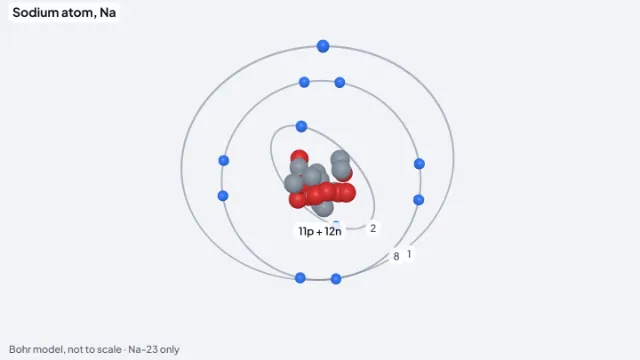
  1. Losing electrons. Sodium (2, 8, 1) can lose 1 electron to reach 2, 8, like neon. Gaining 7 would be far harder, so it takes the easier path and becomes Na⁺.
  2. Gaining electrons. Chlorine (2, 8, 7) gains 1 electron to reach 2, 8, 8, like argon, becoming Cl⁻. Losing and gaining together give the ionic bond.
  3. Sharing electrons. Two atoms that both need electrons, such as two chlorine atoms, can share a pair so each counts 8. This is covalent bonding. When both shared electrons come from one atom, it is a coordinate covalent bond.

Hydrogen is a special case with 1 electron. It can lose it to become H⁺ (just a proton), or gain one to become the hydride ion, H⁻, which completes its duplet. Most often it shares, as in H₂ or HCl.

Which elements lose and which gain?

Metals on the left of the periodic table have few outer electrons and lose them easily; they are called electropositive. The alkali metals (Group 1) and alkaline earth metals (Group 2) are good examples. Non-metals on the right have nearly full outer shells and attract extra electrons; they are electronegative, with fluorine the most electronegative of all, followed by oxygen. That is why sodium and chlorine, or calcium and oxygen, combine so readily.

Worked example: predicting what an atom will do

Question: Magnesium has atomic number 12 and oxygen 8. Use the octet rule to predict how each forms a stable arrangement.

  1. Magnesium is 2, 8, 2. Losing 2 electrons gives 2, 8 (like neon): Mg²⁺. Gaining 6 would be much harder.
  2. Oxygen is 2, 6. Gaining 2 electrons gives 2, 8 (like neon): O²⁻.
  3. Magnesium gives its 2 electrons to oxygen, and the oppositely charged ions attract: magnesium oxide, MgO.

Is the octet rule always obeyed?

Not quite. The octet rule was very useful in early bonding theory, but later work found many compounds in which the central atom has fewer or more than 8 outer electrons. Boron in BF₃, for example, has only 6 outer electrons, which is why it can accept a pair from ammonia in a coordinate covalent bond. For Class 9, the rule reliably predicts the simple ions of Groups 1, 2, 16 and 17 and molecules such as H₂O, NH₃ and CH₄, but treat it as a rule of thumb rather than a law.

Watch atoms reach an octet

In the 3D shells view, pick sodium and press Make ion to see it lose its single M-shell electron and reach the neon arrangement. Press Atom, pick chlorine and repeat: it gains one electron to complete its octet. Then try carbon and argon, and read the Ion box to see why one shares electrons and the other does not react at all.
Common mistakes

  • Saying atoms bond to gain energy. Bonding lowers the energy of the atoms, which makes them more stable.
  • Thinking sodium completes its octet by gaining 7 electrons. It is far easier to lose its 1 outer electron, leaving 2, 8.
  • Applying the octet rule to hydrogen. Hydrogen has only the K shell, so it follows the duplet rule: 2 electrons.
  • Saying the noble gases are stable because they have 8 electrons in total. It is the outermost shell that is full (2 for helium, 8 for the others).
  • Calling non-metals electropositive. Metals lose electrons easily (electropositive); non-metals attract electrons (electronegative).
  • Treating the octet rule as having no exceptions. Some compounds have central atoms with fewer or more than 8 outer electrons.

Exam practice

Exam-style questions

Original questions written in the style of Punjab board exams. Try each one before you reveal the answer.

  1. 1.Short questions on chemical bonding.

    1. (a)Define a chemical bond.

      1 mark
      Show the answer

      Answer: An attraction that keeps atoms joined together in a molecule or a compound.

      Marking points

      • Force of attraction holding atoms together (in a molecule / compound)
    2. (b)Why do atoms form chemical bonds?

      2 marks
      Show the answer

      Answer: To lower their energy and so become more stable, usually by reaching the electronic configuration of the nearest noble gas.

      Marking points

      • To lower their energy / become more stable
      • By completing a duplet or octet (noble gas configuration)
    3. (c)State the duplet rule and the octet rule.

      2 marks
      Show the answer

      Answer: Duplet rule: atoms with only a K shell are stable with 2 electrons in it. Octet rule: other atoms are stable with 8 electrons in their outermost shell.

      Marking points

      • Duplet: 2 electrons in the outer (K) shell
      • Octet: 8 electrons in the outermost shell
  2. 2.Sodium (Z = 11) reacts with chlorine (Z = 17).

    1. (a)Explain why a sodium atom loses one electron rather than gaining seven.

      2 marks
      Show the answer

      Answer: Sodium is 2, 8, 1. Losing one electron gives 2, 8, a complete octet like neon. This needs much less energy than gaining seven electrons, so it is the easier path.

      Marking points

      • Losing 1 electron gives 2, 8 (neon arrangement)
      • This is energetically easier than gaining 7
    2. (b)Write the electronic configuration of the chloride ion and name the noble gas it resembles.

      2 marks
      Show the answer

      Answer: 2, 8, 8; argon.

      Marking points

      • 2, 8, 8
      • Argon
  3. 3.Hydrogen has one electron.

    1. (a)Give the formula of the ion formed when hydrogen gains one electron, and name it.

      2 marks
      Show the answer

      Answer: H⁻, the hydride ion.

      Marking points

      • H⁻
      • Hydride ion
    2. (b)Explain why the hydride ion is stable according to the duplet rule.

      1 mark
      Show the answer

      Answer: It has 2 electrons in its K shell, a complete duplet like helium.

      Marking points

      • Two electrons in the K shell (like helium)

Quiz

Quick check

6 questions

  1. 1.Atoms combine to form bonds because this:
  2. 2.Which noble gas has a duplet rather than an octet?
  3. 3.Which atom completes its octet most easily by gaining one electron?
  4. 4.Metals that lose electrons easily to form positive ions are described as:
  5. 5.Which is the most electronegative element?
  6. 6.What is the electronic configuration of the magnesium ion, Mg²⁺?

Related articles

Next step

Now see it move

Open the full electron shells in 3d (atoms and ions up to calcium) simulation for every preset, graphs and the teacher tools, then test yourself.

Electron shells in 3D simulation: a 3D Bohr model of the first 20 elements3D