Skip to content

Punjab Board Class 9 Chemistry · Chapter 3: Chemical bonding

Comparing ionic and covalent substances

Section 3.6Section 3.8

Ionic compounds are hard, brittle crystalline solids with high melting points; they dissolve in water and carry a current once melting or dissolving frees their ions. Covalent compounds are mostly separate molecules with weak forces between them, so they usually boil low and do not conduct.

Loading simulation…

Symbols match your course. Open the full giant structures in 3d (sodium chloride, diamond, graphite and metals) simulation for more presets and teacher tools.

Book sections covered

This page brings together Section 3.6 (ionic versus covalent compounds) and Section 3.8 (nature of bonding and properties) of Chapter 3 in Punjab Chemistry 9. Intermolecular forces and hydrogen bonding, in Section 3.7, are a separate topic, but they are needed here to explain low boiling points.

How do ionic and covalent compounds compare?

PropertyIonic compounds (e.g. NaCl)Covalent compounds (e.g. CH₄, CO₂)
ParticlesOppositely charged ions in a crystal latticeMostly separate neutral molecules
Physical state at room temperatureUsually crystalline solidsOften gases or liquids; larger molecules are solids
Melting and boiling pointsHigh (NaCl melts at 801 °C)Usually low
HardnessHard but brittleMolecular solids are usually soft
SolubilityGenerally soluble in water (a polar solvent)Usually insoluble in water; soluble in non-polar solvents such as ether and benzene
Electrical conductivityConduct when molten or in solution, not as solidsUsually poor conductors

The words "usually" and "generally" matter: there are exceptions on both sides, and some covalent substances, such as diamond, are giant structures that behave quite differently from small molecules.

Why are ionic solids high-melting yet brittle?

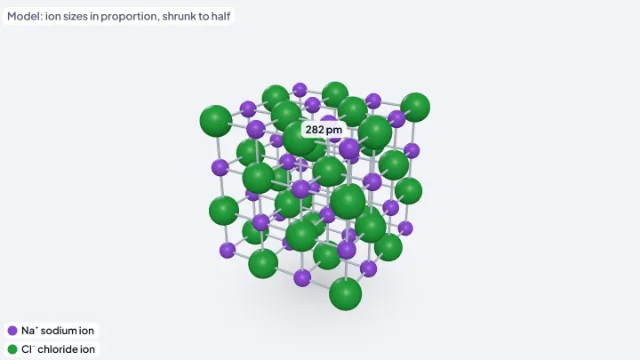
Inside an ionic crystal, each ion is gripped from all sides by its oppositely charged neighbours. Ionic bonds are non-directional, so the whole crystal is one rigid, very stable structure, and a lot of heat is needed to free the ions: hence the high melting point.

The same rigidity makes ionic solids brittle. If a strong force pushes one layer of ions along by one position, ions of the same charge come face to face. They repel each other, and the crystal splits instead of bending.

Why do ionic compounds conduct only when molten or dissolved?

Electricity flows only if charged particles are free to move. In the solid, the ions are tightly held and can only vibrate, so there is no conduction. When the compound melts, the ions become free and move towards the electrodes. Dissolving does the same thing: water molecules pull the ions out of the lattice and surround them, a process called hydration. The negative (oxygen) ends of water molecules face each Na⁺ ion, and the positive (hydrogen) ends face each Cl⁻ ion. The hydrated ions are free to move, so the solution conducts.

Free ions in solution also react quickly. When solutions of sodium chloride and silver nitrate are mixed, the silver and chloride ions meet and a white precipitate of silver chloride forms at once:

AgX+(aq)+ClX−(aq)→AgCl(s)\ce{Ag+(aq) + Cl-(aq) -> AgCl(s)}

The sodium and nitrate ions stay in solution unchanged.

Why do many covalent compounds boil at low temperatures?

Inside each molecule the covalent bonds are strong. Between neighbouring molecules, however, the intermolecular forces are weak. Boiling only separates molecules from each other, so little energy is needed. That is why methane, ammonia, hydrogen chloride, carbon dioxide and sulfur dioxide are gases at room temperature, and why non-metal elements such as nitrogen, oxygen and chlorine are gases too. Water is the notable exception among small molecules: hydrogen bonds between its molecules give it a much higher boiling point than similar compounds such as H₂S.

Covalent molecules have no overall charge, so pure covalent substances usually do not conduct. A few, such as hydrogen chloride, react with water to form ions, and their solutions then conduct.

How do diamond and graphite fit in?

Diamond and graphite are covalent but are not made of small molecules. Diamond links every carbon atom to four neighbours with strong covalent bonds in a rigid network, making it the hardest natural substance; it is used for cutting, polishing and drilling. Graphite is built of flat sheets of carbon hexagons with only weak links between sheets, so they slip; it is used as a lubricant, and its mobile electrons let it conduct and act as an electrode. These forms of carbon are covered on allotropes.

Worked example: identifying the bonding

Question: Substance X melts at 770 °C, dissolves in water and conducts only when molten or dissolved. Substance Y boils at −33 °C and does not conduct when liquid. Identify the type of bonding in each.

  1. X: high melting point, soluble in water, conducts only when its particles are freed. These fit an ionic compound (in fact X could be potassium chloride).
  2. Y: very low boiling point and no conduction. These fit a covalent compound of small molecules (Y could be ammonia).

Compare the structures in 3D

Select sodium chloride in the 3D lattice viewer and press Apply p.d.: nothing moves in the solid. Press Molten and the ions start drifting to opposite sides. Read the Free to carry charge card in each state. Then turn to the molecule viewer for small, separate molecules, each shown with its boiling point.
Common mistakes

  • Saying solid sodium chloride conducts because it contains ions. Its ions are tightly held in the lattice; they must be freed by melting or dissolving.
  • Explaining low boiling points of covalent compounds by weak covalent bonds. The bonds inside molecules are strong; the forces between molecules are weak.
  • Calling ionic solids malleable. They are brittle: a shift in the lattice brings like charges together and the crystal breaks.
  • Saying water simply melts the salt when it dissolves. Water molecules pull the ions out of the lattice and surround them (hydration).
  • Assuming every covalent substance has a low melting point. Diamond and graphite are covalent giant structures with very high melting points.
  • Writing that the sodium and nitrate ions form the precipitate with silver nitrate. Only Ag⁺ and Cl⁻ combine to form AgCl(s).

Exam practice

Exam-style questions

Original questions written in the style of Punjab board exams. Try each one before you reveal the answer.

  1. 1.Compare the properties of ionic and covalent compounds.

    1. (a)Give two differences between ionic and covalent compounds in their physical properties.

      2 marks
      Show the answer

      Answer: Any two of: ionic compounds have high melting and boiling points, covalent compounds usually low; ionic compounds are generally soluble in water, covalent compounds usually not (but soluble in non-polar solvents); ionic compounds conduct when molten or dissolved, covalent compounds are usually poor conductors.

      Marking points

      • One correct difference
      • A second correct difference
    2. (b)Why are ionic compounds brittle?

      2 marks
      Show the answer

      Answer: When a force moves one layer of ions, ions of the same charge are brought next to each other. They repel, and the crystal breaks.

      Marking points

      • Like-charged ions brought together when layers shift
      • Repulsion breaks the crystal
  2. 2.Sodium chloride melts at 801 °C and dissolves in water.

    1. (a)Account for the high melting point of sodium chloride.

      2 marks
      Show the answer

      Answer: The lattice is held together by strong electrostatic forces pulling in every direction, and breaking them all needs a great deal of heat.

      Marking points

      • Strong electrostatic forces between oppositely charged ions (in all directions)
      • Much energy needed to overcome them
    2. (b)What is meant by hydration of ions? Describe how water molecules surround a sodium ion.

      2 marks
      Show the answer

      Answer: Hydration is the surrounding of ions by water molecules when an ionic compound dissolves. The oxygen ends of the water molecules, which carry a partial negative charge, point towards the Na⁺ ion.

      Marking points

      • Water molecules surround the ions
      • Partially negative oxygen ends face Na⁺
    3. (c)Explain why aqueous sodium chloride conducts electricity.

      2 marks
      Show the answer

      Answer: In solution the ions are free to move. They move towards the electrodes and carry charge.

      Marking points

      • Ions free to move
      • Move to the electrodes / carry charge
  3. 3.Methane, CH₄, and carbon dioxide, CO₂, are gases at room temperature.

    1. (a)Explain why these covalent compounds are gases at room temperature.

      2 marks
      Show the answer

      Answer: They are made of small separate molecules with only weak intermolecular forces between them, so separating them takes very little energy.

      Marking points

      • Weak intermolecular forces
      • Little energy needed to separate the molecules
    2. (b)Why does water have a higher boiling point than hydrogen sulfide, H₂S?

      1 mark
      Show the answer

      Answer: Water molecules are held together by hydrogen bonds, which are stronger intermolecular forces.

      Marking points

      • Hydrogen bonding between water molecules

Quiz

Quick check

5 questions

  1. 1.Solid sodium chloride does not conduct electricity because:
  2. 2.Covalent compounds are usually soluble in:
  3. 3.When aqueous sodium chloride is added to silver nitrate solution, the white precipitate is:
  4. 4.Which property is typical of ionic compounds?
  5. 5.Ionic bonds are described as non-directional because:

Related articles

Next step

Now see it move

Open the full giant structures in 3d (sodium chloride, diamond, graphite and metals) simulation for every preset, graphs and the teacher tools, then test yourself.

Giant structures in 3D simulation: the sodium chloride lattice, diamond, graphite, a metal and silicon dioxide3D