Skip to content

Punjab Board Class 9 Chemistry · Chapter 3: Chemical bonding

Covalent bonding

Section 3.2.2

A covalent bond is formed by the mutual sharing of a pair of electrons between two atoms, usually non-metals. Sharing lowers the energy because each electron is attracted by both nuclei. A single bond is one shared pair; O₂ has a double bond (two pairs) and N₂ a triple bond (three).

Loading simulation…

Symbols match your course. Open the full covalent molecules in 3d (ball-and-stick, space-filling and shared pairs) simulation for more presets and teacher tools.

Which part of the book?

This page matches Section 3.2.2, Covalent bond, from the bonding chapter (Chapter 3): how sharing an electron pair lowers the energy of two atoms, single, double and triple covalent bonds, and electron dot and cross (Lewis) structures of simple molecules. Polar and non-polar bonds and the coordinate covalent bond, which come next in the book, have their own pages.

What is a covalent bond?

A covalent bond is formed by the mutual sharing of a pair of electrons between two atoms, each atom usually giving one electron to the pair. Unlike in an ionic bond, no electron is handed over completely. What holds the two atoms together is the strong electrostatic attraction between the shared electrons and both nuclei. Both bonded atoms count the shared pair as part of their own outer shell, so each can complete its duplet or octet. Covalent bonds normally form between non-metal atoms, which all tend to attract electrons.

Why does sharing lower the energy?

Think of two hydrogen atoms approaching each other.

  • Attraction: the electron of each atom is pulled by the nucleus of the other atom as well as its own. This lowers the energy.
  • Repulsion: the two nuclei repel each other, and so do the two electrons. This raises the energy.

As the atoms get closer, the attraction wins at first and the energy falls. If they come too close, repulsion takes over and the energy rises steeply. The atoms settle at the distance where the total energy is lowest, and there they stay, held together as an H₂ molecule. That distance is the bond length.

What are single, double and triple bonds?

BondShared pairsShared electronsLine symbolExample
Single covalent12–H–H, Cl–Cl, H–Cl
Double covalent24=O=O, O=C=O
Triple covalent36≡N≡N

Each atom contributes half of the shared electrons. In O₂, each oxygen atom (2, 6) puts 2 electrons into the bond and needs exactly 2 more, so a double bond completes both octets. In N₂, each nitrogen atom (2, 5) needs 3, so they share three pairs.

How do you draw electron dot and cross structures?

Show only the outer-shell electrons. Use dots for one atom's electrons and crosses for the other's. Put each shared pair between the two atom symbols, and the non-bonding pairs (lone pairs) around the atoms they belong to. Then check every atom: hydrogen should have 2 electrons around it, and the other atoms in most Class 9 examples should have 8.

MoleculeBondsLone pairs on the central atomElectrons round central atom
Water, H₂O2 single2 on O8
Ammonia, NH₃3 single1 on N8
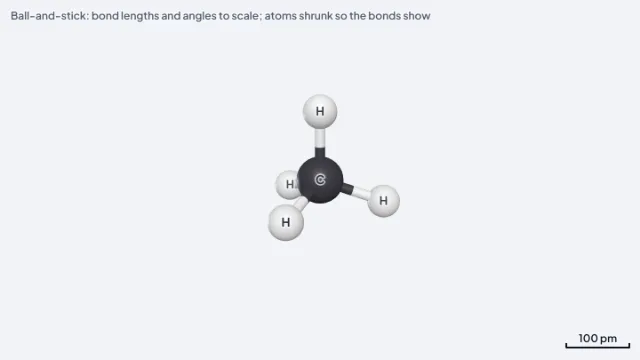
Methane, CH₄4 single08
Carbon dioxide, CO₂2 double08
Hydrogen cyanide, HCN1 single C–H, 1 triple C≡N0 on C (1 on N)8
Ethene, C₂H₄1 double C=C, 4 single C–H0 on each C8 on each C

Worked example: methanol, CH₃OH

Question: Draw the dot and cross structure of methanol and count its bonds.

  1. Carbon (2, 4) needs 4 electrons, so it forms four single bonds: three to hydrogen atoms and one to oxygen.
  2. Oxygen (2, 6) needs 2 electrons, so it forms two single bonds: one to carbon and one to hydrogen. Its other 4 outer electrons make 2 lone pairs.
  3. Each hydrogen has 2 electrons (one shared pair).
  4. Bonds: 3 C–H + 1 C–O + 1 O–H = 5 single covalent bonds; carbon and oxygen each have 8 electrons around them.

The same reasoning works for the book's practice molecules. For example, silicon (2, 8, 4) in SiH₄ forms four single bonds just like carbon in CH₄.

When is a covalent bond polar?

When the two atoms are the same, as in H₂ or Cl₂, the shared pair sits midway and the bond is non-polar. When one atom is more electronegative, as chlorine is in HCl, the pair is pulled towards it, giving it a small negative charge (δ−) and the hydrogen a small positive charge (δ+): a polar covalent bond. The bonds in water are polar for the same reason.

See the bonds in 3D

Our 3D covalent molecules model builds each of these molecules from real bond lengths. Choose methanol and press Pairs 3D to count the shared pairs in the overlaps and the two lone pairs on oxygen, then Pairs 2D for the flat dot and cross structure. Step through Cl₂, O₂ and N₂ to see the single, double and triple bonds, and press Ball+stick to see shapes that a flat drawing cannot show.
Common mistakes

  • Saying electrons are transferred in a covalent bond. They are shared; complete transfer happens in an ionic bond.
  • Counting a double bond as two shared electrons. A double bond is two shared pairs, which is four electrons.
  • Forgetting oxygen's two lone pairs in water, which leaves it with only 4 electrons; it should have 8 (2 shared pairs plus 2 lone pairs).
  • Giving hydrogen 8 electrons around it. Hydrogen follows the duplet rule: 2 electrons.
  • Thinking atoms keep moving closer until they touch. They settle at the distance where the total energy is lowest; closer than that, repulsion raises the energy.
  • Calling the H–Cl bond non-polar. Chlorine is more electronegative, so the shared pair is pulled towards it and the bond is polar.

Exam practice

Exam-style questions

Original questions written in the style of Punjab board exams. Try each one before you reveal the answer.

  1. 1.Short questions on the covalent bond.

    1. (a)Define a covalent bond.

      1 mark
      Show the answer

      Answer: A bond formed by the mutual sharing of a pair of electrons between two atoms.

      Marking points

      • Mutual sharing of an electron pair between two atoms
    2. (b)Explain why two hydrogen atoms form a stable molecule when they share their electrons.

      3 marks
      Show the answer

      Answer: Each electron is attracted by both nuclei, which lowers the energy. The nuclei repel each other and so do the electrons, which raises the energy. At one distance the attractions outweigh the repulsions most, the total energy is at its lowest, and a stable H₂ molecule forms.

      Marking points

      • Attraction between each electron and the other nucleus lowers energy
      • Repulsion between nuclei / between electrons raises energy
      • Molecule forms at the distance of minimum total energy
  2. 2.Nitrogen (Z = 7) and oxygen (Z = 8) both exist as diatomic molecules.

    1. (a)Draw the dot and cross structure of a nitrogen molecule.

      2 marks
      Show the answer

      Answer: N≡N: the nitrogen atoms share three electron pairs, each pair a dot plus a cross, and each N keeps one lone pair, so both reach eight.

      Marking points

      • Three shared pairs (triple bond)
      • One lone pair on each nitrogen
    2. (b)State the type of covalent bond in an oxygen molecule and give the number of electrons shared.

      2 marks
      Show the answer

      Answer: A double covalent bond; 4 electrons (two pairs) are shared.

      Marking points

      • Double covalent bond
      • 4 electrons shared
  3. 3.Carbon dioxide, CO₂, and ammonia, NH₃, are covalent compounds.

    1. (a)Draw the dot and cross structure of carbon dioxide.

      2 marks
      Show the answer

      Answer: Carbon in the middle sharing two pairs with each oxygen (two double bonds); each oxygen has two lone pairs; carbon has no lone pairs.

      Marking points

      • Two double bonds (two shared pairs between C and each O)
      • Two lone pairs on each O; 8 electrons round every atom
    2. (b)How many lone pairs are present on the nitrogen atom in ammonia? Explain.

      2 marks
      Show the answer

      Answer: One. Nitrogen has 5 outer electrons; 3 are used in the three N–H bonds, leaving 2 electrons, which is one lone pair.

      Marking points

      • One
      • 5 − 3 = 2 unshared electrons (one pair)

Quiz

Quick check

6 questions

  1. 1.A triple covalent bond contains how many shared electrons?
  2. 2.Which molecule contains a double covalent bond?
  3. 3.How many single covalent bonds are there in a methane molecule?
  4. 4.Covalent bonds usually form between:
  5. 5.In which molecule is the covalent bond non-polar?
  6. 6.In the dot and cross structure of water, how many electrons surround the oxygen atom?

Related articles

Next step

Now see it move

Open the full covalent molecules in 3d (ball-and-stick, space-filling and shared pairs) simulation for every preset, graphs and the teacher tools, then test yourself.

Covalent molecules in 3D simulation: eleven simple covalent molecules, from H₂ to methanol3D