Textbook link: Section 3.2.1
This page covers Section 3.2.1, Ionic bond, in Chapter 3 of the Punjab textbook: the transfer of electrons in sodium chloride and calcium chloride, the electrovalent bond, and the crystal lattice the ions build. The properties of ionic compounds come later in the chapter, in Sections 3.6 and 3.8.
What is an ionic bond?
An ionic bond, also called an electrovalent bond, forms when one or more electrons are completely transferred from one atom to another. The atom that loses electrons becomes a positive ion (a cation); the atom that gains them becomes a negative ion (an anion). The electrostatic force of attraction between these oppositely charged ions is the bond. Compounds held together this way are ionic compounds.
Only the electrons in the outermost shell take part. The inner shells and the nucleus are not affected, which is why the number of protons stays the same.
How does sodium chloride form?
| Sodium, Na | Chlorine, Cl | |
|---|---|---|
| Atomic number | 11 | 17 |
| Configuration of atom (K, L, M) | 2, 8, 1 | 2, 8, 7 |
| What happens | Loses 1 electron | Gains 1 electron |
| Ion formed | Na⁺ | Cl⁻ |
| Configuration of ion | 2, 8 (like neon) | 2, 8, 8 (like argon) |
In equation form:
The electron lost by sodium is the one gained by chlorine. In an electron dot and cross diagram, sodium's electron is drawn as a cross arriving in chlorine's outer shell, so the chloride ion ends with seven dots and one cross. Fluorine and bromine take an electron from sodium in exactly the same way, giving NaF and NaBr.
How does calcium chloride form?
Calcium is an alkaline earth metal with configuration 2, 8, 8, 2. It loses two electrons to reach 2, 8, 8, the argon arrangement, becoming Ca²⁺. Each chlorine atom can accept only one electron, so two chlorine atoms are needed:
The ions combine in a 1 : 2 ratio, giving the formula CaCl₂. The charges balance: one 2+ ion and two 1− ions.
What is a crystal lattice?
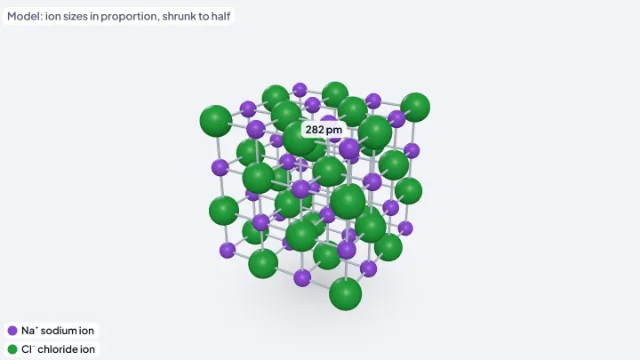
The ions do not stay in separate pairs. Because each ion attracts every oppositely charged ion near it, they build up a regular three-dimensional pattern called a crystal lattice. In sodium chloride, every Na⁺ ion has 6 Cl⁻ ions as its nearest neighbours, and every Cl⁻ has 6 Na⁺ ions. The attraction acts equally in all directions, so ionic bonds are said to be non-directional. Calcium chloride forms its own lattice, with twice as many chloride ions as calcium ions.
Other ionic compounds include KCl, MgF₂, NaF, KBr and CaF₂. In every case a metal from the left of the periodic table has given electrons to a non-metal from the right.
What conditions favour an ionic bond?
- One atom must lose electrons easily: an electropositive metal, such as those in Groups 1 and 2.
- The other must gain electrons readily: an electronegative non-metal, such as those in Groups 16 and 17.
- The bigger the difference between the two in their tendency to lose or gain electrons, the more likely an ionic bond is.
Worked example: potassium oxide
Question: Potassium (Z = 19) reacts with oxygen (Z = 8). Show how the ions form and work out the formula.
- Potassium is 2, 8, 8, 1. It loses 1 electron: K⁺, configuration 2, 8, 8.
- Oxygen is 2, 6. It needs 2 electrons: O²⁻, configuration 2, 8.
- One oxygen atom needs electrons from two potassium atoms.
- Formula: K₂O. Check: .
Try it in the simulation
The giant structures simulation above opens on the sodium chloride lattice. Press Highlight and count the six chloride ions round the ringed sodium ion, turning the block with Front, Side and Top to check none is hidden. Change Ions along each edge and read the Ratio and formula card: a small block can be uneven at its edges, but a whole crystal is 1 : 1. To watch the electron move from sodium to chlorine, use Make ion in the electron shells in 3D simulation.