Skip to content

Cambridge IGCSE Chemistry (0620) · The Periodic Table

Group I: alkali metals

8.2.18.2.2

Lithium, sodium and potassium are soft, low-density metals with one outer electron. Down Group I the melting point decreases, the density generally increases and the reactivity increases, so potassium reacts with water most violently of the three. Core.

Loading simulation…

Symbols match your course. Open the full electron shells in 3d (atoms and ions up to calcium) simulation for more presets and teacher tools.

Which syllabus statements does this cover?

What are the Group I metals like?

Group I is the first column of the Periodic Table, and its metals are called the alkali metals, because they react with water to make alkaline solutions. The syllabus focuses on three of them: lithium, sodium and potassium.

They are unusual metals:

  • Soft: a lump can be cut with a knife, and the softness increases down the group.
  • Shiny when freshly cut, but the surface tarnishes in seconds as it reacts with oxygen and water vapour in the air.
  • Low density: lithium, sodium and potassium all float on water.
  • Stored under oil, which keeps air and moisture away from them.

Every atom in the group has one electron in its outer shell, which it loses to form a 1+ ion: Li⁺, Na⁺, K⁺. That shared feature is why they all react in such similar ways.

MetalMelting point / °CDensity / g per cm³Reaction with cold water
Lithium1810.53Floats and fizzes steadily
Sodium980.97Melts into a ball and whizzes around on the surface
Potassium630.86Violent; the hydrogen catches fire with a lilac flame
  • Melting point decreases down the group. All three melt far below most metals; sodium melts below the boiling point of water, which is why it turns into a ball as it reacts.
  • Density generally increases down the group. Potassium is the well-known exception, a little less dense than sodium, but the overall trend continues with rubidium (1.53) and caesium (1.93). In the exam, describe the general trend.
  • Reactivity increases down the group, as the reactions with water show.

Why does reactivity increase down the group?

When an alkali metal reacts, its single outer electron is lost. Going down the group, each atom has one more occupied shell, so the outer electron is further from the nucleus and has more inner shells between it and the nucleus. It is held less strongly and is lost more easily. The easier the electron is to lose, the faster and more violently the metal reacts.

What happens when an alkali metal reacts with water?

Each metal gives a metal hydroxide, which dissolves to make an alkaline solution, and hydrogen gas. For sodium:

2 Na(s)+2 HX2O(l)→2 NaOH(aq)+HX2(g)\ce{2Na(s) + 2H2O(l) -> 2NaOH(aq) + H2(g)}

Lithium and potassium follow the same pattern, giving LiOH and KOH. Universal indicator added to the water turns blue or purple as the hydroxide forms. Calcium also reacts with cold water, more gently, but it is in Group II.

Worked example: predicting rubidium

Question: Rubidium is the next element below potassium in Group I. Predict its melting point compared with potassium's, how it reacts with water, and the formula of its chloride.

  1. Melting point: the trend is downward (181, 98, 63 °C), so rubidium should melt below 63 °C. (Its real melting point is 39 °C.)
  2. Reaction with water: reactivity increases down the group, so rubidium reacts even more violently than potassium, giving rubidium hydroxide, RbOH, and hydrogen.
  3. Chloride: it is in Group I, so it forms Rb⁺. With Cl⁻ the formula is RbCl.
  4. Density: following the general trend, expect it to be denser than potassium; it is, at 1.53 g/cm³, so it sinks in water.

When you predict, always name the trend you are using; that is where most of the marks are.

See the outer electron in 3D

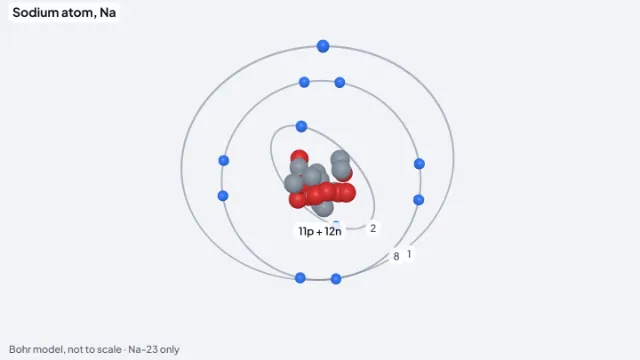
In electron shells in 3D, tap lithium, sodium and potassium in The first 20 elements table. Watch the single outer electron sit one shell further out each time, while the Group card stays the same and the Period card goes 2, 3, 4. Press Make ion on each one: the panel explains how each loses its outer electron to leave the arrangement of a noble gas. Use Flat shells, like an exam diagram to compare them the way you would draw them.

For the bigger picture, see how the table is arranged and the contrasting trend in Group VII. Our ion-forming guide explains why the 1+ charge is so common here.
Common mistakes

  • Saying reactivity decreases down Group I. It increases: potassium is more reactive than sodium, which is more reactive than lithium.
  • Saying melting point increases down the group. It decreases, from about 181 °C for lithium to 63 °C for potassium.
  • Writing NaOH₂ or Na₂OH. Sodium hydroxide is NaOH, because Na⁺ and OH⁻ balance one to one.
  • Leaving hydrogen out of the products with water. Every alkali metal gives its hydroxide and hydrogen gas.
  • Explaining the reactivity trend by more outer electrons. All have one; it is lost more easily further down because it is further from the nucleus.
  • Calling the solution acidic. The metal hydroxide makes the water alkaline, which is where the name alkali metal comes from.

Exam practice

Exam-style questions

Original questions written in the style of Cambridge IGCSE Chemistry. Try each one before you reveal the answer.

  1. 1.A teacher drops a small piece of sodium into a trough of water containing universal indicator.

    1. (a)Describe two observations the class would make.

      2 marks
      Show the answer

      Answer: Any two: the sodium floats; it melts into a silvery ball; it moves quickly around the surface; it fizzes; it gets smaller and disappears; the indicator turns blue or purple.

      Marking points

      • One correct observation
      • A second correct observation
    2. (b)Write the balanced symbol equation, with state symbols, for this reaction.

      2 marks
      Show the answer

      Answer: 2Na(s) + 2H₂O(l) → 2NaOH(aq) + H₂(g)

      Marking points

      • Correct formulae, balanced
      • Correct state symbols
    3. (c)State one safety precaution the teacher should take.

      1 mark
      Show the answer

      Answer: Any one: use a very small piece; use a safety screen; wear eye protection; handle the sodium with tongs.

      Marking points

      • One sensible precaution
  2. 2.Lithium, sodium and potassium are the first three metals in Group I.

    1. (a)Describe the trend in melting point and in reactivity from lithium to potassium.

      2 marks
      Show the answer

      Answer: Melting point decreases down the group; reactivity increases down the group.

      Marking points

      • Melting point decreases
      • Reactivity increases
    2. (b)Suggest why these metals are stored under oil.

      1 mark
      Show the answer

      Answer: To keep out air and water (moisture), which they would react with.

      Marking points

      • Prevents contact with air / oxygen / water
  3. 3.Caesium is in Group I, below rubidium. Rubidium melts at 39 °C.

    1. (a)Predict the melting point of caesium compared with rubidium.

      1 mark
      Show the answer

      Answer: Lower than 39 °C (it is about 28 °C).

      Marking points

      • Below 39 °C
    2. (b)Predict how caesium reacts with cold water compared with potassium, and name the two products.

      3 marks
      Show the answer

      Answer: More violently (it is more reactive), forming caesium hydroxide and hydrogen.

      Marking points

      • More vigorous than potassium
      • Caesium hydroxide
      • Hydrogen
    3. (c)Give the formula of caesium oxide.

      1 mark
      Show the answer

      Answer: Cs₂O, because two Cs⁺ ions balance one O²⁻ ion.

      Marking points

      • Cs₂O

Quiz

Quick check

6 questions

  1. 1.Which Group I metal reacts most vigorously with cold water?
  2. 2.What are the products when lithium reacts with water?
  3. 3.How does the melting point change from lithium to potassium?
  4. 4.Why does a freshly cut surface of sodium quickly go dull?
  5. 5.Why is potassium more reactive than sodium?
  6. 6.Which statement describes the Group I metals?

Related articles

Next step

Now see it move

Open the full electron shells in 3d (atoms and ions up to calcium) simulation for every preset, graphs and the teacher tools, then test yourself.

Electron shells in 3D simulation: a 3D Bohr model of the first 20 elements3D