Where the energy in a circuit comes from
Charges flowing round a circuit are a little like water carried round a closed pipe by a pump. The pump does not create water; it lifts the same water again and again so that it can turn a wheel lower down. A cell plays the pump's part. It does not make charge. It hands energy to the charge that passes through it, and the lamps, heaters and motors in the circuit take that energy back out.
Two quantities describe this, and both are measured in volts:
- e.m.f. tells us how much energy the source gives to each coulomb;
- potential difference (p.d.) tells us how much energy each coulomb gives up between two points, usually across one component.
Electromotive force
A source of e.m.f. changes some other kind of energy into electrical energy:
- a cell or battery uses chemical energy;
- a thermocouple uses a difference in temperature (thermal energy);
- a generator uses mechanical work, from a turbine or an engine;
- a solar cell uses light.
We define the e.m.f. as the work a source does in driving one unit of positive charge once round the complete circuit. If the source does work while a charge goes round,
The name is old-fashioned: e.m.f. is not a force at all. It is energy per coulomb, and its unit is the joule per coulomb, which is the volt:
So a 9 V battery gives 9 J to every coulomb that passes through it. To find the e.m.f. of a cell, connect a voltmeter straight across its terminals while nothing else is drawing current.
Potential difference
Inside a cell, chemical reactions pile up electrons on the negative terminal and leave a shortage on the positive one. This gives the two terminals different electric potentials. Electric potential at a point is the electric potential energy per unit charge there, and the potential difference between two points is how much those potentials differ.
In a working circuit, the p.d. between the two ends of a lamp or heater equals the electrical energy turned into other forms (heat, light, motion) for every coulomb that passes through it:
Its unit is again the volt. A lamp with 3 V across it changes 3 J of electrical energy into heat and light for each coulomb flowing through it.
Measuring with a voltmeter
A voltmeter goes in parallel, with one lead on each side of the component, because it compares the two ends. It needs a very high resistance, so that almost no current is diverted through it and the circuit behaves as it did before.
Like ammeters, voltmeters are made as analogue meters with a pointer and as digital meters with a numerical display, and each has several ranges, from millivolts up to hundreds of volts. On a low range a large voltage can damage the meter; on a high range a small voltage gives a reading that is hard to read precisely. Begin high and step down.
Cells joined in series and in parallel
Series: when cells are connected one after another, positive to negative, each one adds energy to the same charge in turn. The total e.m.f. is the sum:
Three 1.5 V cells in a row in a remote control give 4.5 V. A car battery is six 2 V cells in series, which is why it gives 12 V. One extra point the book does not cover: turn one cell round the wrong way and it works against the others, so its e.m.f. is subtracted, not added.
Parallel: when identical cells are joined side by side, all positive terminals together and all negative terminals together, each charge passes through only one of them. The combined e.m.f. is the same as that of one cell. Four 1.5 V cells in parallel still give 1.5 V. What changes is that the load is shared between the cells, so together they can deliver a larger current, or the same current for longer.
Worked numerical 1: a battery and a lamp
A battery does 180 J of work moving 15 C of charge round a circuit. Find its e.m.f. If the p.d. across the lamp in the same circuit is 11 V, how much energy does the lamp transfer while those 15 C flow through it?
Data: ,
For the lamp, :
The other 15 J is changed into heat inside the battery and the connecting wires.
Worked numerical 2: a solar garden light
A garden light has two 1.2 V rechargeable cells in series. How much electrical energy do the cells give to a charge of 500 C?
E.m.f. and p.d. in the simulation
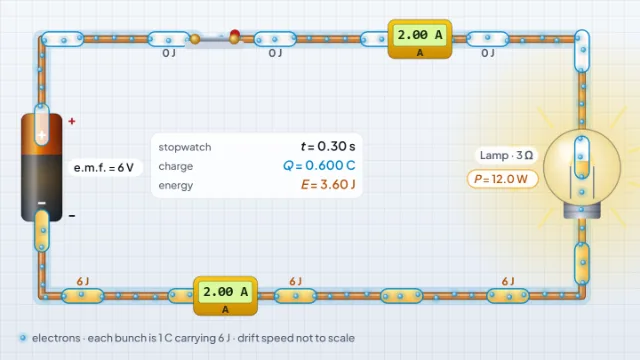
On the stage, the bunches of electrons drifting along the wire each stand for one coulomb, and the bar on each bunch shows the energy it carries.
- With the default 6 V battery, each bunch leaves the battery carrying 6 J and arrives back empty after crossing the lamp. The What a volt means box in the panel spells it out: 6 V means 6 J for every coulomb.
- Pick the 12 V, 36 W heater example and press Play. Now each coulomb carries 12 J to the heater. The Working panel shows the battery's e.m.f. as the work done on each coulomb.
- The battery in this model is ideal, so its e.m.f. is equal to the p.d. across the component. In a real battery a little energy is lost inside, as in worked numerical 1.