Physics7 min read
The Feynman Technique for Physics: Explain It Simply to Find Your Gaps
How to revise by explaining a topic in plain words and catching the points where you get stuck. Where the 'Feynman technique' name really comes from, what research on self-explanation and learning by teaching shows, and two worked physics explanations: series circuits and the hammer and feather.
Published
On this page
- Where does the Feynman technique come from?
- What does the research say?
- How do you use the Feynman technique for physics?
- Worked example 1: why is the current the same in a series circuit?
- Worked example 2: why do a hammer and a feather fall together on the Moon?
- Common mistakes
- Did Feynman invent the Feynman technique?
- Who should I explain to?
- Is it different from self-explanation?
- Does it work for chemistry?
In short
The Feynman technique means revising a topic by explaining it in plain words, as if to a younger student, and noting exactly where your explanation stalls: each stall is a gap to go back and fix. The well-known four-step version is a modern summary named after the physicist Richard Feynman, not a method he wrote down, but the idea behind it is well supported by research on self-explanation and on learning by teaching.
Where does the Feynman technique come from?
Feynman (1918 to 1988) won a share of the 1965 Nobel Prize in Physics and was famous at Caltech for his teaching. One story about him is told by his colleague David Goodstein in a 1989 article in Physics Today. Goodstein once asked Feynman to explain why particles with half-integer spin obey Fermi–Dirac statistics, and Feynman offered to prepare a lecture on it for first-year students. A few days later he came back and admitted he could not do it at that level. To him that meant physicists did not truly understand it yet.
That is the heart of the idea: if you cannot explain something simply, you may not understand it as well as you think.
The tidy recipe found online (pick a topic, explain it to a child, find the gaps, simplify) spread through study blogs and videos long after his death. There is no sign that Feynman ever set it out as a method. So the name is borrowed, but the method can still be tested on its own merits, and research has done that.
What does the research say?
Self-explanation. Michelene Chi and colleagues (1989, Cognitive Science) recorded university students thinking aloud as they studied worked examples in mechanics, Newton's laws included. The students who later solved problems well had explained each step to themselves far more often, asking why it worked and linking it to the principle behind it. Weaker students mostly reread the examples and were worse at noticing what they had not understood.
In a follow-up, Chi, de Leeuw, Chiu and LaVancher (1994, Cognitive Science) asked 14 thirteen- and fourteen-year-olds to explain each line of a text on the human circulatory system to themselves. They gained more from pre-test to post-test than a group who read the text without being prompted, and the students who explained most built the most accurate picture of how blood flows.
Learning by teaching. Nestojko, Bui, Kornell and Bjork (2014, Memory and Cognition) told some students they would have to teach a passage and others that they would be tested. In fact everyone was tested and nobody taught. The "teachers" still recalled more, organised it better and answered more questions on the main points. Expecting to explain seems to change the way you study.
Why it works. Koh, Lee and Lim (2018, Applied Cognitive Psychology) found that teaching from memory helped learning about as much as a recall test did, while teaching from a script did not. Much of the benefit seems to come from pulling the ideas out of your own memory. So explain without your notes.
How do you use the Feynman technique for physics?
- Choose one narrow question, not a whole chapter: "Why is the current the same everywhere in a series circuit?"
- Close the book and explain out loud or on paper, to an imaginary student two years younger than you.
- Underline every weak spot: a word you cannot unpack, a step you skip, any "it just does".
- Go back to the source for those spots only, then explain again, shorter.
- Test it on an exam-style question. If the explanation gets you the marks, it is good enough.
Worked example 1: why is the current the same in a series circuit?
A typical first try: "The current goes round, and the bulbs use some of it up, so... actually it is the same everywhere, because that is the rule."
Gaps found: What is current? Does a lamp use it up? Why should the rule be true?
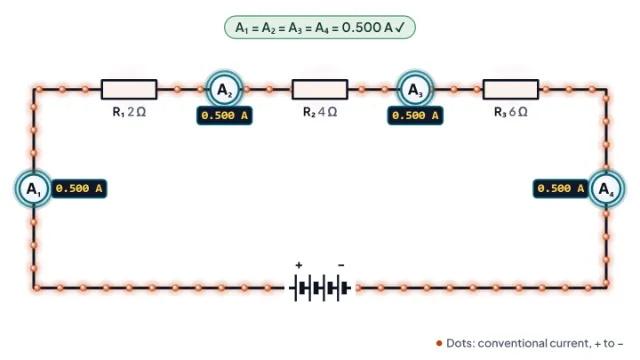
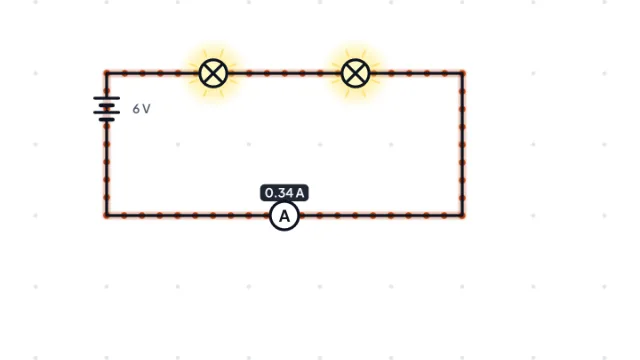
After checking: Current is the rate at which charge flows past a point. With only one path round a series loop, every charge that passes the first lamp must also pass the second. Charges are not used up in a lamp; they pass through it and hand over energy, which heats the filament until it glows. The wires are already full of free electrons, and they all start drifting together when the circuit closes, a bit like the links of a bicycle chain. If more charge passed one point each second than another, charge would pile up between them, and it does not. So the same charge flows past every point each second, and every ammeter in the loop reads the same. What the lamps share out is the energy, which is why the potential difference splits between them.
Try it in the circuit builder: load the series circuit and move the ammeter to three places. Then add a resistor in the series and parallel rules simulation and predict the new reading. For more, read our explainer on current and our circuit rules guide.
Worked example 2: why do a hammer and a feather fall together on the Moon?
On 2 August 1971, at the end of the Apollo 15 moonwalks, commander David Scott held up a geology hammer and a falcon feather and let go of both at once. They hit the dust together.
A typical first try: "Heavier things are pulled harder, so the hammer should win. But the Moon has no gravity, so they float down the same."
Gaps found: The Moon does have gravity; otherwise nothing would fall. And if the hammer is pulled harder, why does it not win?
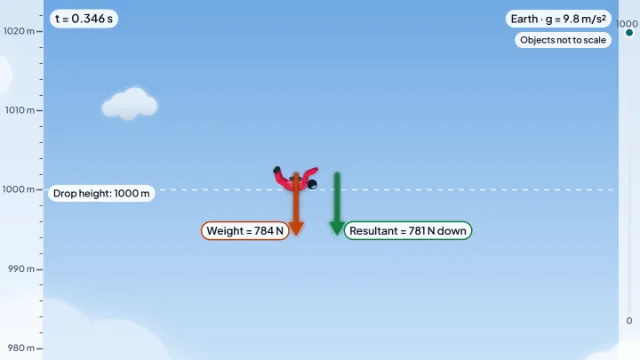
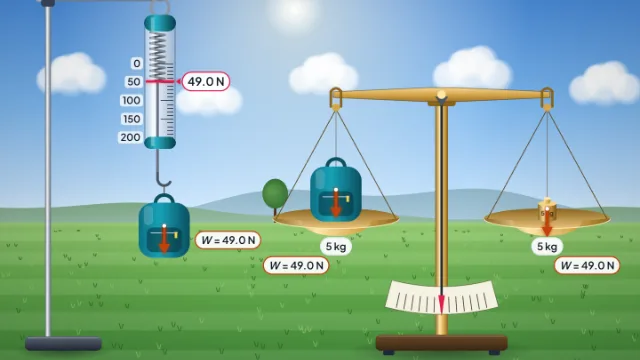
After checking: On the Moon, as on Earth, the hammer's weight is bigger, because weight is mass times the gravitational field strength. But it also has more mass to get moving. Acceleration is resultant force divided by mass, so the mass cancels: both speed up at the same 1.6 m/s². On Earth the feather drifts because air resistance is large next to its tiny weight. The Moon has no air, so weight is the only force on each, and they stay side by side.
Choose the Moon in our falling objects simulation, answer the predict-first question, then switch to Earth and watch air resistance take over. Our guides to weight versus mass and terminal velocity go further.
Common mistakes
- Explaining with your notes open. You are then reading, not recalling.
- Hiding behind jargon. "Because of inertia" is not an explanation until you can say what inertia does here.
- Choosing too big a topic. "All of electricity" turns into a list of facts.
- Explaining only in your head. Silent explanations skip steps without your noticing. Say it aloud or write it.
- Explaining a misconception fluently. A smooth explanation can still be wrong, so always check it against a trusted source or the simulation.
Did Feynman invent the Feynman technique?
No. It is named after him because of his reputation for clear explanations, but the step-by-step version was put together by others much later. The ideas inside it, self-explanation and learning by teaching, have their own evidence.
Who should I explain to?
A friend, a younger brother or sister, or an empty chair. Even planning to teach helped in the 2014 study, so imagining a listener still counts.
Is it different from self-explanation?
They overlap. Self-explanation means asking "why does this step work?" while you study. The Feynman technique adds a final explanation from memory, which also acts as a self-test.
Does it work for chemistry?
Yes. Try explaining why salt conducts when molten or dissolved, yet not as a dry solid, then check whether you mentioned ions that are free to move. Our guide to effective revision shows how to fit explaining alongside self-testing and spaced practice.