Skip to content

Cambridge IGCSE Chemistry (0620) · Electrochemistry

Electroplating

4.1.64.1.7

Electroplating coats an object with a thin layer of metal to make it look better and resist corrosion. The object is the cathode, the plating metal is the anode, and the electrolyte is a solution containing ions of that same metal. Core.

Loading simulation…

Symbols match your course. Open the full electrolysis in 3d (molten and aqueous compounds, products at each electrode) simulation for more presets and teacher tools.

Which syllabus statements does this cover?

What is electroplating and why is it done?

Electroplating uses electrolysis to coat an object with a thin, even layer of another metal. It is done for two reasons:

  • Appearance: a shiny layer of silver, gold or chromium makes cutlery, jewellery, taps and trophies look attractive, at far lower cost than making the whole object from the precious metal.
  • Resistance to corrosion: a layer of an unreactive or protective metal keeps air and water off the metal underneath. Steel is often plated with chromium, nickel or tin so that it does not rust.

Typical examples are chromium-plated steel for bicycle handlebars and bathroom taps, silver-plated cutlery made from a cheaper alloy, and tin-plated steel for food cans.

How is an object electroplated?

The set-up is an ordinary electrolytic cell with three deliberate choices:

Part of the cellWhat it isWhy
Cathode (negative electrode)The object to be platedMetal ions are attracted to it and form metal on its surface
Anode (positive electrode)A piece of the plating metalIt dissolves, replacing the metal ions used up at the cathode
ElectrolyteA solution containing ions of the plating metalIt supplies the ions that carry the metal to the object

A direct-current supply is connected so that the object is negative. Positive metal ions move through the solution to the object, gain electrons there and become a coating of metal atoms. At the same time, atoms of the anode lose electrons and go into the solution as ions. Metal is in effect transferred from the anode to the object.

Worked example: copper plating a steel key

Question: Describe how you would electroplate a steel key with copper. Name the electrodes and electrolyte, and state what you would observe.

  1. Cathode: the clean steel key, connected to the negative terminal.
  2. Anode: a strip of pure copper, connected to the positive terminal.
  3. Electrolyte: aqueous copper(II) sulfate, which contains Cu²⁺ ions.
  4. Observations: a pink-brown coating of copper builds up on the key; the copper anode slowly gets thinner and loses mass; the blue colour of the solution stays the same, because copper ions are added at the anode as fast as they are removed at the cathode.

For a good result, the object is cleaned first (grease stops the coating sticking) and a small current is used for longer, which gives a smoother, more even layer.

What happens at each electrode? (Supplement)

The two half-equations show the metal moving from anode to cathode, two electrons per copper atom:

CuX2+(aq)+2 eX−→Cu(s)\ce{Cu^{2+}(aq) + 2e^{-} -> Cu(s)}

Cu(s)→CuX2+(aq)+2 eX−\ce{Cu(s) -> Cu^{2+}(aq) + 2e^{-}}

The first, at the cathode, is reduction; the second, at the anode, is oxidation. Because both involve the same number of electrons, in an ideal cell the mass gained by the object equals the mass lost by the anode, and the concentration of the electrolyte stays constant. More on building these is on ionic half-equations.

How do you choose the set-up for a different metal?

The rule is always the same: object at the cathode, plating metal at the anode, a solution of the plating metal's ions as the electrolyte.

Coating wantedAnodeElectrolyte containsMain purpose
Silver on a spoonSilverSilver ions, Ag⁺Appearance
Nickel on a steel screwNickelNickel ions, Ni²⁺Protection from rusting
Copper on a steel keyCopperCopper(II) ions, Cu²⁺Appearance and protection

Chromium is an exception (beyond the syllabus): industrial chromium plating uses an anode that does not dissolve, with a chromium compound in the solution, so the electrolyte has to be topped up as it is used.

See it happen in the simulation

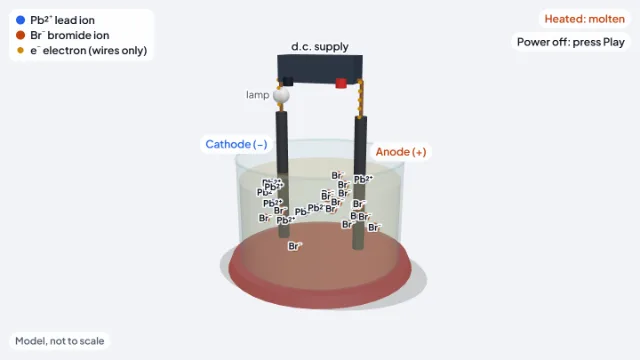
In electrolysis in 3D, set the Electrolyte to Copper(II) sulfate solution and switch Electrodes to Copper. Press Play: the Cathode (−) card shows copper forming while the Anode (+) card shows "Copper dissolves", and the solution keeps its blue colour throughout. That is exactly the electroplating cell, with the cathode playing the part of the object. Switch back to Graphite electrodes and play again: now oxygen bubbles at the anode and the solution slowly loses its colour, because nothing replaces the copper ions.

Zinc coatings (galvanising, 9.5 Supplement) go one step further and protect steel sacrificially, because zinc is more reactive than iron: see the reactivity series page. To test yourself on the whole chapter, try the electrochemistry quiz.
Common mistakes

  • Making the object the anode. The object to be plated must be the negative electrode, the cathode, where metal forms.
  • Choosing an electrolyte without ions of the plating metal. To plate with copper you need a solution containing Cu²⁺, such as copper(II) sulfate.
  • Giving only one reason for electroplating when two are asked for. Learn both: appearance and resistance to corrosion.
  • Saying the blue colour fades when copper plating with a copper anode. Every copper ion used at the object is matched by one released from the anode, so the blue does not change.
  • Using an alternating current. Electroplating needs direct current so that the object stays negative.
  • (Supplement) Writing the cathode half-equation with electrons on the right. At the cathode ions gain electrons: Cu²⁺ + 2e⁻ → Cu.

Exam practice

Exam-style questions

Original questions written in the style of Cambridge IGCSE Chemistry. Try each one before you reveal the answer.

  1. 1.A jeweller wants to electroplate a nickel ring with silver.

    1. (a)State the material used for the cathode and for the anode.

      2 marks
      Show the answer

      Answer: Cathode: the nickel ring. Anode: silver.

      Marking points

      • Cathode is the ring
      • Anode is silver
    2. (b)Suggest what the electrolyte must contain.

      1 mark
      Show the answer

      Answer: Silver ions (a solution of a silver salt).

      Marking points

      • Silver ions / Ag⁺ in solution
    3. (c)Give one reason for silver plating the ring.

      1 mark
      Show the answer

      Answer: To improve its appearance (or to protect it from corrosion).

      Marking points

      • Appearance or corrosion resistance
  2. 2.A steel spoon is plated with copper using copper(II) sulfate solution and a copper anode.

    1. (a)Describe two observations made during the plating.

      2 marks
      Show the answer

      Answer: Any two: a pink-brown layer forms on the spoon; the copper anode gets smaller; the solution stays blue.

      Marking points

      • First valid observation
      • Second valid observation
    2. (b)Explain why the solution keeps its colour during plating.

      2 marks
      Show the answer

      Answer: Copper ions are removed from the solution at the cathode, but the copper anode dissolves and adds the same number of copper ions back.

      Marking points

      • Cu²⁺ ions removed at the cathode
      • Replaced at the same rate by the dissolving anode
    3. (c)(Supplement) Write the ionic half-equation for the reaction at the spoon.

      2 marks
      Show the answer

      Answer: Cu²⁺ + 2e⁻ → Cu

      Marking points

      • Cu²⁺ → Cu
      • 2e⁻ on the left
  3. 3.Steel bicycle handlebars are often plated with chromium.

    1. (a)Give two reasons why the handlebars are chromium plated.

      2 marks
      Show the answer

      Answer: It gives a shiny, attractive finish, and it stops the steel rusting by keeping air and water away.

      Marking points

      • Appearance
      • Prevents rusting / corrosion
    2. (b)Suggest why the handlebars are cleaned thoroughly before plating.

      1 mark
      Show the answer

      Answer: Grease or dirt would stop the chromium coating sticking evenly to the steel.

      Marking points

      • So the coating sticks evenly / grease prevents a good coating

Quiz

Quick check

6 questions

  1. 1.In electroplating, which electrode is the object being plated?
  2. 2.Which electrolyte would be used to plate an object with copper?
  3. 3.What happens to a copper anode during copper plating?
  4. 4.Which is a reason for electroplating steel with chromium?
  5. 5.Why must a direct current be used for electroplating?
  6. 6.(Supplement) Which half-equation takes place at the anode when silver plating with a silver anode?

Next step

Now see it move

Open the full electrolysis in 3d (molten and aqueous compounds, products at each electrode) simulation for every preset, graphs and the teacher tools, then test yourself.

Electrolysis in 3D simulation: a 3D electrolysis cell with labelled ions3D