GCSE AQA Chemistry · 4.3 · Chapter 4 of 11
Quantitative chemistry
11 topics1 of 11 topic guides ready2 simulations
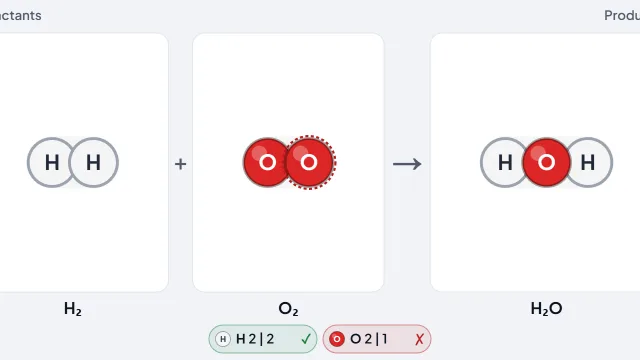
Conservation of mass and balanced equations
Topic guide4.3.1.1No atoms are made or lost, so total mass is unchanged and equations must balance.
Relative formula mass
Topic guide coming soon4.3.1.2Add up the Ar values of every atom in the formula; the reacting masses balance.
Apparent mass changes when a gas is involved
Topic guide coming soon4.3.1.3In an open container mass seems to rise when a gas is taken in and fall when a gas escapes.
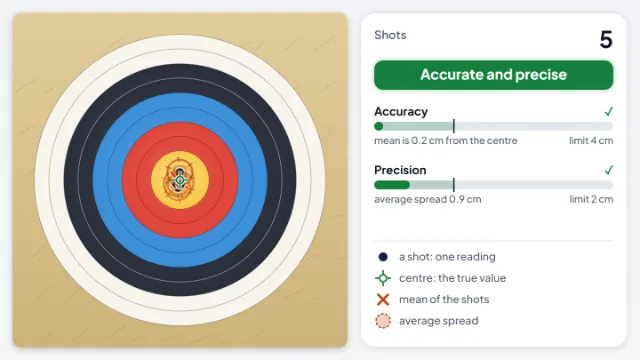
Uncertainty in chemical measurements
Topic guide coming soon4.3.1.4Estimate uncertainty from the range of repeat results about the mean.
Moles and the Avogadro constant
Topic guide coming soon4.3.2.1Higher tierOne mole has 6.02 × 10²³ particles; its mass in grams equals Mr; convert between mass and moles.
Reacting masses, balancing with moles and limiting reactants
Topic guide coming soon4.3.2.24.3.2.34.3.2.4Higher tierUse mole ratios from equations to find masses, build equations from masses, and find which reactant runs out.
Concentration of solutions in g/dm3
Topic guide coming soon4.3.2.5Mass of solute per volume of solution; find the mass in a given volume.
Percentage yield
Topic guide coming soon4.3.3.1Separate chemistry onlyActual against theoretical yield, why yields fall short, and calculating the theoretical mass (HT).
Atom economy
Topic guide coming soon4.3.3.2Separate chemistry onlyShare of reactant mass that ends up in the wanted product, and why high atom economy matters.
Concentration in mol/dm3
Topic guide coming soon4.3.4Higher tierSeparate chemistry onlyMoles or mass of solute from concentration and volume, and finding an unknown concentration from reacting volumes.
Volumes of gases
Topic guide coming soon4.3.5Higher tierSeparate chemistry onlyEqual moles of gases take equal volumes; one mole is 24 dm3 at room conditions; gas volumes from equations.
Next step
Start with Conservation of mass and balanced equations
The first topic guide in this chapter, with its simulation, worked examples and exam-style questions.