Chemistry topic
Bonding, structure and properties
Why does salt melt at hundreds of degrees while water boils at 100 °C? Turn molecules and giant lattices around in 3D, count shared pairs and ions, and link each structure to its melting point and whether it conducts electricity.
In short
What is the difference between ionic, covalent and metallic bonding?
Ionic bonding is the attraction between oppositely charged ions, formed when a metal transfers electrons to a non-metal, as in sodium chloride. Covalent bonding is a shared pair of electrons between two non-metal atoms, as in water. Metallic bonding is the attraction between positive metal ions and a sea of delocalised electrons, which is why metals conduct electricity.
Simulations
 3D
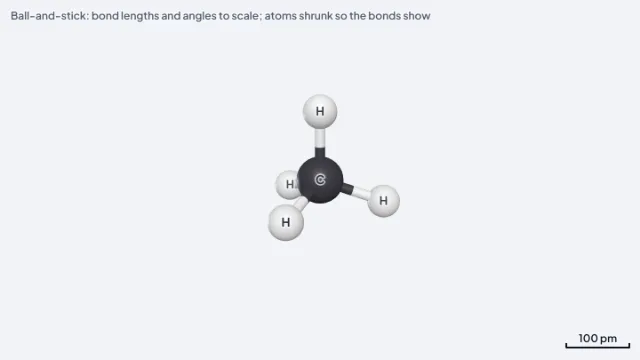
Covalent molecules in 3D (ball-and-stick, space-filling and shared pairs)
Turn 11 covalent molecules in 3D: ball-and-stick, space-filling and shared-pair views, dot-and-cross diagrams, lone pairs and bond angles.Predict: A nitrogen molecule, N₂, is two nitrogen atoms joined by covalent bonding. Each nitrogen atom starts with 5 electrons in its outer shell. How many pairs of electrons do the two atoms share?Try it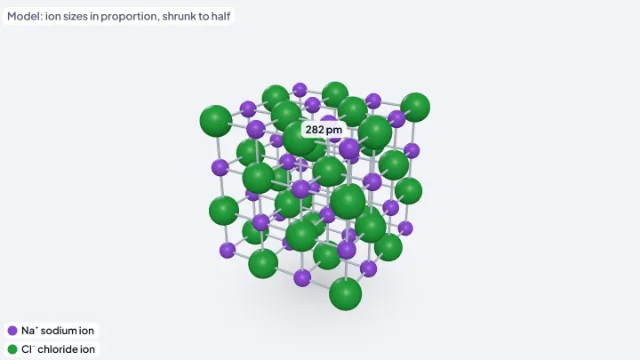 3D
Giant structures in 3D (sodium chloride, diamond, graphite and metals)
Turn sodium chloride, diamond, graphite, magnesium and silicon dioxide in 3D. Count neighbours, melt the salt, slide the layers and see what conducts.Predict: In solid sodium chloride, how many chloride ions are the nearest neighbours of each sodium ion?Try it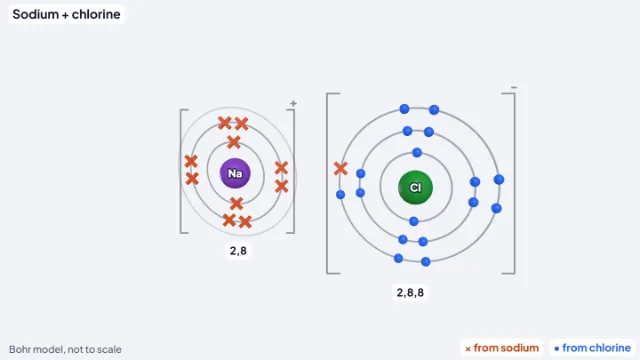 3D
Ionic bonding in 3D (electron transfer and the ions formed)
Watch metal atoms hand electrons to non-metal atoms in 3D, see the ions form with their charges, then draw the dot-and-cross diagram and the formula.Predict: Magnesium (2,8,2) reacts with oxygen (2,6) to make magnesium oxide. What charge does the magnesium ion carry?Try it
Articles
12 min read
Diamond vs Graphite: Structure, Bonding and Properties (Plus Graphene and Fullerenes)
Diamond and graphite are both pure carbon. Learn how 4 bonds per atom make diamond hard and non-conducting, how 3 bonds and delocalised electrons make graphite soft and conducting, how to write full-mark explanations, and where graphene and fullerenes fit in.
Read article
10 min read
Covalent Bonding and Dot-and-Cross Diagrams: Water, Ammonia, Methane, CO₂, O₂ and N₂ Step by Step
A step-by-step method for drawing dot-and-cross diagrams of covalent molecules, with a table of shared pairs and lone pairs for eleven molecules, worked examples for water, carbon dioxide and nitrogen, double and triple bonds, and the checks that catch most mistakes.
Read article
11 min read
How Atoms Form Ions: Charges From the Group, Ion Electron Configurations and Formulae
Learn why metal atoms lose electrons and non-metal atoms gain them, how to predict an ion's charge from the periodic table, how to write the electron configuration of an ion, why carbon and the noble gases form no simple ions, and how to write ionic formulae, with worked examples.
Read article
9 min read
Ionic, Covalent and Metallic Bonding Compared: Structures, Melting Points and Conductivity
Compare the three types of bonding and the four structures they make (giant ionic, simple molecular, giant covalent and metallic), with a comparison table, real melting points, a worked example that identifies an unknown solid, and the mistakes that cost marks.
Read article
6 min read
The Learning Styles Myth, and What Really Helps: Dual Coding for Science
Why matching lessons to a 'visual', 'auditory' or 'kinaesthetic' style is not backed by evidence, what a fair test of the idea looks like, and what does help everyone: words and pictures together, and simulations used actively by predicting first, then testing.
Read article
Next step
Keep exploring
Every chemistry simulation, the 3D models and the chemistry courses.