Chemistry topic
Rates of reaction
Particles only react when they collide hard enough. Watch them move in 3D, then raise the temperature, add more particles, break up a solid or add a catalyst and see how the rate of successful collisions changes.
In short
What does collision theory say about the rate of a reaction?
Particles react only when they collide with at least the activation energy. Anything that makes these successful collisions more frequent raises the rate: a higher temperature (faster particles with more energy), a higher concentration or gas pressure, a larger surface area, or a catalyst, which gives the reaction a route with a lower activation energy.
Simulations
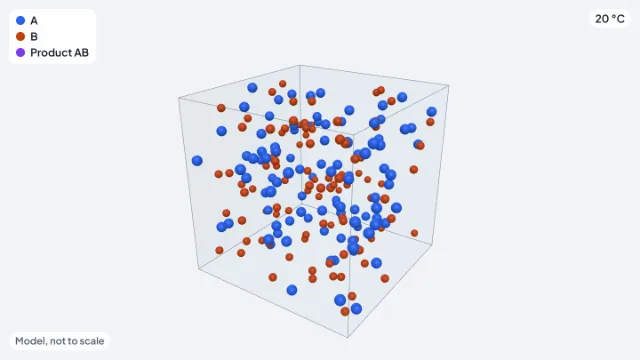 3D
Collision theory in 3D (temperature, concentration, surface area and catalysts)
Watch particles collide in a 3D vessel. Change temperature, concentration, surface area and a catalyst, and see why only some collisions react.Predict: A vessel holds 100 particles of A and 60 of B at 20 °C. Play runs it for 4 seconds, then runs the same mixture again with the B doubled to 120 particles in the same volume. In the second run, how many A–B collisions happen each second?Try it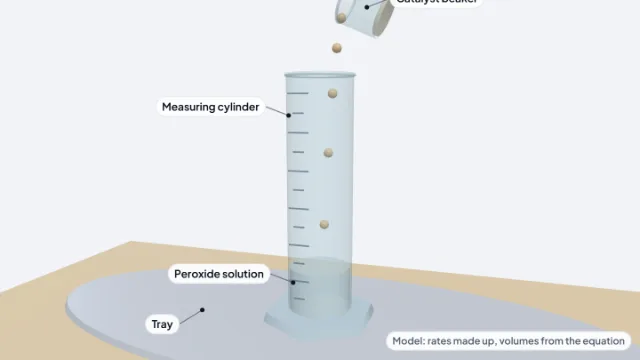 3DWow science
Elephant toothpaste in 3D (a catalyst decomposing hydrogen peroxide into a foam tower)
Why does elephant toothpaste foam so fast? Add a catalyst to hydrogen peroxide in 3D, zoom in on the molecules and graph the oxygen made over time.Predict: Potassium iodide is added as the catalyst and the hydrogen peroxide breaks down into water and oxygen. When the foam has stopped, how much of the catalyst is left?Try it
Articles
Next step
Keep exploring
Every chemistry simulation, the 3D models and the chemistry courses.