Chemistry topic
Chemical changes
Chemical changes make new substances. Pass a current through molten and dissolved compounds to see which products form at each electrode, and link what happens to the ions and electrons involved.
In short
What happens during electrolysis?
An electric current passes through a molten or dissolved ionic compound. Positive ions move to the negative electrode (cathode) and gain electrons, and negative ions move to the positive electrode (anode) and lose electrons, so new substances form at each electrode, such as a metal or hydrogen at the cathode and a non-metal such as chlorine or oxygen at the anode.
Simulations
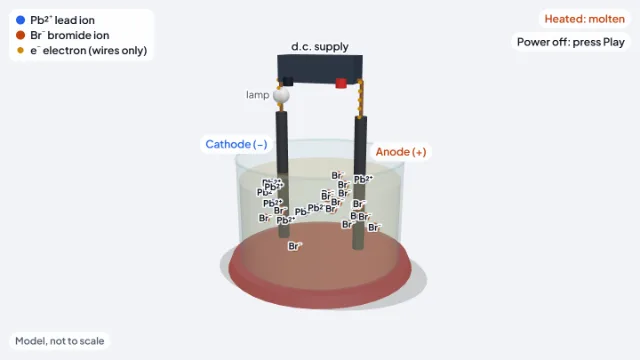 3D
Electrolysis in 3D (molten and aqueous compounds, products at each electrode)
Switch on a 3D electrolysis cell and watch ions drift to the electrodes. Compare molten and aqueous compounds and predict the product at each electrode.Predict: Concentrated sodium chloride solution is electrolysed with graphite electrodes. What forms at the cathode (the negative electrode)?Try it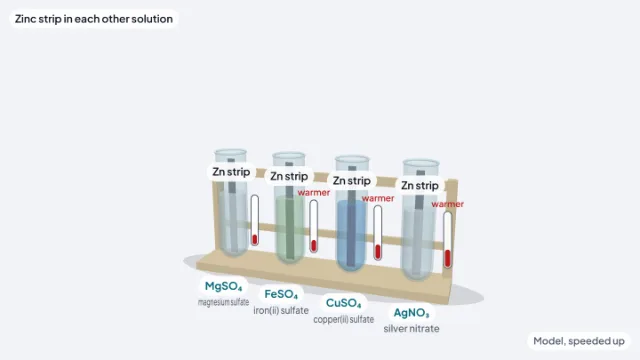 3D
Reactivity series and displacement in 3D (metals in salt solutions)
Lower metal strips into salt solutions in 3D, watch coatings form and colours change, then fill a results grid and deduce the reactivity series.Predict: A clean strip of copper is lowered into zinc sulfate solution. What happens?Try it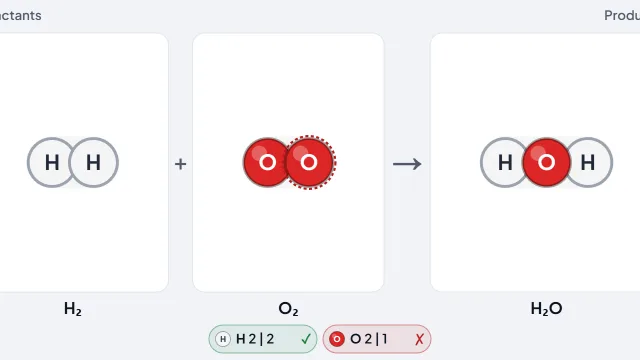
Balancing chemical equations (atom counts and state symbols)
Balance chemical equations with − and + buttons while a live atom counter shows every atom conserved. Add state symbols and check the masses.Predict: Methane burns in oxygen: CH₄ + O₂ → CO₂ + H₂O. When the equation is balanced with the smallest whole numbers, what number goes in front of O₂?Try it
Virtual practicals
Do the practicals from your course in the browser: follow the method and record what you measure or observe.
Articles
7 min read
The Science of Revising: Which Study Methods Actually Work for Physics and Chemistry
What a major review of learning research found about ten popular study methods, why rereading and highlighting feel useful but are not, and how to turn self-testing and spaced revision into a weekly plan for GCSE, IGCSE and Punjab board physics and chemistry.
Read article
7 min read
The Memory Palace (Method of Loci) for Science Revision: How to Use It
How the memory palace works, where the legend of Simonides comes from, and what brain scans of memory champions showed. Then three worked palaces for science lists: the electromagnetic spectrum, the reactivity series and the first 20 elements, with the method's honest limits.
Read article
Next step
Keep exploring
Every chemistry simulation, the 3D models and the chemistry courses.