Skip to content

Punjab Board Class 10 Physics · Chapter 20: Atomic and nuclear physics

Atomic structure and Rutherford's experiment

Section 20.1

Rutherford fired alpha particles at thin gold foil. Most went straight through, a few were turned sharply and a very few bounced back. So an atom is nearly all empty, with a tiny, dense, positive nucleus holding nearly all its mass, and electrons spread round it as a fuzzy cloud.

Loading simulation…

Symbols match your course. Open the full atomic models and rutherford scattering simulation for more presets and teacher tools.

From solid balls to a nuclear atom

The idea that everything is built from tiny particles called atoms goes back to John Dalton, who pictured each atom as a solid, unbreakable ball. In 1897 J. J. Thomson showed that atoms hold light, negatively charged electrons. Since a whole atom is neutral, he suggested the electrons sit inside a spread-out ball of positive matter, rather like raisins in a pudding. Nobody could yet say where the mass and the positive charge of an atom really were.

Rutherford's gold foil experiment

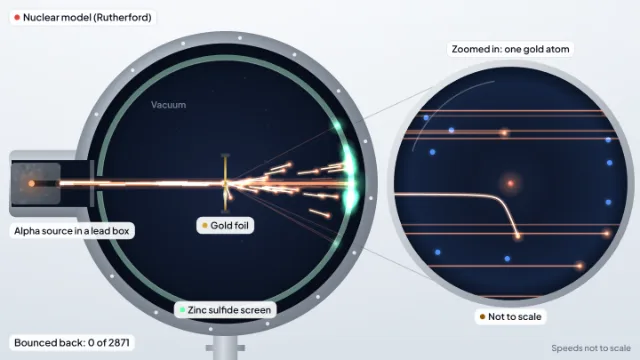
In Ernest Rutherford’s laboratory, Hans Geiger and Ernest Marsden used alpha particles to probe the inside of atoms. Rutherford explained their results in 1911, the date your book gives (the first measurements were made a couple of years earlier). Alpha particles are fast, positively charged and, compared with electrons, heavy: each has about the mass of a helium atom.

The set-up had four main parts:

  1. a radioactive source (radium) inside a thick lead block, with a narrow hole so that a thin beam of alpha particles came out;
  2. a sheet of gold foil, far thinner than paper, in the path of the beam;
  3. a circular screen coated with zinc sulfide around the foil, on which every arriving alpha particle shows up as a brief spark of light;
  4. a microscope that could be moved round the screen, so the flashes could be counted at every angle.

The apparatus was kept in a vacuum, so that air did not stop the alpha particles before they reached the foil (a detail beyond the book).

What they saw

  • Nearly all of them carried on through the gold, undeflected or turned by only a degree or two.
  • Some were turned aside through larger angles.
  • A very small number, roughly one in several thousand, bounced back from the foil, through angles bigger than 90°.

If Thomson's picture were right, the positive charge would be thinly spread and could never push a heavy, fast alpha particle backwards. Rutherford later compared it to firing a heavy shell at tissue paper and seeing it come back (a famous remark, not in the book).

What the results tell us

ObservationConclusion about the atom
Most alpha particles pass straight throughAtoms are largely empty
A few are turned through large anglesAll the positive charge sits in one tiny region, which repels the positive alpha particles
Very few bounce straight backThat tiny region, the nucleus, is very dense and holds almost all the atom's mass

So Rutherford's nuclear model says:

  1. at the centre of every atom is a small, dense, positively charged nucleus;
  2. the nucleus contains most of the mass of the atom;
  3. the electrons are found far out from the nucleus, and the rest of the atom is empty space.

The nucleus is about 10 000 times smaller across than the atom itself.

Electrons as a fuzzy cloud

Rutherford imagined electrons going round the nucleus like planets round the Sun. Later work showed this picture is wrong. Electrons behave as quantum objects: their position and motion at any instant cannot be predicted, only the probability of finding them in a region. If you could look at an atom you would see a blurred electron cloud around a tiny nucleus, densest in the places an electron is most probably found and fading away elsewhere.

Beyond the book: the "shells" that electrons are said to occupy are really energy levels, and an electron in an outer shell has more energy than one in an inner shell.

Worked numerical 1: a model atom

An atom is about 1×10⁻¹⁰ m1 \times 10^{-10}\ \text{m} across and its nucleus about 1×10⁻¹⁴ m1 \times 10^{-14}\ \text{m}. A student builds a model with a 1 cm marble as the nucleus. How wide must the model atom be?

ratio=width of atomwidth of nucleus=10−10 m10−14 m=104\text{ratio} = \frac{\text{width of atom}}{\text{width of nucleus}} = \frac{10^{-10}\ \text{m}}{10^{-14}\ \text{m}} = 10^{4}

The atom must be 10 000 times wider than the marble: 10 000×1 cm=100 m10\,000 \times 1\ \text{cm} = 100\ \text{m}, about the length of a football ground.

Worked numerical 2: counting the rare ones

In a run, 40 000 alpha particles hit the foil, and on average 1 in every 8000 bounces back. How many bounce back?

40 0008000=5\frac{40\,000}{8000} = 5

Only about 5 out of 40 000 return. The rest pass through or are only nudged, which is why the experiment needed patient counting over many hours. The numbers in this example are made up to show the method, not the original results.

Rutherford scattering in the simulation

  1. Choose Plum pudding under Atom model, then press Fire. Look at the Largest angle card: Thomson's atom only turns the alpha particles by a degree or so.
  2. Switch to Nuclear and fire again. Watch the Bounced back card. A small number now return through more than 90°.
  3. Compare the Through, under 10° and Deflected 10° to 90° cards to see how rare large angles are. Set Chart scale to ×10 steps so the few large-angle counts show on the histogram.
  4. Lower the Alpha particle energy. Slower alpha particles are turned more easily, so more of them are deflected (this energy setting goes beyond the book).
Common mistakes

  • Saying most alpha particles bounced back. Almost all passed straight through; only a very small number came back.
  • Giving the observations without the conclusions. Each result has to be linked to what it shows about the atom.
  • Writing that the nucleus is negatively charged. It repels the positive alpha particles, so it must be positive.
  • Picturing electrons moving round fixed circular paths like planets. Their positions can only be described by probability, as a cloud.
  • Thinking the nucleus is a large part of the atom. It is about ten thousand times smaller across than the whole atom.

Exam practice

Exam-style questions

Original questions written in the style of Punjab board exams. Try each one before you reveal the answer.

  1. 1.Rutherford's team directed a narrow stream of alpha particles onto gold foil far thinner than paper, and the particles were detected on a zinc sulfide screen around the foil.

    1. (a)Describe what happened to the alpha particles.

      3 marks
      Show the answer

      Answer: Nearly all went straight through or were deflected by a tiny angle; some were deflected through large angles; a very small number bounced back through more than 90°.

      Marking points

      • Most passed straight through
      • Some deflected through large angles
      • Very few bounced back
    2. (b)Explain what each observation shows about the structure of the atom.

      3 marks
      Show the answer

      Answer: Passing straight through shows that most of each atom is empty. Large deflections show a small concentrated positive charge repelling the alpha particles. Bouncing back shows this nucleus is very dense and contains most of the mass.

      Marking points

      • Mostly empty space
      • Small, positively charged centre (nucleus)
      • Nucleus holds most of the mass / is dense
    3. (c)State the purpose of the zinc sulfide screen.

      1 mark
      Show the answer

      Answer: It gives a small flash of light where each alpha particle hits it, so the particles can be counted at different angles.

      Marking points

      • Flashes where alpha particles strike, so they can be detected or counted
  2. 2.A gold atom is about 3 × 10⁻¹⁰ m across. The diameter of its nucleus is roughly one ten-thousandth of that.

    1. (a)Estimate the diameter of the gold nucleus.

      2 marks
      Show the answer

      Answer: 3 × 10⁻¹⁰ m ÷ 10 000 = 3 × 10⁻¹⁴ m.

      Marking points

      • Divides by 10 000 (10⁴)
      • 3 × 10⁻¹⁴ m
    2. (b)Use this to explain why so few alpha particles came close enough to the nucleus to be turned back.

      2 marks
      Show the answer

      Answer: The nucleus is a tiny target compared with the whole atom, so nearly every alpha particle passes far from any nucleus and goes through almost undeflected.

      Marking points

      • The nucleus is a very small target
      • Most alpha particles miss it by a large distance
  3. 3.Modern physics describes the electrons in an atom differently from Rutherford's planetary picture.

    1. (a)Describe the modern picture of electrons in an atom.

      2 marks
      Show the answer

      Answer: Electrons do not follow fixed orbits. Their exact position cannot be predicted, so they form a fuzzy cloud showing where they are likely to be found, denser where the chance is higher.

      Marking points

      • No fixed, predictable orbits
      • Electron cloud describing probability of position
    2. (b)Why is the electron cloud drawn thicker in some places than in others?

      2 marks
      Show the answer

      Answer: The cloud is a map of chance. It is thick in the regions where an electron is often found and faint where it is seldom found.

      Marking points

      • Thick where finding an electron is likely
      • Faint where it is unlikely

Quiz

Quick check

6 questions

  1. 1.Most alpha particles in Rutherford's experiment passed straight through the gold foil. This shows that:
  2. 2.A few alpha particles came back off the gold. What does this tell us?
  3. 3.Roughly how many times wider is an atom than its nucleus?
  4. 4.The alpha particles in Rutherford's experiment were detected by:
  5. 5.In the modern picture of the atom, an electron is best described as:
  6. 6.From his results, Rutherford concluded that the nucleus holds:

Related articles

Next step

Now see it move

Open the full atomic models and rutherford scattering simulation for every preset, graphs and the teacher tools, then test yourself.

Atomic models and Rutherford scattering simulation: a virtual Geiger–Marsden experiment