The same rays that harm can heal
Every day, cancer hospitals deliberately aim beams of high-energy radiation, such as gamma rays, at patients' tumours. Yet the same kind of radiation, taken in carelessly, can cause cancer. Section 20.9 explains this double nature: why nuclear radiation damages living cells, and how that power, and other properties of radioactive isotopes, are put to good use.
Why nuclear radiation is harmful
All three nuclear radiations, alpha, beta and gamma, are ionising. As they pass through matter they knock electrons out of atoms, leaving charged ions behind and breaking the chemical bonds that hold molecules together. In a living cell the most important molecule hit is DNA, the set of instructions the cell follows.
How much harm is done depends on:
- the dose: how much radiation energy the body absorbs;
- the exposure time: a short burst or years of steady exposure;
- the type of radiation: alpha ionises most strongly, gamma least.
Effects on the body
- Killing cells. A high dose damages DNA so badly that cells die. This is harmful when healthy tissue is hit, but it is exactly what radiotherapy uses to destroy cancer cells.
- Mutations. Damaged DNA may be repaired wrongly, changing the cell's genetic code. If this happens in reproductive cells, the change can be passed to children as an inherited disorder.
- Cancer. Long exposure to even low doses raises the chance that a mutated body cell starts dividing out of control.
- Radiation sickness. A very large dose in a short time causes nausea, vomiting, hair loss and organ damage, and can be fatal.
Natural and human-made sources of the radiation we all receive, and the rules for keeping exposure low, are on the page about where background radiation comes from.
Choosing the right isotope for a job
Two properties decide which isotope suits a use:
- the type of radiation. Alpha cannot get through paper or skin, beta is blocked by aluminium a few millimetres thick, and gamma passes through the body and through thick packaging;
- the half-life. Isotopes put into the body should have short half-lives (hours or days), so the activity dies away quickly once the job is done. Isotopes in equipment that must work for years, such as alarms, gauges and sterilisers, need long half-lives, so the source does not have to be replaced often.
Uses of nuclear radiation
Medicine
- Radiotherapy. Narrow beams of gamma rays from a cobalt-60 source are aimed at a tumour from several directions. The beams cross at the tumour, giving it a large dose while each patch of healthy tissue on the way gets far less.
- Thyroid treatment and scans. The thyroid gland in the neck collects iodine. A patient swallows a little iodine-131 (half-life 8 days). Its radiation can destroy an overactive or cancerous thyroid, or show how well the gland is working, and the short half-life keeps the long-term dose small.
Food preservation
Packed food is passed through gamma rays from cobalt-60 or caesium-137. The radiation kills bacteria and moulds, so the food keeps for longer without its quality being spoiled. The food itself does not become radioactive: it is only exposed to the rays and never touches the radioactive material.
Sterilising medical equipment
Syringes, surgical gloves and bandages are sealed in their packets first and then exposed to gamma rays from cobalt-60 (half-life 5.27 years). The rays pass through the wrapping and kill bacteria and viruses without heating or melting the plastic, and the contents stay germ-free until the packet is opened.
Smoke detectors
A household smoke alarm holds a tiny source of americium-241, which gives out alpha particles.
- The alpha particles ionise the air in a narrow gap between two metal plates, and the ions carry a tiny current across it.
- When smoke drifts in, its particles absorb alpha particles and pick up the ions, so fewer charges cross the gap.
- The current falls, and the electronics sound the alarm.
Alpha is ideal here: it ionises air strongly but cannot escape through the plastic case. Americium-241 has a half-life of 432 years, so the source outlasts the alarm.
Worked numerical 1: an alarm that keeps going
What fraction of the americium-241 in a smoke alarm is still there after 10 years?
About 98% is left, so the alarm's current hardly changes during its working life.
Worked numerical 2: iodine after treatment
A patient is treated with iodine-131. What fraction of it is still radioactive after 40 days?
In practice the body also gets rid of some iodine naturally, so the real amount left is even less.
Worked numerical 3: when to change the steriliser source
A cobalt-60 source is replaced once its activity has fallen to one-quarter of its value when new. One-quarter is 2 half-lives:
How the three radiations differ in charge and penetrating power is set out in the notes on alpha, beta and gamma radiation (section 20.4), and how fast each isotope fades is the subject of section 20.8, half-life and carbon dating.
Radiation uses in the simulation
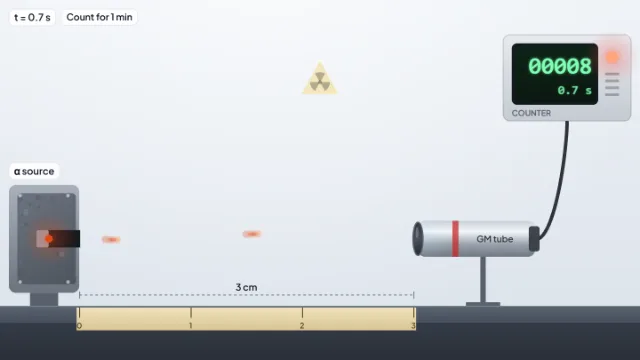
- In the Penetration: what absorbs each radiation experiment, choose the Alpha source and add a Paper absorber: the count falls almost to background. That is why alpha is safe inside a smoke alarm's case.
- Switch to Gamma and try Aluminium and then Lead. Gamma still gets through aluminium, which is why it can sterilise sealed packets and reach a tumour deep inside the body.
- Choose the Beta source with Aluminium to see the kind of absorption a thickness gauge relies on.