Our local star
Every planet in the solar system is held on its path by one object: the Sun. Its gravitational pull keeps the eight planets, the Earth among them, moving round it, and its light and heat drive almost everything that happens on the Earth's surface, from winds and rain to the growth of crops.
Among the stars in the sky the Sun is quite ordinary. Astronomers class it as a medium-sized star: many stars are far bigger and brighter, and very many more are smaller and dimmer. It only looks special because it is so close to us. Even so, it is enormous by our standards, about 1.39 million km across, wide enough to line up roughly 109 Earths from edge to edge.
What the Sun is made of
The Sun is a huge ball of hot gas, made almost entirely of the two lightest elements:
- about three quarters of its mass is hydrogen;
- about one quarter is helium;
- only a couple of per cent is everything else, such as oxygen, carbon and iron.
Your book gives the figures as 74 % hydrogen and 24 % helium. Other sources round them slightly differently, but every source agrees that hydrogen and helium make up nearly all of it.
Where the energy comes from
The Sun is not on fire. Burning needs oxygen and would use up a ball of fuel this size in a few thousand years. Instead, deep in the core, where the temperature is around 15 million °C, hydrogen nuclei are squeezed together so hard that they join to make helium. This joining of light nuclei is nuclear fusion. A tiny amount of mass disappears in each reaction and reappears as a large amount of energy. The energy works its way out to the surface, which is at about 5500 °C, and then streams away into space in every direction.
The radiation the Sun gives out
The Sun sends out electromagnetic waves, which need no medium and cross empty space at about 3 × 10⁸ m s⁻¹. Almost all of its output lies in three regions of the electromagnetic spectrum:
- infrared, which we feel as warmth on our skin;
- visible light, which lets us see;
- ultraviolet, which causes sunburn and helps the skin make vitamin D.
Roughly half of the energy in sunlight is infrared, about two fifths is visible light and less than a tenth is ultraviolet. These rays warm the land, sea and air, set up weather patterns, power photosynthesis and so support life.
Comparing the planets
To compare planets, astronomers use a few measured quantities.
- Orbital distance: the average distance between a planet and the Sun. A planet close in receives far more solar energy on each square metre than one far out.
- Orbital period: the time for one complete trip round the Sun, the planet's "year". A planet's year grows longer as its orbit gets wider.
- Density: mass divided by volume. It tells us what a planet is made of. The four inner planets are rocky with metal cores and have high densities; the giant planets are mostly hydrogen and helium (with ices in Uranus and Neptune) and have low densities.
- Surface temperature: set mainly by the distance from the Sun, but also by the atmosphere. A thick blanket of carbon dioxide traps heat; a thin atmosphere lets it escape.
- Gravitational field strength at the surface: the force on each kilogram, in N kg⁻¹. It is almost the same everywhere on a planet's surface, and it gets weaker the further you go from the planet.
| Planet | Average distance from Sun (million km) | Orbital period | Density (kg m⁻³) | Mean surface temperature (°C) | g at surface (N kg⁻¹) |
|---|---|---|---|---|---|
| Mercury | 57.9 | 88 days | 5430 | 167 | 3.7 |
| Venus | 108 | 225 days | 5240 | 464 | 8.9 |
| Earth | 150 | 365 days | 5510 | 15 | 9.8 |
| Mars | 228 | 1.88 years | 3930 | −65 | 3.7 |
| Jupiter | 778 | 11.9 years | 1330 | −110 | 23.1 |
| Saturn | 1430 | 29.4 years | 690 | −140 | 9.0 |
| Uranus | 2870 | 84.0 years | 1270 | −195 | 8.7 |
| Neptune | 4510 | 165 years | 1640 | −200 | 11.0 |
Values are rounded from NASA's planetary fact sheets. The giant planets have no solid surface, so their "surface" temperature and field strength are given at the height in the atmosphere where the pressure equals the Earth's sea-level pressure.
Reading the data: patterns and exceptions
- Distance and period: the period rises steadily down the table. Mars, about 1.5 times as far out as the Earth, takes nearly twice as long to go round.
- Density: Mercury, Venus, Earth and Mars are all above 3900 kg m⁻³; the giants are all below 1700 kg m⁻³. Saturn's density is less than that of water (1000 kg m⁻³).
- Temperature: it generally falls with distance, but Venus is hotter than Mercury even though it is almost twice as far from the Sun. Its very thick carbon dioxide atmosphere traps heat. Mars is cold because it is further away and its air is thin.
- Field strength: a bigger mass gives a bigger g, so Jupiter's is the strongest. Size matters too, though: Saturn is about 95 times the Earth's mass, yet its g is a little below ours because it is so wide.
Worked numerical 1: weight on Mars
Using the table, find the weight of a 900 kg rover on Mars and on the Earth.
Its mass is 900 kg on both planets. Only its weight changes: on Mars it is about 0.38 of its Earth value.
Worked numerical 2: light from the Sun
How long does sunlight take to reach the Earth, 1.50 × 10¹¹ m away? Light travels at 3 × 10⁸ m s⁻¹.
The same sum for Neptune, about 4.51 × 10¹² m away, gives roughly 15 000 s, a little over 4 hours.
Worked numerical 3: a year on Jupiter
Jupiter takes 4333 Earth days to orbit the Sun. Express this in Earth years.
Planetary data in the simulation
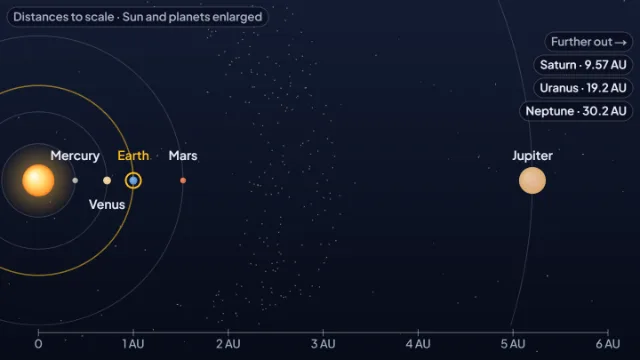
The simulation above draws the Sun and planets with real distances and sizes.
- In the Distances view, choose each Planet in turn and read the Distance from Sun and One orbit takes cards. Check that the period grows as you move outwards.
- Switch to the Sizes view to compare the planets' diameters with the Sun's, all on one scale.
- Pick the guided set-ups Light to Earth and Light to Neptune, then press Send light and compare the times with worked numerical 2.