A planet running a slight fever
Global warming means the Earth's surface, averaged over the whole globe, getting steadily hotter over many decades. A rise of one degree sounds tiny, but averaged over the whole planet and every season it means far more energy stored in the air, the land and especially the oceans. That extra energy shows up as more violent weather.
Why the Earth is warming
Sunlight, mostly visible light and short-wavelength infrared, passes through the atmosphere and warms the ground and the sea. The warm surface then gives out its own radiation, which is long-wavelength infrared. Some gases in the air, called greenhouse gases, absorb part of this outgoing infrared and send some of it back down, so the surface stays warmer than it would otherwise be. This natural greenhouse effect makes the Earth habitable. The problem is that people have been adding more of these gases, which traps more heat.
The main human causes are:
- burning fossil fuels (coal, oil and natural gas) in power stations, factories and vehicles, which releases carbon dioxide;
- cutting down forests, which removes trees that would take carbon dioxide out of the air;
- farming and some industrial methods, which release methane (from rice paddies, cattle and landfill) and nitrous oxide (from fertilisers).
Carbon dioxide makes the largest contribution. Its concentration has risen from about 280 parts per million before the industrial age to about 420 parts per million today, and the planet's surface is now on average more than 1 °C warmer than in the late 1800s.
How warming feeds extreme weather
Hurricanes and cyclones. Warm sea water is the fuel of these storms (see the cyclones page). Warmer oceans supply more evaporated water and so more energy, giving stronger winds and heavier rain. Melting land ice and the expansion of sea water as it warms raise the sea level, so storm surges reach further inland and coastal flooding becomes more frequent.
Heat waves. With more heat trapped, spells of extreme heat become hotter, longer and more frequent. Cities suffer most: concrete, brick and tarmac absorb heat by day and release it at night, so built-up areas stay several degrees warmer than the countryside around them.
Heavy rainfall and flooding. Warmer air can hold more water vapour, about 7 % more for every degree Celsius. When it rains, more water falls at once, overwhelming rivers and drains. Pakistan's catastrophic 2022 monsoon floods were studied by climate scientists, who concluded that warming had probably made the extreme rainfall heavier.
Wildfires. High temperatures and long dry spells dry out soil, grass and forest. Dry vegetation catches fire easily, and fire seasons in many regions now start earlier and last longer.
Droughts. Higher temperatures increase evaporation from soil, rivers and reservoirs. Where rainfall is already low or becomes less reliable, droughts grow longer and more severe, harming crops, livestock and drinking-water supplies.
Winter storms. In places where it is still cold enough to snow, the extra moisture in warmer air can fall as heavier snowfall during winter storms.
Geothermal activity: heat from inside the Earth
Separately from global warming, the Earth carries a huge store of heat in its interior. Part of it is left over from when the planet formed, and part is released continually by the radioactive decay of elements such as uranium, thorium and potassium in the rocks. The deeper you go, the hotter the rock: on average the temperature rises by roughly 25 °C for every kilometre of depth.
This internal heat drives geothermal activity:
- volcanoes, where molten rock (magma) reaches the surface;
- hot springs, where groundwater heated deep underground flows back up;
- geysers, where heated water and steam burst out in jets from time to time;
- slow convection currents in the hot mantle rock, which help to move the tectonic plates and cause earthquakes where plates meet.
Where hot rocks lie close to the surface, the heat can be put to work. Water is pumped down, comes back as steam and turns a turbine and generator. Geothermal energy counts as renewable, because the Earth's internal heat will last for billions of years. It is reliable day and night, but only practical in suitable places such as Iceland or New Zealand.
Worked numerical 1: how much more carbon dioxide?
The carbon dioxide level has risen from about 280 to about 420 parts per million. Find the percentage increase.
So the air now holds about one and a half times as much carbon dioxide as before industry began.
Worked numerical 2: temperature in a deep well
The ground surface is at 20 °C and the rock gets hotter by 25 °C for each kilometre of depth. Estimate the temperature at the bottom of a well 3 km deep.
Water pumped down to this depth comes back almost boiling. In volcanic areas the rocks are much hotter at shallower depths, which is where geothermal power stations are built.
Global warming and geothermal energy in the simulation
The simulation above compares the energy resources used to generate electricity.
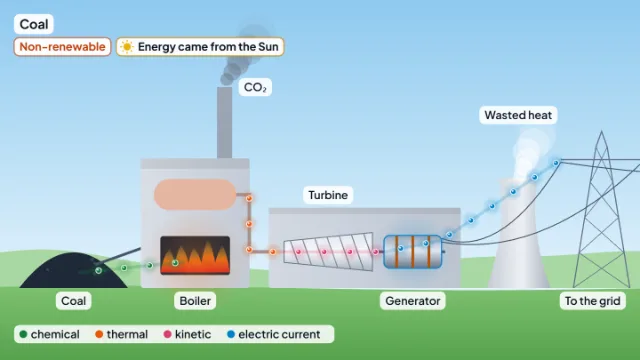
- In the How it works view, set Energy resource to Geothermal and press Play to follow the energy from hot rocks to the generator. Note that it is labelled Renewable and Not from the Sun.
- Use Back and Next to reach Coal, Oil and Natural gas, and read the CO₂ while running row in the Advantages and disadvantages card for each. Compare it with Geothermal: burning fossil fuels is the main source of the extra greenhouse gas.
- Switch to the Energy mix view, build a mix and run the day. Compare the CO₂, whole life card for a fossil-heavy mix and a mostly renewable one.