Radiation exposure
Radiation exposure means receiving energy from radiation, whether from a natural source such as the Sun or the rocks beneath us, or from an artificial source such as an X-ray machine or a nuclear power station. The radiation that matters most for health is ionising radiation (alpha, beta, gamma, X-rays and cosmic rays), which is energetic enough to strip electrons from atoms (to ionise them) and so damage living cells.
How much harm it does depends on the dose. A small dose, like the one everybody receives each year from nature, carries only a very small risk. A large dose, or a moderate dose received again and again, can kill cells or damage their DNA. That is why people who work with radiation follow strict safety rules, so that its benefits in medicine, industry and research can be used safely.
Background radiation
Switch on a Geiger–Müller (GM) tube in a laboratory with every radioactive source locked away, and it still clicks every few seconds. It is detecting background radiation: the low level of ionising radiation that is around us all the time, everywhere on the Earth, from both natural and human-made sources.
You cannot escape it, and you do not need to. Life has always existed alongside it. But it must be measured and subtracted whenever you take readings from a radioactive source in an experiment.
The main natural sources
(a) Radon gas in the air. Uranium in rocks and soil decays through a chain of steps, one of which produces radon, a radioactive gas. Radon is colourless, odourless and tasteless, so nobody notices it. It leaks from the ground and may collect indoors, especially in basements and in rooms with poor ventilation. Radon is an alpha emitter. Outside the body alpha particles are harmless, but when radon is breathed in, the alpha particles are released right next to the cells lining the lungs, where they are very damaging. High radon levels raise the risk of lung cancer, so homes in affected areas are tested and ventilated. Worldwide, radon is the largest single source of natural background radiation.
(b) Rocks and buildings. The ground contains small amounts of radioactive elements such as uranium, thorium and potassium-40. Granite has more than most rocks. Bricks, concrete and stone made from these rocks carry the radioactivity into our homes, so the walls around us give off a little gamma radiation.
(c) Food and drink. Plants take up radioactive isotopes from soil, water and air, and animals eat the plants. The two most important are potassium-40 and carbon-14. Every time we eat and drink, a little enters our bodies, so we are all slightly radioactive. The dose from this source is small but steady.
(d) Cosmic rays from space. The Sun and distant stars and galaxies send out streams of very fast particles, mostly protons. When these cosmic rays smash into molecules high in the atmosphere they produce showers of other particles and gamma rays. The atmosphere absorbs much of this radiation, so the higher you are, the less air there is to protect you and the bigger the cosmic-ray dose: people living in high mountains, and airline crews who fly often, receive more.
Human-made sources
A smaller share of background radiation comes from human activity:
- hospital procedures: X-ray images, CT scanning and radiotherapy (by far the largest artificial source);
- leftover fallout from nuclear weapons tests carried out in the past;
- small releases from nuclear power stations and from radioactive waste.
Harmful effects of too much radiation
- A large dose in a short time causes radiation sickness: nausea, vomiting, tiredness and damage to organs.
- Long-term exposure to lower doses raises the risk of cancer, for example in the lungs, thyroid and bones.
- Radiation can alter DNA, causing mutations that may be passed to future generations.
- Spilled or released radioactive substances can contaminate the air, water supplies, soil and crops.
- Internal exposure happens when radioactive dust is breathed in, or contaminated food or water is swallowed: the material stays inside the body and keeps irradiating it.
- Accidents, such as leaks, spills or explosions at nuclear plants, and careless disposal of waste can harm whole communities and ecosystems.
Keeping exposure low
People who handle radioactive materials reduce their dose by:
- limiting time: finishing each task quickly so the source is out only briefly;
- keeping distance: handling sources with long tongs, never with bare hands;
- using shielding: storing sources in lead-lined boxes and standing behind lead or concrete screens;
- wearing protective clothing and gloves so that no radioactive material reaches the skin;
- monitoring: wearing a badge (dosimeter) that records the total dose received.
Worked numerical 1: correcting a count rate
With no source present, a GM tube records 450 counts in 20 minutes. With a source in front of it, the count rate is 180 counts per minute. Find the background count rate, then the corrected count rate for the source alone.
Worked numerical 2: is it background only?
A student measures 96 counts per minute near a rock sample, where the background is 24 counts per minute. How much of the count rate comes from the rock?
The reading near the rock is four times the background, and the rock alone gives three times the background, so it is clearly radioactive. Had the reading been about 24 counts per minute, the rock would have shown no detectable activity.
Background radiation in the simulation
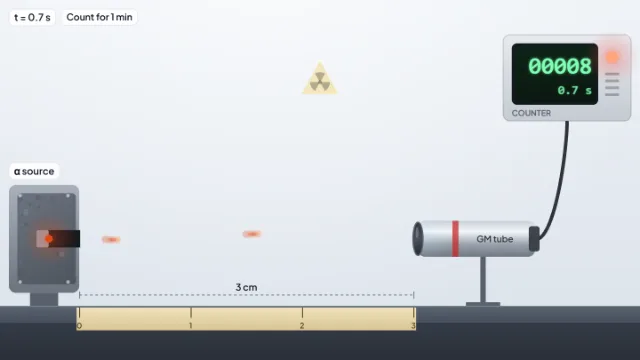
Above, a GM tube and counter sit on a bench beside alpha, beta and gamma sources.
- Set the Source to None and press Play. Only the background reaches the tube: read the Count rate at the end of the count.
- Change the Background count rate setting and repeat. Real labs read about 15 to 30 counts per minute, and the value changes from place to place.
- Choose a source, count for 1 min, and compare the Count rate with the Corrected count rate, which has the background taken away. The Results table keeps every reading.