Skip to content

Punjab Board Class 10 Physics · Chapter 20: Atomic and nuclear physics

Radioactive decay and decay equations

Section 20.5

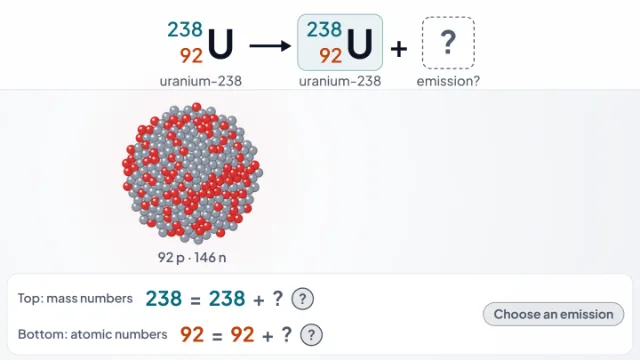
In radioactive decay an unstable parent nucleus gives out radiation and becomes a daughter. Alpha decay lowers A by 4 and Z by 2. Beta decay turns a neutron into a proton, so Z rises by 1 and A stays the same. Gamma emission changes neither number. Both rows of every equation must balance.

Loading simulation…

Symbols match your course. Open the full nuclear equations simulation for more presets and teacher tools.

A nucleus that changes

Radioactive decay is a change inside an unstable nucleus. The nucleus may have an unhealthy balance of neutrons and protons, or simply too much energy. By shooting out alpha or beta radiation, or releasing a burst of gamma energy, it moves towards a more stable arrangement.

The nucleus that decays is the parent. What is left behind is the daughter. In alpha and beta decay the daughter has a different charge number, so it is a different element; in gamma emission it stays the same nuclide, just with less energy.

The two balancing rules

Every decay equation is written in nuclide notation, ZAX{}^{A}_{Z}\text{X}, and must balance in two ways:

  1. Top numbers (mass numbers): both sides must add up to the same total, because nucleons are neither made nor lost.
  2. Bottom numbers (charge numbers): both sides must again give one total, because charge is conserved.

To use the rules you need the "nuclide symbols" of the radiations themselves:

RadiationSymbolTop (A)Bottom (Z)
alpha particle⁴₂He42
beta particle (electron)⁰₋₁β0−1
gamma rayγ00

Alpha decay

The nucleus throws out 2 protons and 2 neutrons together, so the mass number goes down by 4 and the charge number down by 2:

ZAX→Z−2A−4Y+24He+energy{}^{A}_{Z}\text{X} \rightarrow {}^{A-4}_{Z-2}\text{Y} + {}^{4}_{2}\text{He} + \text{energy}

Beta decay

Inside the nucleus a neutron turns into a proton, and a fast electron is shot out. The nucleus has one more proton and one fewer neutron, so the nucleon total is unchanged while the charge number goes up by 1:

ZAX→Z+1AY+−10β+energy{}^{A}_{Z}\text{X} \rightarrow {}^{A}_{Z+1}\text{Y} + {}^{0}_{-1}\beta + \text{energy}

The book also mentions positrons (positive electrons) as a form of beta radiation; only the electron kind, shown here, is needed for decay equations.

Gamma emission

An alpha or beta emission frequently leaves the new nucleus excited, marked with a star. It gets rid of the spare energy as a gamma ray. Neither number changes:

ZAX∗→ZAX+γ{}^{A}_{Z}\text{X}^{*} \rightarrow {}^{A}_{Z}\text{X} + \gamma

Worked numerical 1: alpha decay of polonium

Polonium-210, 84210Po{}^{210}_{84}\text{Po}, is an alpha emitter. What nucleus does it leave?

  • New mass number: 210−4=206210 - 4 = 206
  • New charge number: 84−2=8284 - 2 = 82, the charge number of lead (Pb)
84210Po⟶82206Pb+24He+energy{}^{210}_{84}\text{Po} \longrightarrow {}^{206}_{82}\text{Pb} + {}^{4}_{2}\text{He} + \text{energy}

Check: top 206+4=210206 + 4 = 210, bottom 82+2=8482 + 2 = 84. Both balance.

Worked numerical 2: beta decay of caesium

Caesium-137, 55137Cs{}^{137}_{55}\text{Cs}, decays by beta emission. Identify the daughter.

  • The mass number is unchanged at 137.
  • The charge number rises by one to 56: barium (Ba).
55137Cs⟶56137Ba+−10β+energy{}^{137}_{55}\text{Cs} \longrightarrow {}^{137}_{56}\text{Ba} + {}^{0}_{-1}\beta + \text{energy}

Check the bottom row: 56+(−1)=5556 + (-1) = 55.

Worked numerical 3: gamma from nickel

Cobalt-60 beta-decays to nickel-60, which is left excited and then emits a gamma ray:

2860Ni∗→2860Ni+γ{}^{60}_{28}\text{Ni}^{*} \rightarrow {}^{60}_{28}\text{Ni} + \gamma

Both numbers are the same on each side: the nucleus has lost energy, not particles.

Worked numerical 4: counting decays in a series

Thorium-232, 90232Th{}^{232}_{90}\text{Th}, decays through a chain of steps to stable lead-208, 82208Pb{}^{208}_{82}\text{Pb}. How many alpha and beta decays happen?

Only alpha decay changes the mass number, by 4 each time:

alpha decays=232−2084=6\text{alpha decays} = \frac{232 - 208}{4} = 6

Six alpha decays alone would lower ZZ by 12, from 90 to 78. Lead has Z=82Z = 82, so ZZ must climb back by 4, and each beta decay raises it by 1:

beta decays=82−78=4\text{beta decays} = 82 - 78 = 4

This kind of chain question goes beyond the book's examples but uses only its two rules.

Balancing equations in the simulation

  1. In Build mode, choose polonium-210 under Start with and pick α alpha under What the nucleus gives out.
  2. Use the steppers under Daughter nucleus to set the mass number and atomic number of what is left, then press Check. The stage shows whether the top and bottom rows balance.
  3. Try caesium-137 with β⁻ beta. Notice that only the bottom number of the daughter changes.
  4. Switch to Chain and press Next to follow uranium-238 down its decay series one real step at a time.
Common mistakes

  • Lowering Z by 4 and A by 2 in alpha decay. It is the other way round: the mass number drops 4, the charge number 2.
  • Making Z go down in beta decay. One neutron is converted to a proton, so Z goes up by 1.
  • Writing the beta particle as ⁰₁β. Its charge number is −1, and leaving out the minus sign unbalances the bottom row.
  • Changing A or Z for gamma emission. A gamma ray has no mass and no charge, so the nuclide stays the same.
  • Keeping the parent's chemical symbol after alpha or beta decay. A new Z means a new element.
  • Balancing only the top row. The bottom numbers must also add up on both sides.

Exam practice

Exam-style questions

Original questions written in the style of Punjab board exams. Try each one before you reveal the answer.

  1. 1.Plutonium-239, ²³⁹₉₄Pu, decays by emitting an alpha particle.

    1. (a)Write the decay equation, using X for the daughter.

      3 marks
      Show the answer

      Answer: ²³⁹₉₄Pu → ²³⁵₉₂X + ⁴₂He + energy.

      Marking points

      • Alpha particle written as ⁴₂He
      • Daughter mass number 235
      • Daughter charge number 92
    2. (b)Name the daughter element. Its charge number is that of the fuel used in many nuclear reactors.

      1 mark
      Show the answer

      Answer: Uranium (Z = 92); the daughter is uranium-235.

      Marking points

      • Uranium
  2. 2.Bismuth-214, ²¹⁴₈₃Bi, is a beta emitter.

    1. (a)Describe what happens inside the nucleus during beta decay.

      2 marks
      Show the answer

      Answer: Within the nucleus, one neutron is converted to a proton; at the same moment a fast electron, the beta particle, is ejected.

      Marking points

      • Neutron changes into a proton
      • Electron emitted from the nucleus
    2. (b)Write the equation for the decay of bismuth-214, using Y for the daughter.

      3 marks
      Show the answer

      Answer: ²¹⁴₈₃Bi → ²¹⁴₈₄Y + ⁰₋₁β + energy.

      Marking points

      • Beta written ⁰₋₁β
      • Mass number stays 214
      • Charge number 84
  3. 3.Uranium-238, ²³⁸₉₂U, decays first by alpha emission and then by two beta emissions in a row.

    1. (a)Find the mass number and charge number of the nucleus after all three decays.

      3 marks
      Show the answer

      Answer: After alpha: A = 234, Z = 90. Each beta raises Z by 1 and leaves A alone, so after two betas A = 234 and Z = 92.

      Marking points

      • Alpha step: 234 and 90
      • Beta steps leave A at 234
      • Final Z = 92
    2. (b)Explain how the final nucleus is related to the original uranium-238.

      2 marks
      Show the answer

      Answer: It has the same charge number, 92, so it is still uranium, but with 4 fewer neutrons: it is an isotope, uranium-234.

      Marking points

      • Same Z, so same element (uranium)
      • Different A: an isotope (uranium-234)
    3. (c)After the decays the nucleus is left excited. What does it emit, and how does this change A and Z?

      2 marks
      Show the answer

      Answer: It emits a gamma ray; A and Z both stay the same, only energy is lost.

      Marking points

      • Gamma ray
      • No change in A or Z

Quiz

Quick check

6 questions

  1. 1.In alpha decay, the mass number and charge number of the nucleus change by:
  2. 2.²¹⁴₈₂Pb emits a beta particle. The daughter nucleus is:
  3. 3.Which emission leaves both A and Z unchanged?
  4. 4.In beta decay, which change happens inside the nucleus?
  5. 5.In ²²²₈₆Rn → ²¹⁸₈₄Po + Q, the particle Q is:
  6. 6.A nucleus emits one alpha particle and then two beta particles. Overall, its charge number:

Related articles

Next step

Now see it move

Open the full nuclear equations simulation for every preset, graphs and the teacher tools, then test yourself.

Nuclear equations simulation: pick a real radioactive nucleus, choose what it gives out and set the daughter's numbers