Skip to content

Punjab Board Class 10 Physics · Chapter 20: Atomic and nuclear physics

Interconversion of matter and energy (E = mc²)

Section 20.7

Mass is a form of energy: E = mc², with c = 3 × 10⁸ m s⁻¹, so a tiny mass equals a huge energy. In fission and fusion the products weigh slightly less than the reactants; this mass defect Δm becomes energy, E = Δm c². In atomic mass units, 1 u is equivalent to 931.5 MeV.

Loading simulation…

Symbols match your course. Open the full nuclear fission and fusion simulation for more presets and teacher tools.

A little mass, a lot of energy

Burning one kilogram of coal releases roughly 30 million joules. If that same kilogram of matter could be changed completely into energy, it would give 9×10169 \times 10^{16} J, about three billion times as much. The reason is a single idea, put forward by Albert Einstein in 1905: mass itself is a form of energy. Section 20.7 shows how that idea explains where nuclear energy comes from.

Matter and energy can change into each other

Einstein's equation links a mass mm with an amount of energy EE:

E=mc2E = mc^2
  • EE is the energy, in joules (J). For single nuclei it is often given in mega-electronvolts (MeV).
  • mm is the mass that is converted, in kilograms (kg).
  • cc, the speed light travels through empty space, is 3×1083 \times 10^{8} metres per second.

Because c2=9×10¹⁶c^2 = 9 \times 10^{16}, a tiny mass corresponds to a gigantic energy. The conversion works in both directions:

  • Mass into energy. In nuclear fission and fusion a small part of the mass of the nuclei disappears and the same amount of energy appears, as the kinetic energy of the products and as gamma radiation. This powers nuclear reactors and the Sun.
  • Energy into mass. Under extreme conditions, energy can make new particles. A high-energy gamma photon passing close to a nucleus can turn into an electron and a positron (its antiparticle). This is pair production, seen in particle accelerators and in cosmic-ray showers.

Since mass and energy can be exchanged, the conservation law is really about both together: in an isolated system the total of mass-energy stays constant.

Mass defect

Weigh the particles before and after a nuclear reaction and you find that what comes out has slightly less mass than what went in. The missing amount is the mass defect, Δm\Delta m:

Δm=(mass of reactants)−(mass of products)\Delta m = (\text{mass of reactants}) - (\text{mass of products})

The energy released is

E=Δm c2E = \Delta m \, c^2

Strictly, the same is true of chemical reactions, such as burning fuel, but there the change is only a few parts in ten billion, far too small for any balance. In nuclear reactions the fraction of mass lost is millions of times larger.

The atomic mass unit

The masses of atomic nuclei and their protons and neutrons are awkward in kilograms, so they are usually given in atomic mass units (u), part of the uniform mass scale:

1 u=112 of the mass of one carbon-12 atom≈1.66×10⁻²⁷ kg1\ \text{u} = \tfrac{1}{12}\ \text{of the mass of one carbon-12 atom} \approx 1.66 \times 10^{-27}\ \text{kg}

Using E=mc2E = mc^2, a mass of 1 u is equivalent to about 931.5 MeV. That gives a short cut for nuclear reactions:

E (in MeV)=Δm (in u)×931.5E\ (\text{in MeV}) = \Delta m\ (\text{in u}) \times 931.5

Worked numerical 1: the energy in one gram

How much energy is equivalent to 1.0 g of matter?

m=1.0×10⁻³ kgm = 1.0 \times 10^{-3}\ \text{kg} E=mc2=1.0×10−3×(3×108)2=9.0×10¹³ JE = mc^2 = 1.0 \times 10^{-3} \times (3 \times 10^{8})^2 = 9.0 \times 10^{13}\ \text{J}

Dividing by 3.6×1063.6 \times 10^{6} J per kilowatt-hour, this is 2.5×1072.5 \times 10^{7} kWh. A home using 300 units a month uses 3600 units a year, so this could supply about 7000 such homes for a whole year.

Worked numerical 2: where 931.5 MeV comes from

Find the energy equivalent of 1 u, given 1 MeV=1.6×10⁻¹³ J1\ \text{MeV} = 1.6 \times 10^{-13}\ \text{J}.

E=1.66×10−27×(3×108)2=1.494×10⁻¹⁰ JE = 1.66 \times 10^{-27} \times (3 \times 10^{8})^2 = 1.494 \times 10^{-10}\ \text{J} 1.494×10−101.6×10⁻¹³≈934 MeV\frac{1.494 \times 10^{-10}}{1.6 \times 10^{-13}} \approx 934\ \text{MeV}

The small difference from 931.5 MeV comes only from rounding cc and the other constants. With precise values the answer is 931.5 MeV.

Worked numerical 3: energy from a fusion

Deuterium and tritium fuse into helium-4 and a neutron:

12H+13H⟶24He+01n{}^{2}_{1}\mathrm{H} + {}^{3}_{1}\mathrm{H} \longrightarrow {}^{4}_{2}\mathrm{He} + {}^{1}_{0}\mathrm{n}

Masses: deuterium 2.0141 u, tritium 3.0160 u, helium-4 4.0026 u, neutron 1.0087 u.

before=2.0141+3.0160=5.0301 uafter=4.0026+1.0087=5.0113 u\text{before} = 2.0141 + 3.0160 = 5.0301\ \text{u} \qquad \text{after} = 4.0026 + 1.0087 = 5.0113\ \text{u} Δm=5.0301−5.0113=0.0188 u\Delta m = 5.0301 - 5.0113 = 0.0188\ \text{u} E=0.0188×931.5≈17.5 MeVE = 0.0188 \times 931.5 \approx 17.5\ \text{MeV}

With masses quoted to more decimal places the accepted value is 17.6 MeV, released by a single fusion. For the fission of uranium, which gives roughly 200 MeV per nucleus, see the notes on fission, fusion and chain reactions.

Worked numerical 4: from energy back to mass

A nuclear power station sends out 4.5×10134.5 \times 10^{13} J of energy. What mass has been converted?

m=Ec2=4.5×10139×1016=5×10⁻⁴ kg=0.5 gm = \frac{E}{c^2} = \frac{4.5 \times 10^{13}}{9 \times 10^{16}} = 5 \times 10^{-4}\ \text{kg} = 0.5\ \text{g}

Half a gram of mass, spread over many tonnes of fuel.

Mass and energy in the simulation

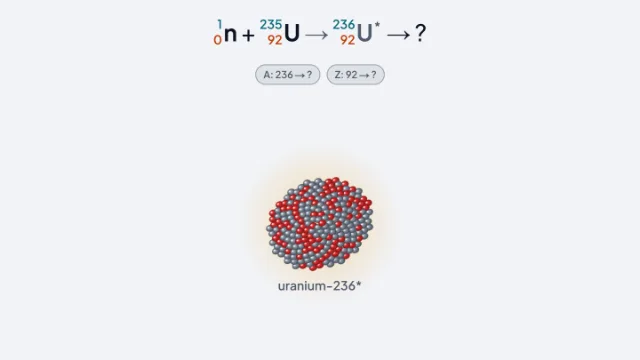
  1. Under What to show, pick Fission. With a Slow setting for the Incoming neutron, press Play. The Energy released card shows about 200 MeV: the energy of the mass that went missing in that one split.
  2. Try the other Fission products pairs. The sim shows the same rounded figure of about 200 MeV for each; in reality the mass defect, and so the energy, differs slightly from one pair of fragments to another.
  3. Choose Fusion, turn the Fuel temperature up to Extreme, then run it with Play. When the nuclei fuse, the Energy released card shows the 17.6 MeV calculated above.
Common mistakes

  • Forgetting to square c. The factor is (3 × 10⁸)² = 9 × 10¹⁶, not 3 × 10⁸.
  • Putting the mass in grams. E = mc² gives joules only when m is in kilograms.
  • Using the whole mass of the fuel in E = mc². Only the mass defect, the mass that actually disappears, becomes energy.
  • Taking the mass defect the wrong way round. It is the mass before the reaction minus the mass after, which is positive when energy is released.
  • Multiplying a mass in kilograms by 931.5. The 931.5 MeV short cut only works with the mass defect in atomic mass units (u).
  • Thinking mass and energy are each conserved separately. In nuclear reactions it is their total, mass-energy, that stays the same.

Exam practice

Exam-style questions

Original questions written in the style of Punjab board exams. Try each one before you reveal the answer.

  1. 1.In a nuclear reactor, the products of each uranium-235 fission have a total mass about 3.2 × 10⁻²⁸ kg smaller than the neutron and nucleus that went in.

    1. (a)What is the name for this difference in mass?

      1 mark
      Show the answer

      Answer: The mass defect, Δm.

      Marking points

      • Mass defect
    2. (b)Use Einstein's equation to calculate the energy released by one fission.

      3 marks
      Show the answer

      Answer: E = Δm c² = 3.2 × 10⁻²⁸ × (3 × 10⁸)² = 3.2 × 10⁻²⁸ × 9 × 10¹⁶ ≈ 2.9 × 10⁻¹¹ J.

      Marking points

      • E = Δm c²
      • Squares c to 9 × 10¹⁶
      • About 2.9 × 10⁻¹¹ J
    3. (c)Convert this energy into MeV, using 1 MeV = 1.6 × 10⁻¹³ J.

      1 mark
      Show the answer

      Answer: 2.88 × 10⁻¹¹ ÷ 1.6 × 10⁻¹³ = 180 MeV.

      Marking points

      • About 180 MeV
  2. 2.Two deuterium nuclei can fuse to make a helium-3 nucleus and a neutron. The masses are: deuterium 2.0141 u, helium-3 3.0160 u, neutron 1.0087 u.

    1. (a)Find the mass defect of this reaction.

      2 marks
      Show the answer

      Answer: Before: 2 × 2.0141 = 4.0282 u. After: 3.0160 + 1.0087 = 4.0247 u. Δm = 4.0282 − 4.0247 = 0.0035 u.

      Marking points

      • Totals 4.0282 u and 4.0247 u
      • Δm = 0.0035 u
    2. (b)Calculate the energy released, given that 1 u is equivalent to 931.5 MeV.

      2 marks
      Show the answer

      Answer: E = 0.0035 × 931.5 ≈ 3.3 MeV.

      Marking points

      • Multiplies Δm in u by 931.5
      • About 3.3 MeV
  3. 3.Einstein's equation E = mc² describes the interconversion of matter and energy.

    1. (a)State what each symbol stands for, with its SI unit.

      3 marks
      Show the answer

      Answer: E: energy, in joules (J). m: mass converted, in kilograms (kg). c: light's speed in a vacuum, 3 × 10⁸ m s⁻¹.

      Marking points

      • E energy in J
      • m mass in kg
      • c speed of light in m s⁻¹
    2. (b)Give one example of energy being turned into matter.

      2 marks
      Show the answer

      Answer: Pair production: a high-energy gamma photon near a nucleus changes into an electron and a positron, as happens in particle accelerators.

      Marking points

      • Pair production from a high-energy photon
      • Electron–positron (particle–antiparticle) pair formed

Quiz

Quick check

6 questions

  1. 1.In E = mc², the symbol c stands for:
  2. 2.The energy equivalent of 2.0 g of mass is:
  3. 3.The mass defect of a nuclear reaction is:
  4. 4.One atomic mass unit, 1 u, is defined as:
  5. 5.A reaction has a mass defect of 0.0100 u. The energy released is about:
  6. 6.Which process turns energy into matter?

Related articles

Next step

Now see it move

Open the full nuclear fission and fusion simulation for every preset, graphs and the teacher tools, then test yourself.

Nuclear fission and fusion simulation: watch a slow neutron split uranium-235 and balance the equation