What radioactivity is
Some nuclei are unstable. They may hold too many or too few neutrons for their number of protons, or carry spare energy. Such a nucleus becomes more stable by throwing out radiation from its nucleus. This is radioactivity, and the change it causes in the nucleus is called radioactive decay.
Henri Becquerel discovered it in 1896 when uranium salts fogged a wrapped photographic plate. Marie Curie and Ernest Rutherford then studied it in detail; Curie found two new radioactive elements, polonium and radium.
Some elements, such as uranium and radium, are radioactive naturally. Others can be made radioactive artificially, for example in a nuclear reactor.
Spontaneous and random
Radioactive emission has two key features:
- Spontaneous: nothing has to trigger it. Heating, cooling, squeezing or chemically combining the material does not speed it up or slow it down.
- Random: there is no way to say which nucleus will decay next, or when a particular nucleus will decay.
Even so, a sample holds an enormous number of nuclei, so the overall rate of decay follows a steady, predictable pattern, just as you cannot predict one coin toss but can predict that about half of a thousand tosses will be heads.
The three radiations
| Property | Alpha (α) | Beta (β) | Gamma (γ) |
|---|---|---|---|
| What it is | helium nucleus: 2 protons + 2 neutrons, ⁴₂He | fast electron from the nucleus (a positron in some decays) | electromagnetic wave (photons) of high energy |
| Charge | +2e | −1e (electron) or +1e (positron) | 0 |
| Mass | about 4 u (heavy) | very small | none |
| Ionising effect | strong | moderate | weak |
| Penetrating power | low: stopped by paper or a few cm of air | moderate: passes paper, stopped by a few mm of aluminium | high: only reduced by thick lead or concrete |
| In electric and magnetic fields | deflected slightly | deflected strongly, opposite way to alpha | not deflected |
Here e is the elementary charge, the size of one electron's charge (1.6 × 10⁻¹⁹ coulomb), and u is the atomic mass unit. Gamma rays are given out when a nucleus that is left in an excited state drops to a lower energy, usually just after it has emitted an alpha or beta particle.
Why ionising and penetrating go in opposite orders
To ionise an atom, radiation must knock an electron out of it. Each time it does, it loses some energy.
- Alpha particles are large, slow and doubly charged. They pull hard on the electrons of every atom they pass, so they ionise very strongly. They use up their energy within a short distance, and so cannot get far: a sheet of paper stops them.
- Beta particles have a single charge and much less mass and move faster, so they interact less often. They ionise less, and travel further before stopping.
- Gamma rays have no charge and no mass. They meet atoms only now and then, so they ionise weakly but can pass through a great deal of material.
The pattern to remember: strong ionisers are poor penetrators, and weak ionisers travel furthest.
Deflection in electric and magnetic fields
Only charged radiation is pushed by a field.
- Between charged plates, alpha particles are pulled towards the negative plate and beta particles (electrons) towards the positive plate. Gamma rays go straight on.
- In a magnetic field at right angles to their motion, alpha and beta particles curve in opposite directions, found with Fleming's left-hand rule (treat a beam of alpha particles as a current in the direction they move, and a beam of electrons as a current in the opposite direction). Gamma rays are not bent.
- Beta particles bend much more than alpha particles. An alpha particle has thousands of times the mass of an electron, so although it carries twice the charge it is far harder to turn.
Worked numerical 1: charge on alpha particles
What is the charge on one alpha particle, and how many alpha particles together carry ?
Worked numerical 2: identifying a source
A Geiger counter near an unknown source reads (all in counts per minute, with a background of 20 counts per minute):
| Between source and tube | Reading | Minus background |
|---|---|---|
| nothing | 620 | 600 |
| paper | 260 | 240 |
| 3 mm aluminium | 21 | 1 |
- Paper removes 360 counts per minute, so the source gives out alpha.
- 240 per minute pass paper but are stopped by aluminium, so it also gives out beta.
- Behind aluminium the count is back to background, so there is no gamma.
Taking away the background count is a step beyond this section of the book (background radiation is met in Chapter 21), but it makes the reasoning clear.
Radiation in the simulation
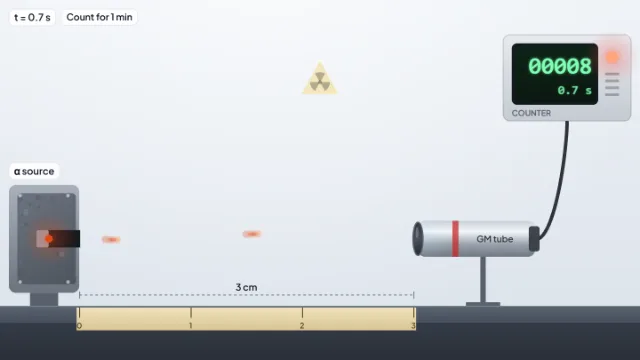
- Under Experiment choose Penetration: what absorbs each radiation. Pick Alpha as the Source, press Play, then set Absorber to Paper. The count rate falls to the background.
- Repeat with Beta: paper barely changes the count, but Aluminium stops it. With Gamma, try Lead and raise the Lead thickness: the count falls but does not vanish.
- Choose Deflection in electric and magnetic fields. Switch the Field between Electric and Magnetic, and press Reverse the field. Alpha and beta curve opposite ways; gamma never bends.
- Pick Unknown as the source and use the Identify the source challenge, as in worked numerical 2.