A clock inside the atom
Archaeologists dig up a wooden bowl in the Indus valley. Nobody wrote down when it was made, yet a laboratory can tell them its age to within a century or two. The wood carries its own clock: a radioactive form of carbon whose nuclei break down at a steady, known pace. Section 20.8 introduces that pace, the half-life, and the way it is used for dating.
Activity: how fast a sample decays
The activity of a radioactive sample is the number of its nuclei that decay each second, giving out alpha, beta or gamma radiation.
- The SI unit is the becquerel (Bq): 1 Bq means 1 decay per second.
- An older unit is the curie (Ci): decays per second.
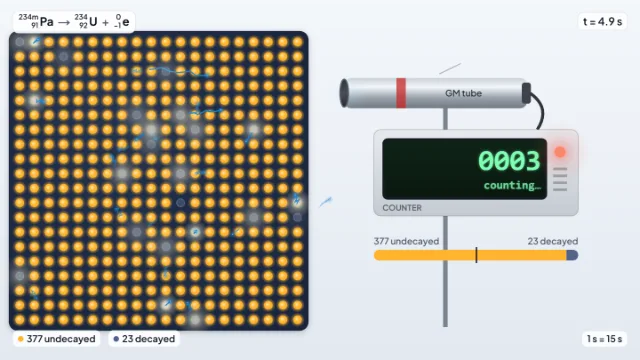
Activity depends on two things: how many radioactive nuclei are present, and how unstable each one is. The second is measured by the decay constant ; an isotope with a short half-life has a large . Take two samples with the same number of nuclei, and the one with the shorter half-life has the higher activity. A Geiger–Müller counter or a scintillation detector records the radiation and gives a count rate, which goes up and down with the activity.
What half-life means
Half-life (): how long it takes until just half of a sample's radioactive nuclei have decayed.
In the same time the activity, and the count rate from the sample, also halve. Each isotope has its own half-life, and nothing we do changes it: heating, cooling, squeezing, dissolving or combining the isotope in a compound makes no difference. Big and small samples of the same isotope have exactly the same half-life.
No one can say when a particular nucleus will decay: it is a matter of chance. But with billions of nuclei, the chances average out, and half of them reliably go in each half-life.
Halving again and again
Start with undecayed nuclei.
| Time passed | Undecayed nuclei left | Fraction left |
|---|---|---|
| 0 | N₀ | 1 |
| 1 half-life | N₀/2 | 1/2 |
| 2 half-lives | N₀/4 | 1/4 |
| 3 half-lives | N₀/8 | 1/8 |
| 4 half-lives | N₀/16 | 1/16 |
The number of half-lives that have passed, , and the amount left, , are
where is the total time. Plotted against time, falls along a smooth curve that drops steeply at first and then more and more slowly, never quite reaching zero. This shape is called exponential decay. To read a half-life off such a graph, pick any value on the curve, find where the curve has fallen to half of it, and read the time between the two.
Some half-lives
| Isotope | Half-life | One use or hazard |
|---|---|---|
| Radon-222 | 3.8 days | gas from rocks; indoor health hazard |
| Iodine-131 | 8 days | thyroid treatment and imaging |
| Polonium-210 | 138 days | heat source for space probes |
| Cobalt-60 | 5.27 years | radiotherapy, sterilising equipment |
| Tritium (hydrogen-3) | 12.3 years | glowing paints, tracer studies |
| Strontium-90 | 28.8 years | thickness gauges, some eye treatments |
| Carbon-14 | 5730 years | dating once-living remains |
| Potassium-40 | 1.25 billion years | dating rocks |
| Uranium-238 | 4.5 billion years | dating rocks and the Earth |
| Thorium-232 | 14 billion years | possible reactor fuel, dating rocks |
Half-lives range from fractions of a second to far longer than the age of the universe. Take care with Table 20.2 in the textbook: it prints "days" for cobalt-60, tritium and strontium-90, but their half-lives are really 5.27, 12.3 and 28.8 years, as given here. Why a short half-life suits a medical tracer and a long one suits a smoke alarm is explained in the notes on how radiation is used and the harm it can do.
Carbon dating
High in the atmosphere, cosmic rays knock neutrons out of atoms. When one of these neutrons hits a nitrogen-14 nucleus, it can turn it into carbon-14. This radioactive carbon joins oxygen as carbon dioxide, which plants take in by photosynthesis; animals then eat the plants. So every living thing keeps a small, steady share of carbon-14 alongside ordinary carbon-12.
When the plant or animal dies, it stops taking in carbon. From then on its carbon-14 decays with a half-life of about 5730 years and is not replaced. Measuring how much carbon-14 is left, compared with the amount in living material, tells scientists how many half-lives have passed since death. The method works for wood, bone, cloth, shells and charcoal up to roughly 50 000 years old; beyond that, too little carbon-14 is left to measure.
Worked numerical 1: iodine for a thyroid scan
A hospital receives 80 mg of iodine-131, half-life 8 days. How much is left after 24 days?
Worked numerical 2: half-life from count rates
A source's count rate (background already removed) falls from 640 counts per second to 40 counts per second in 2 hours. Find the half-life.
640 → 320 → 160 → 80 → 40: that is 4 halvings in 2 hours, so
Worked numerical 3: how old is the charcoal?
Charcoal from an ancient fireplace has one-eighth of the carbon-14 found in fresh wood. One-eighth means 3 half-lives:
Worked numerical 4: activity in becquerels
A medical sample has an activity of 2400 Bq and a half-life of 6 hours. What is its activity one day later?
The decay equations for alpha and beta emission, which say what each nucleus turns into, are covered in the radioactive decay notes for section 20.5. To practise reading decay curves, finding a mystery isotope and choosing the right isotope for a job, play the Half-Life Detective game.
Half-life in the simulation
- Pick Iodine-131 from the Isotope list and press Play. Watch the Undecayed card and the Time card, which counts in half-lives: each time it passes another whole number, the undecayed count has roughly halved.
- Press New sample several times. The exact numbers change because decay is random, but the half-life stays the same.
- Switch to Carbon-14 to see a much longer half-life on the same kind of curve, and compare the Activity readings.
- Choose Custom isotope, set your own Half-life, and check that the activity halves in that time.