Nuclear reactions
A chemical reaction only rearranges the electrons around atoms; every nucleus comes out unchanged. A nuclear reaction changes the nucleus itself, so one element can turn into others. Nuclear reactions release (or absorb) far more energy per atom than chemical ones. The two that matter most are fission and fusion.
Fission: splitting a heavy nucleus
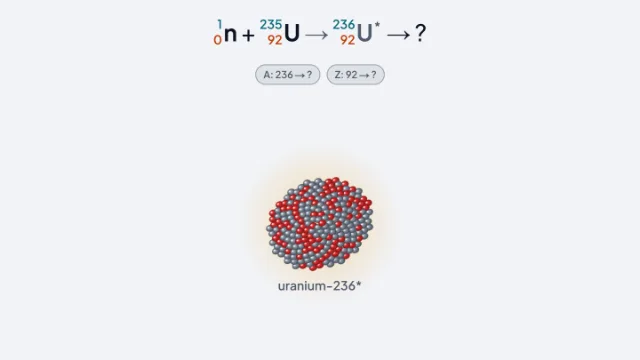
In nuclear fission a large, heavy nucleus such as uranium-235 absorbs a neutron, becomes very unstable and splits into two smaller nuclei of roughly similar size. At the same time it throws out two or three fresh neutrons (2.5 on average) and a large amount of energy, about 200 MeV per split. Otto Hahn and Fritz Strassmann discovered fission at the end of 1938 and published it early in 1939, the year your book gives.
Uranium-235 captures a slow neutron far more readily than a fast one. One possible split is
The fragments vary from one fission to the next; barium-141 and krypton-92 with three neutrons is another common pair.
Where the energy comes from
Add up the masses after a fission and you get slightly less than the mass before. That small missing mass has become energy, mostly as the kinetic energy of the flying fragments and neutrons, together with gamma rays. The link between mass and energy is Einstein's , covered in section 20.7.
Chain reactions
Each fission frees two or three neutrons, and each of those can split another uranium-235 nucleus. This self-sustaining process is a chain reaction.
- Uncontrolled: if most neutrons go on to cause fissions, the number of fissions multiplies every step and the energy pours out in a fraction of a second. This is an atomic bomb.
- Controlled: in a nuclear reactor, control rods soak up the spare neutrons, leaving just one neutron per fission, on average, to trigger the next split. The power stays steady and is used to raise steam and drive generators. A moderator such as water slows the neutrons so uranium-235 can capture them (control rods and moderators are named here as a detail beyond the book).
Fusion: joining light nuclei
In nuclear fusion, two light nuclei combine into a single heavier nucleus, and energy is released. The product again has a little less mass than the nuclei that went in, and that mass appears as energy.
The fusion that is easiest to bring about uses deuterium and tritium, the two heavier isotopes of hydrogen. Tritium meets deuterium:
Both nuclei are positive, so they repel. They only get close enough to fuse if they collide at enormous speed, which means the fuel must be at a temperature of many millions of kelvin.
Fusion powers the stars
Stars, including the Sun, shine because of fusion. In the Sun's core, at about 15 million kelvin (the book rounds this up to nearly 20 million), hydrogen nuclei fuse in a series of steps whose overall result is that four hydrogen nuclei become one helium nucleus. The energy released by each such helium nucleus is about 26.7 MeV; the book quotes 25.7 MeV, but the accepted figure is the larger one.
Fission and fusion compared
| Fission | Fusion | |
|---|---|---|
| The change | one heavy nucleus breaks in two | light nuclei join |
| Typical fuel | uranium-235 | isotopes of hydrogen |
| How it starts | a neutron is absorbed | very high temperature and pressure |
| Where it is used | nuclear power stations, atomic bombs | the Sun and stars; experimental reactors |
| Waste | radioactive fragments | mainly helium, far less radioactive waste |
In both, the products have less mass than the starting nuclei, and that difference is released as energy.
Worked numerical 1: balancing a fission equation
Check the xenon–strontium equation above.
- Top row: left ; right .
- Bottom row: left ; right .
Both balance, so the equation is possible.
Worked numerical 2: energy from many fissions
One fission gives about 200 MeV. Using :
A reactor splits nuclei. The energy released is
Worked numerical 3: a growing chain
Suppose every fission leads to exactly two more. Starting from one fission, how many fissions happen in the eleventh generation?
The number doubles ten times: . After only a few dozen generations the count runs into trillions, which is why an uncontrolled chain is explosive.
Fission and fusion in the simulation
- Choose Fission under What to show. Set Incoming neutron to Slow, press Play, and read the Neutrons released and Energy released cards. Try Fast: the neutron usually bounces off.
- Change Fission products to compare different pairs of fragments. The sums of top and bottom numbers always balance.
- Choose Chain. With Controlled (reactor), move Control rods in and watch the Fissions caused by each fission (k) card: above 1 the chain grows, below 1 it dies away.
- Choose Fusion and raise the Fuel temperature from Low to Extreme. Only the hottest, fastest nuclei get close enough to fuse.