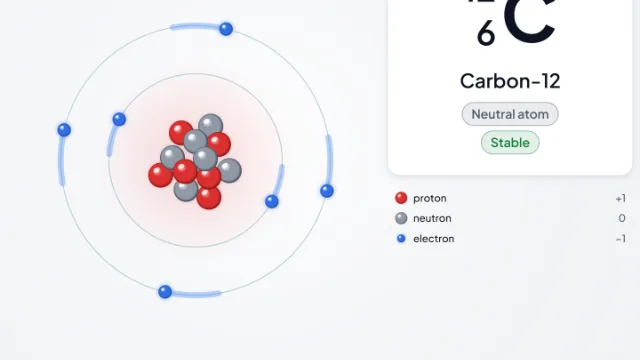
What is inside the nucleus
The nucleus sits at the very centre of an atom and carries almost all of its mass. It is built from two kinds of particle:
- protons, each with a positive charge equal in size to an electron's charge;
- neutrons, which have no charge and almost the same mass as a proton.
Protons and neutrons together are called nucleons. Electrons are not part of the nucleus. Each one is roughly 1836 times lighter than a proton, which is why they add almost nothing to an atom's mass.
Protons all carry positive charge, so they repel one another strongly at such close range. They stay packed together because of the strong nuclear force, an attraction that acts between all nucleons (protons and neutrons alike) but only over extremely short distances, about the width of a nucleus.
Two numbers that describe a nucleus
| Quantity | Symbol | What it counts |
|---|---|---|
| Charge number (atomic number) | Z | protons in the nucleus |
| Mass number (nucleon number) | A | protons + neutrons in the nucleus |
| Neutron number | N | neutrons in the nucleus |
The charge number is the element's identity card. Every carbon nucleus has 6 protons, every oxygen nucleus 8, every iron nucleus 26. Change and you have a different element. also sets the element's place in the periodic table and, through the electrons that match the protons in a neutral atom, how it behaves chemically.
The mass number counts every nucleon. Electrons are left out because their mass is so small.
Because nucleons are either protons or neutrons, the number of neutrons is found by subtraction:
Nuclide notation
A nuclide is one particular kind of nucleus, fixed by its values of and . It is written with the chemical symbol , the mass number as a superscript and the charge number as a subscript:
So is a carbon nucleus with 12 nucleons, 6 of them protons. The top number is always the larger (or equal, for ordinary hydrogen), because it includes the protons.
Worked numerical 1: sodium
How many protons, neutrons and (in a neutral atom) electrons are there in ?
- Protons:
- Neutrons:
- Electrons in the neutral atom: equal to the protons, so 11
Worked numerical 2: uranium
A uranium nucleus has 92 protons and 146 neutrons. Write its nuclide symbol.
Worked numerical 3: name the element
A nucleus has mass number 39 and contains 20 neutrons. Find and name the element.
The element with 19 protons is potassium, so the nuclide is .
How big is a nucleus?
Compared with the whole atom, the nucleus is tiny: around to across, against about for the atom. Yet that speck holds practically all the atom's mass, so nuclear matter is astonishingly dense. These sizes are rough, rounded values; the book only says the nucleus is very small compared with the atom.
Building nuclei in the simulation
- In Build mode, use the Protons stepper to add 3 protons. The Element card names lithium, and the Atomic number card reads 3.
- Add 4 neutrons. The Mass number card becomes 7, and the Neutron number card shows .
- Watch the Nuclide notation card: the top number follows the nucleons and the bottom number follows the protons only.
- Add electrons until the Charge card says the atom is neutral. Adding or removing electrons changes the charge, but never or .