Same element, different mass
Take any two oxygen atoms and you will always count 8 protons in each nucleus; the proton count is what defines oxygen. Their neutron counts, though, need not agree. Atoms of one element that differ only in their neutron count are called isotopes.
Isotopes of an element have the same charge number but different mass numbers , because they contain different numbers of neutrons.
Most elements exist naturally as a mixture of two or more isotopes. An element can therefore have more than one isotope, and each isotope is named by its mass number: carbon-12, carbon-14, uranium-235 and so on.
The three isotopes of hydrogen
Hydrogen shows the idea most simply. All three isotopes have one proton and, as neutral atoms, one electron.
| Isotope | Symbol | Protons | Neutrons |
|---|---|---|---|
| Hydrogen-1 (protium) | ¹₁H | 1 | 0 |
| Hydrogen-2 (deuterium) | ²₁H | 1 | 1 |
| Hydrogen-3 (tritium) | ³₁H | 1 | 2 |
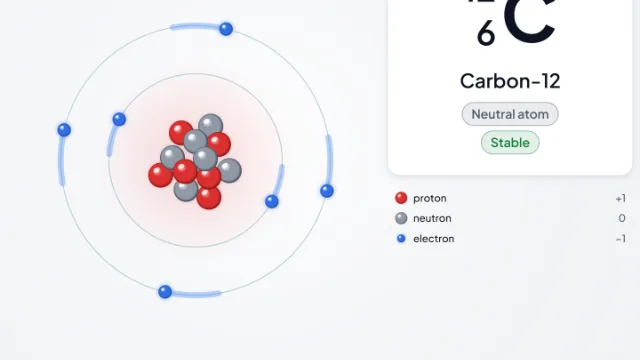
Carbon is another example. Its isotopes , and all have 6 protons but hold 6, 7 and 8 neutrons. Carbon-14 is the one used in carbon dating.
Chemistry the same, nucleus different
The chemical behaviour of an atom depends on its electrons, and a neutral atom always has as many electrons as protons. Isotopes have the same number of protons, so they have the same electrons and react in the same way. Water made with deuterium ("heavy water") still behaves chemically like ordinary water.
The neutrons, though, change the nuclear properties:
- the mass of the atom (a tritium atom is roughly three times as heavy as a protium atom);
- the stability of the nucleus: protium and deuterium are stable, but tritium is radioactive. Likewise carbon-12 and carbon-13 are stable while carbon-14 decays.
So isotopes share chemical properties but can differ in physical and nuclear ones such as density, mass and radioactivity.
Isotopes and ions are not the same thing
Changing the number of electrons does not make a new isotope. An atom that gains or loses electrons becomes an ion, with an overall charge:
- a sodium atom (11 protons, 11 electrons) that loses one electron becomes , with 11 protons and 10 electrons;
- a chlorine atom that gains an electron becomes .
The nucleus, and so the isotope, is unchanged in both cases.
Worked numerical 1: two chlorine isotopes
Chlorine has two common isotopes, and . Compare their particles.
| Chlorine-35 | Chlorine-37 | |
|---|---|---|
| Protons, Z | 17 | 17 |
| Neutrons, N = A − Z | 35 − 17 = 18 | 37 − 17 = 20 |
| Electrons (neutral atom) | 17 | 17 |
Only the neutron number differs, by 2.
Worked numerical 2: which are isotopes?
Four nuclei are listed: , , and (letters stand in for the symbols). Which two are isotopes of the same element?
Isotopes must share . Only Y and Q both have , so they are isotopes of one element (potassium), with and neutrons. X, Y and R share a mass number of 40, but their charge numbers differ, so they are three different elements.
Worked numerical 3: average mass (beyond the book)
About 75% of chlorine atoms are chlorine-35 and 25% are chlorine-37. The average mass number of a large sample is
This is why the relative atomic mass of chlorine is not a whole number. The book does not ask for this calculation; it is included because you will meet it in chemistry.
Comparing isotopes in the simulation
- Choose Compare under What to do. Two neutral atoms of the same element sit side by side.
- Use Neutrons 1 and Neutrons 2 to give them different neutron numbers. In the table, the Electrons row stays the same for both atoms, which is why the chemistry matches, while Neutrons N changes.
- Step through elements with Element. Look at the Nucleus row for each isotope: some are Stable and some are Radioactive.
- Switch to Build, make carbon with 6, 7 and then 8 neutrons, and read the Nuclide notation card for carbon-12, carbon-13 and carbon-14.