Newton's third law in AQA 8463
Spec point 4.5.6.2.3 appears on Foundation and Higher papers, in GCSE Physics and in Combined Science, with no equation. You must apply the law to objects in equilibrium, such as a hanging lamp or a parked car. It builds on the interaction pairs of 4.5.1.2.
What the law says
An interaction between two objects always produces two forces: each object pushes or pulls on the other. The forces in such a pair:
- are the same size;
- point in opposite directions along one line;
- are the same type, such as both gravitational or both friction;
- act on two different objects, one on each;
- start and stop together, so neither comes first.
Mass makes no difference: when a bus hits a bicycle, each pushes on the other equally hard.
To find a partner, swap the names: the partner of "A on B" is "B on A", of the same type. A bat pushes a ball forwards; the ball pushes the bat backwards.
Why a pair never cancels
Forces only combine into a resultant when they act on the same object. The forces in a third-law pair act on different objects, so they cannot cancel. Balanced forces are a separate idea: forces on one object whose resultant is zero.
Worked example: a lamp in equilibrium
A ceiling lamp of mass 2.5 kg hangs still on its cable, with N/kg.
Weight. N downwards, from the Earth. Partner: the lamp's gravitational pull on the Earth, 24.5 N upwards.
Tension. The lamp is not accelerating, so the forces on it balance: the cable pulls it upwards with 24.5 N. Partner: the lamp pulls the cable downwards with 24.5 N.
Weight and tension balance, but both act on the lamp, so they are not a pair. Tug the lamp downwards and the tension grows while the weight stays at 24.5 N.
Everyday interactions
- Walking: your shoe pushes the pavement backwards, and friction from the pavement pushes you forwards.
- Swimming: you drive water backwards and the water drives you forwards.
- Rockets: the engine forces exhaust gas backwards, so the gas thrusts the rocket forwards, even in space where there is no air.
- Earth and Moon: each pulls the other equally hard, but the Earth's acceleration is far smaller because its mass is about 81 times the Moon's.
- Horse and cart: the cart pulls back on the horse as hard as the horse pulls the cart. The cart accelerates when the horse's pull on it exceeds the friction acting on it. The horse accelerates when the ground pushes its hooves forwards harder than all the backward forces on it, mostly the cart's pull.
Equal forces, unequal effects
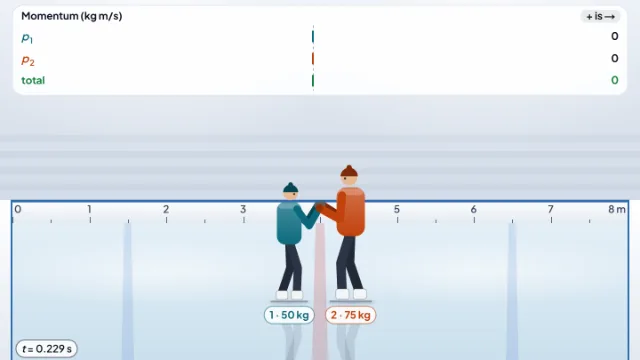
Skaters of 50 kg and 75 kg push apart with 150 N on each. Using , which you must recall, the lighter one accelerates at m/s² and the heavier one at m/s².
Higher tier only. Before the push the total momentum is zero. Momentum is conserved, so afterwards the two momenta are equal in size and opposite in direction, and the total is still zero. If the 75 kg skater leaves at 0.40 m/s, that skater's momentum is kg m/s, so the 50 kg skater moves the other way at m/s. This calculation is GCSE Physics only; see the momentum page.
Simulation activities
In the simulation above, press Push: skaters of 50 kg and 75 kg push with 150 N. While their hands touch, each carries an arrow: same length, opposite ways. Readings then gives −0.600 m/s and +0.400 m/s; the total momentum stays 0 kg m/s. Set Who pushes? to Skater 1 and push again: the arrows still match.
Change the Scene to Force pairs, where Book on a table asks first for the weight's partner. Pick The table pushes the book up and read which checks fail, then find the true partner.
Then choose Rocket and press Fire: the gas and the rocket each feel 100 kN, in opposite directions.