Action and reaction in §3.4
Section 3.4 of the Class 9 book ends with Newton's third law, the law of action and reaction. No formula is needed; board papers often ask for the statement, examples and why the forces never cancel. Its link to momentum and gun recoil is on the conservation of momentum page (§3.10). To see how questions are set on the new syllabus, look through the PECTAA model paper for Class 9 physics.
Statement of the third law
Statement: forces always come in pairs. If body A pushes or pulls body B, then at the same moment B pushes or pulls A with a force of equal magnitude in the opposite direction.
A short form often used in answers: every action has a reaction that is equal in size and opposite in direction. Either force may be called the action; the other is then the reaction. Every action–reaction pair:
- has two forces of equal magnitude;
- has opposite directions, along one straight line;
- is of one nature: both gravitational, both normal forces, or both friction;
- acts on two different bodies, never on one;
- starts and stops together: the reaction never lags behind.
To find a reaction, swap the bodies: the reaction to 'hand on wall' is 'wall on hand'.
Why action and reaction do not cancel
Two forces can only cancel when they act on the same body. Action and reaction act on different bodies, so each can change the motion of its own body. Forces that do cancel, on one body in equilibrium, are balanced forces (the first law).
The block on the table
For the textbook's block resting on a table, two forces act on the block itself: its weight (the Earth pulling it down) and (the table pushing it up). The block stays at rest, so these are balanced: . They are not action and reaction: both act on the block, and they are of different nature.
| Action | Reaction |
|---|---|
| Block presses down on the table | Table pushes up on the block with |
| Earth pulls the block down with | Block pulls the Earth up with |
The book says the block presses on the table with a force equal to its weight. That holds for a block simply resting on a level table, and needs two laws: equilibrium gives , and the third law makes the block's push equal to . Any other vertical push or pull on the block changes this.
Worked numerical. A 2 kg block rests on a table, with , so . Then a student presses down on it with 15 N. For equilibrium, , so by the third law the block presses on the table with 35 N, while its weight stays 20 N.
Everyday examples
- Walking: the foot pushes the ground backwards; friction from the ground pushes the foot forwards.
- Swimming: strokes push water backwards; the water pushes the swimmer ahead.
- Gun: the gun pushes the bullet forwards and the bullet pushes the gun backwards, so the gun recoils.
- Rocket: it throws hot exhaust gases backwards and the gases push it forwards; no air is needed, so it works in space too.
- Earth and Moon: each attracts the other with an equal gravitational force.
- Donkey cart: the cart pulls back on the donkey as hard as the donkey pulls it, yet both move off. The cart speeds up when the donkey's pull beats the friction on the cart; the donkey does when the ground's push on its hooves beats the backward forces on it, chiefly the cart's pull.
Worked numerical: equal forces, unequal accelerations
Students of 40 kg and 60 kg on roller skates push apart, each feeling 120 N for 0.5 s.
From rest, gives and , in opposite directions. Taking the first student's direction as negative, , so the total momentum is still zero, as §3.10 predicts.
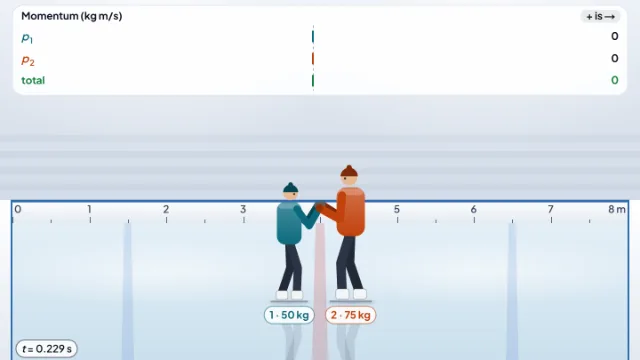
Action and reaction on screen
In the simulation above, the 50 kg and 75 kg skaters are set to push with 150 N. Press Push: each skater gets an arrow, equal in length and opposite in direction. Readings then shows as −0.600 m/s and as +0.400 m/s, and the total momentum is still 0. Once the push ends, the impulse on each skater appears in Check it with the equations under the graphs: N s.
Switch the Scene to Force pairs. Book on a table is already showing, with every force 10 N. Try The table pushes the book up as the weight's partner and read why it fails. Choose Earth and Moon: both pulls are N. Last, pick Rocket and press Fire: compare the forces on the rocket and its gas.