Physics12 min read
Why Does Air Pressure Decrease with Altitude? Atmospheric Pressure Explained
What causes atmospheric pressure, why it falls with height, and how that explains popping ears, squashed bottles, swollen crisp packets, water boiling below 100 °C and thin air for climbers. Then see how barometers measure it, with two worked examples.
Updated
On this page
- What is atmospheric pressure?
- What is normal air pressure at sea level?
- Why does air get thinner with altitude?
- What happens to air pressure as altitude decreases?
- How does the air pressure around you compare with the top of a mountain?
- Does air move from high pressure to low pressure?
- How does lower pressure show up in everyday life?
- How do you measure air pressure?
- Exam question explained
- How can you explore it in the simulation?
- Common mistakes
- Key points
In short
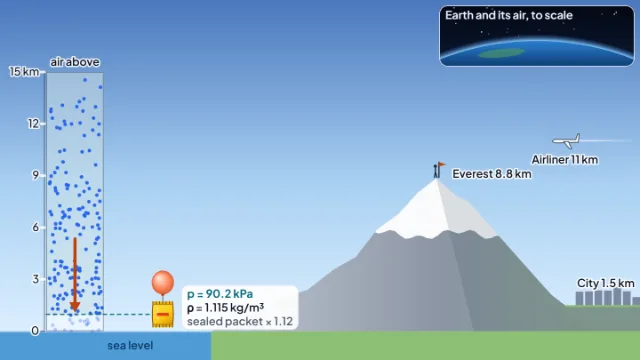
As altitude increases, air pressure decreases: the higher you go, the lower the pressure. It falls because there is less air above you. Every layer of air carries the weight of all the air stacked on top of it. Climb a mountain and part of the atmosphere is now below your feet, so a smaller weight of air presses down from above.
The air around you is also squashed less, so it is less dense: each cubic metre holds fewer molecules. With fewer molecules, fewer of them strike any patch of surface each second. So the force on each square metre, which is the pressure, is smaller.
At sea level, atmospheric pressure is about 101 kPa (101 000 Pa). On the summit of Mount Everest, 8849 m up, measurements give only about 34 kPa, one third of the sea-level value.
What is atmospheric pressure?
Air molecules race about in random directions. When one hits a surface, it bounces off and gives that surface a tiny push. Countless pushes like this every second blend into a steady force. Atmospheric pressure is the force on each square metre. Molecules arrive from every side, so the air presses on a floor, a ceiling and a wall alike.
You can also picture the pressure as weight. Gravity pulls the air down, so the pressure at any level equals the weight of the column of air resting on each square metre. At sea level that is about 101 000 N, the weight of roughly 10 300 kg of air. You are not crushed because the pressure inside your body matches it.
What is normal air pressure at sea level?
Standard sea-level pressure is defined as 101 325 Pa, which is the same as 101.325 kPa, 1013.25 hPa or 1 atmosphere (1 atm). It holds up a mercury column about 760 mm tall.
Weather forecasts and maps give pressure in hectopascals (hPa). One hectopascal is 100 Pa and equals one millibar, so a "1013" on a weather map means 101.3 kPa. Highs and lows move the reading up or down by a few per cent from day to day, which is far smaller than the change you get by climbing a mountain.
Chemists meet a slightly different number. Their standard pressure for tables of data is 100 000 Pa (1 bar), chosen as a round value, while "1 atm" means 101 325 Pa. Both are close to real sea-level air pressure, so check which one a question uses.
Why does air get thinner with altitude?
Think of a tall pile of foam mattresses: the bottom one is squashed flat, the top one hardly at all. Air behaves the same way, because a gas is easy to compress. The lowest air is squeezed hardest, so it is the densest.
So the pressure does not drop by the same amount for every kilometre you climb. A kilometre of dense air near the ground holds a lot of mass. A kilometre of thin air high up holds far less.
| Height | Example | Pressure | Air density |
|---|---|---|---|
| 0 km | A beach | 101 kPa | 1.23 kg/m³ |
| 1.5 km | A high city | 85 kPa | 1.06 kg/m³ |
| 5.5 km | Half the air is below you | 51 kPa | 0.70 kg/m³ |
| 8.8 km | Top of Everest | 32 kPa | 0.48 kg/m³ |
| 11 km | An airliner cruising | 23 kPa | 0.36 kg/m³ |
These values come from the International Standard Atmosphere, a model used in aviation. Real readings differ from the model by several per cent with the weather, the season and the place, so the summit measurement is a little above the model's 32 kPa. Nearly all the air lies within about 30 km of the ground: a very thin skin on a planet with a radius of about 6400 km.
How fast does it fall near the ground? In the lowest few hundred metres the air's density is about 1.2 kg/m³, so each metre of height holds back about 1.2 × 9.8 = 12 Pa. That is roughly 1.2 kPa for every 100 m you climb, which is why a fast lift ride to the top of a tall building can be enough to make your ears pop.
What happens to air pressure as altitude decreases?
It goes up. Coming down a mountain, or as a plane descends, you move below more of the atmosphere, so a greater weight of air is stacked above you and the air around you is squeezed to a higher density. It is the same rule run backwards, and it is why a plastic bottle sealed at altitude caves in once you reach the valley.
How does the air pressure around you compare with the top of a mountain?
If you are near sea level, the air presses on you with about 101 kPa. The model atmosphere gives about 77 kPa at the height of Murree (2291 m), roughly three quarters of that. On Everest's summit, measurements give about 34 kPa, a third. So at the top of a high mountain the air pressing on each square metre of your skin is a lot lower, and a breath of air there holds far fewer molecules.
Does air move from high pressure to low pressure?
Yes. Where the pressure is higher on one side than the other, there is a resultant force on the air from the high-pressure side towards the low-pressure side, so air flows that way. Across a weather map, these pressure differences drive the wind.
How does lower pressure show up in everyday life?
Popping ears. The small air space behind each eardrum is joined to your throat by a narrow tube. As a plane climbs and the cabin pressure falls, the air in that space pushes the eardrum outwards. Swallowing or yawning opens the tube, some air escapes and the pressures balance with a pop. On the way down, swallowing lets air back in.
Swollen packets and squashed bottles. An airliner's cabin may be kept as low as about 75 kPa. A crisp packet sealed near sea level holds gas at about 101 kPa, so in the cabin, or on a mountain, that gas presses outwards more strongly than the thinner air presses in. The packet swells, often until it is tight. A bottle sealed during a flight does the opposite as the plane comes down. Our post on gas pressure and volume shows how a trapped gas changes size.
Worked example 1: a bottle after a flight
A passenger finishes a plastic bottle of water on a flight and screws the cap on tightly. The cabin air is at 75 kPa. The plane lands in Karachi, where the air pressure is 101 kPa. One side of the bottle is roughly flat, 20 cm tall and 6.0 cm wide. Find the resultant force on that side after landing, if the bottle has not changed shape.
Given: inside = 75 kPa, outside = 101 kPa, A = 0.20 m × 0.060 m = 0.012 m²
Pressure difference: 101 − 75 = 26 kPa = 26 000 Pa
Equation: , so , using the pressure difference
Substitution:
Answer: F = 312 N, about 310 N (2 significant figures), acting inwards
That is the weight of about a 32 kg mass, so the thin plastic caves in. As it does, the trapped air is squeezed and its pressure rises, so the bottle stops before it is flat.
Water boils below 100 °C. Water boils when its vapour can push back as hard as the air pressing on its surface. With less air pressure, that happens at a lower temperature: about 95 °C in a city 1.5 km up, and only about 70–72 °C on top of Everest. Rice, lentils and eggs cook more slowly in this cooler water, unless a pressure cooker traps the steam and lets the water pass 100 °C.
Climbers and oxygen. Air is about one fifth oxygen at every height a climber can reach. But at low pressure each lungful holds fewer molecules, so on Everest's summit a breath carries about a third as much oxygen as at sea level. Many climbers breathe bottled oxygen near the top.
How do you measure air pressure?
For a mercury barometer, a glass tube about 1 m long with one sealed end is filled to the top with mercury. It is then turned over, with its open end kept below the surface of more mercury in a dish. The column sinks, then stops once the pressure it exerts equals the air pressure on the open dish. At sea level the column is about 760 mm high, and the space above it is nearly empty. Mercury is used because it is so dense, 13 600 kg/m³. Water would need a column over 10 m tall.
An aneroid barometer uses no liquid. Inside is a sealed metal box with most of the air removed and thin, ridged sides. Rising pressure squashes the box slightly, falling pressure lets it spring back, and levers turn this tiny movement into the swing of a pointer. An aircraft altimeter is an aneroid barometer marked in heights.
Worked example 2: a barometer on Everest
On the summit of Everest, scientists measured a pressure that would hold up a mercury column 253 mm tall. Find the pressure. The density of mercury is 13 600 kg/m³; and g is 9.8 N/kg.
Given: column height h = 253 mm = 0.253 m; g = 9.8 N/kg; density ρ = 13 600 kg/m³
Equation for the pressure under a liquid column:
Substitution:
Answer: p = 33 720 Pa, about Pa (2 significant figures)
Compare with sea level: 253 ÷ 760 = 0.33, so only a third of the atmosphere's weight lies above the summit. With g = 10 m s⁻², as Punjab books use, you get 34 408 Pa, still about Pa.
Exam question explained
Question (5 marks). A student takes a barometer up a radio mast. At the bottom it reads 100.8 kPa. At the top it reads 97.3 kPa.
(a) Explain why the reading is lower at the top. (2 marks)
(b) Take the density of air as 1.2 kg/m³ all the way up and g as 9.8 N/kg. Find the height of the mast. (3 marks)
Answer (a). At the top there is less air above the barometer, so a smaller weight of air presses down on each square metre (1 mark). The air there is also less dense, so fewer molecules hit the barometer each second (1 mark).
Answer (b).
Pressure difference: Δp = 100.8 − 97.3 = 3.5 kPa = 3500 Pa (1 mark)
Equation: , rearranged to
Substitution: (1 mark)
Answer: Δh = 298 m, about 300 m (1 mark)
What examiners look for. In part (a), "the air is thinner" alone earns little. Name the cause: less air above, so less weight, and fewer molecules striking each second. In part (b), the usual slip is leaving the pressure in kPa, which gives an answer 1000 times too small. Taking the density as constant is fair here, because over 300 m it changes by only about 3%.
How can you explore it in the simulation?
Open the atmospheric pressure and altitude simulation and press Play. A weather balloon carrying a sealed crisp packet climbs from sea level to 15 km, and the pressure and density graphs fall steeply at first, then gently. Choose Airliner, 11 km from the Go to… menu: the Crisp packet card shows the bag stretched taut.
Next, pick Collapsing can from the scene menu, drag the Altitude slider to 8.8 km and press Heat. The Inside temperature card stops at 70 °C, where water boils at that pressure. Then pick Barometer, choose Everest, 8.8 km and press Play. The mercury settles at 238 mm, the standard model's value.
Compare the liquid pressure and depth simulation and the gas laws and particles simulation.
Common mistakes
- Thinking pressure rises as you climb. It always falls with height in the atmosphere, just as it rises with depth in water.
- Blaming weaker gravity. Gravity barely changes over a few kilometres. The pressure falls because less air lies above you.
- Writing "the air is thinner" and stopping. Link it to fewer molecules per cubic metre and fewer collisions per second.
- Saying a bottle or can is sucked in. The outside air is simply pushing more strongly.
- Assuming a steady fall. Each kilometre removes less pressure than the one below it.
- Giving 100 °C as the boiling point everywhere. Water boils at 100 °C only when the air pressure is standard.
Key points
- Air molecules hitting surfaces cause atmospheric pressure. It also equals the weight of air resting on each square metre.
- It is about 101 kPa at sea level and about a third of that on top of Everest.
- Higher up there is less air above you, so the air is less dense and the pressure is lower.
- Lower pressure pops ears, swells sealed packets and lowers the boiling point of water.
- At sea level, a mercury barometer's column is about 760 mm tall. An aneroid barometer uses a sealed metal box.