Skip to content

Punjab Board Class 9 Physics · Chapter 4: Turning effects of force

Circular motion and centripetal force

Section 4.13

At uniform speed on a circle, a body's heading keeps turning, so the velocity is never constant. An unbalanced force at 90° to the velocity, towards the centre, is needed: the centripetal force, Fc = mv²/r. Tension, friction or gravity supplies it; without it, a body leaves along the tangent.

Loading simulation…

Symbols match your course. Open the full circular motion simulation for more presets and teacher tools.

Uniform speed, changing velocity

Think of a rickshaw going round a circular chowk at a steady 6 m s⁻¹. Its speedometer needle stays still, yet it faces a new direction at every instant. At each point of the circle the velocity lies along the tangent there, and no two tangents point the same way.

Since velocity has direction, a change of heading on its own is a change of velocity. A body going round a circle at uniform speed is therefore accelerating, although it neither speeds up nor slows down.

Why the force must be perpendicular

By Newton's first law, a body with no net force on it keeps a uniform velocity in a straight line. To bend its path into a circle, an unbalanced force must act on it all the time, at right angles to the velocity.

Pages 97–98 of your book explain why. A force at any other angle would have a rectangular component along the velocity, and that component would change the speed. At 90° the component along the velocity is Fccos⁡90∘=0F_c \cos 90^\circ = 0, so only the direction changes. On a circle, a line at 90° to the velocity runs along the radius. The path bends inwards, so the force points along the radius to the centre, never away from it.

Definition: the centripetal force is the net force, pointing at every instant to the centre of the circle, that keeps a body moving round that circle at uniform speed.

The formula: learn it

Board papers in Punjab give no equation list, so memorise:

Fc=mv2rF_c = \frac{mv^2}{r}
SymbolQuantitySI unit
FcF_ccentripetal forceN
mmmass of the bodykg
vvits uniform speedm s⁻¹
rrradius of the circlem

Units: kg × (m s⁻¹)² ÷ m = kg m s⁻², which is the newton.

Change made (other two kept the same)New centripetal force
Speed doubled4Fc4F_c
Mass doubled2Fc2F_c
Radius doubledFc/2F_c/2
Radius halved2Fc2F_c

Worked numerical 1: a ball on a string

A 300 g ball on a 1.5 m string is swung round a horizontal circle on a smooth floor at a uniform 5 m s⁻¹. Find the centripetal force on it.

Data: m=300 g=0.3 kgm = 300\ \text{g} = 0.3\ \text{kg}, v=5 m s−1v = 5\ \text{m s}^{-1}, r=1.5 mr = 1.5\ \text{m}, Fc=?F_c = ?

Fc=mv2r=0.3 kg×(5 m s−1)21.5 m=7.5 kg m2 s−21.5 m=5 NF_c = \frac{mv^2}{r} = \frac{0.3\ \text{kg} \times (5\ \text{m s}^{-1})^2}{1.5\ \text{m}} = \frac{7.5\ \text{kg m}^2\,\text{s}^{-2}}{1.5\ \text{m}} = 5\ \text{N}

The tension in the string supplies this 5 N.

Worked numerical 2: the fastest safe speed on a bend

A 1000 kg car takes a level bend of radius 50 m. Friction from the road can push its tyres towards the centre with at most 4500 N. Find the greatest speed for the bend.

Data: m=1000 kgm = 1000\ \text{kg}, r=50 mr = 50\ \text{m}, Fc=4500 NF_c = 4500\ \text{N}, v=?v = ?

v2=Fc rm=4500×501000=225 m2 s−2v=225=15 m s−1v^2 = \frac{F_c\, r}{m} = \frac{4500 \times 50}{1000} = 225\ \text{m}^2\,\text{s}^{-2} \qquad v = \sqrt{225} = 15\ \text{m s}^{-1}

That is 54 km h⁻¹. Any faster and friction falls short, so the car skids towards the outer edge of the bend.

Sources of centripetal force

  • Stone or ball on a string: the tension in the string.
  • Moon and artificial satellites round the Earth: the Earth's gravitational pull.
  • Car or motorcycle on a level road: friction between the tyres and the road.
  • Spin dryer: the drum wall keeps pushing the clothes towards the centre. Water reaching a hole has nothing holding it on the circle, so it flies out through the hole.

If the centripetal force stops, say the string breaks, the body travels straight along the tangent with uniform velocity. It does not fly outwards along the radius: no outward force acts at any stage.

Simulation: checking the formula

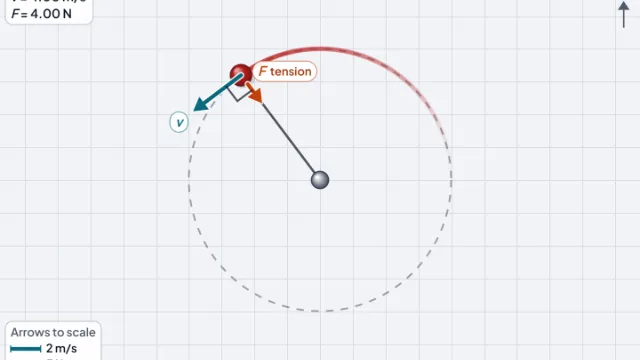
In the simulation above, the ball (0.5 kg) circles at 4 m s⁻¹ with radius 2 m. Work out the force first: 0.5×42÷2=40.5 \times 4^2 \div 2 = 4 N. The Force needed card (FcF_c) reads 4.00 N.

  1. Press Play. The Speed card does not budge from 4.00 m s⁻¹, but the Velocity direction card keeps changing. A small square marks 90° between the force arrow (to the centre) and the velocity arrow.
  2. What to change starts on Speed, so leave it there. Record a reading, move the Speed slider up to 8 m s⁻¹ and record again: FcF_c is now 16.0 N, four times as much.
  3. Choose Radius, put the speed back to 4 m s⁻¹ and set the radius to 1 m: FcF_c rises from 4.00 N to 8.00 N.
  4. Press Cut string. The ball travels along the tangent at an unchanged speed.
  5. Pick Roundabout in the scene menu: a 1000 kg car at 10 m s⁻¹ on a 25 m circle needs 4000 N of friction. Press Play, then Hit ice, and the car leaves the roundabout in a straight line.
Formula sheet

Equations

  • Centripetal force

    Learn this

    Fc=mv2r

    centripetal force = mass × (speed)² ÷ radius

Common mistakes

  • Leaving the mass in grams or the radius in centimetres. Change them to kg and m before using Fc = mv²/r, otherwise the answer will not come out in newtons.
  • Forgetting to square the speed. When v is doubled, Fc becomes four times as large, not two times.
  • Saying that a body moving in a circle with uniform speed has uniform velocity. The direction of the velocity changes from point to point, so the velocity is not uniform.
  • Writing that a whirled stone flies outwards along the radius when the string breaks. It leaves along the tangent at its earlier speed and travels straight.
  • Adding an outward 'centrifugal force' to a diagram. The only horizontal force on a whirled stone is the tension, and it pulls inwards.
  • Thinking that a larger radius needs a larger force. For the same mass and speed, doubling r makes Fc half as large.

Exam practice

Exam-style questions

Original questions written in the style of Punjab board exams. Try each one before you reveal the answer.

  1. 1.Short questions on motion in a circle.

    1. (a)Define centripetal force and write the formula used to calculate it.

      2 marks
      Show the answer

      Answer: The net force, pointing at every instant to the centre of the circle, that keeps a body on its circular path at uniform speed. Fc = mv²/r.

      Marking points

      • force towards the centre keeping a body on a circular path at uniform speed
      • Fc = mv²/r
    2. (b)A body moves round a circle with uniform speed. Is its velocity uniform? Give a reason.

      2 marks
      Show the answer

      Answer: No. The velocity at each point is along the tangent, and the tangent's direction changes from point to point. Velocity has direction as well as magnitude, so turning alone changes it.

      Marking points

      • no, the velocity changes
      • its direction (along the tangent) changes continuously, and velocity is a vector
    3. (c)Explain why the centripetal force must act at right angles to the velocity of the body.

      2 marks
      Show the answer

      Answer: Any component of the force along the velocity would change the speed. The speed is uniform, so the component along the velocity must be zero; this happens only when the angle is 90°, because Fc cos 90° = 0.

      Marking points

      • a component of the force along the velocity would change the speed (magnitude of velocity)
      • for uniform speed this component must be zero: Fc cos 90° = 0, so the force is perpendicular
  2. 2.A 400 g stone on the end of a 0.6 m string is swung round a horizontal circle, keeping a uniform speed of 3 m s⁻¹. Ignore gravity.

    1. (a)Calculate the centripetal force on the stone.

      3 marks
      Show the answer

      Answer: m = 0.4 kg; Fc = mv²/r = 0.4 × 3² ÷ 0.6 = 3.6 ÷ 0.6 = 6 N

      Marking points

      • mass changed to 0.4 kg
      • values put into Fc = mv²/r: 0.4 × 3² ÷ 0.6
      • 6 N
    2. (b)The speed is increased to 6 m s⁻¹ with the same string. Without substituting into the formula again, find the new centripetal force.

      2 marks
      Show the answer

      Answer: The speed is doubled and Fc is proportional to v², so Fc becomes four times as large: 4 × 6 = 24 N.

      Marking points

      • speed doubled, so Fc becomes four times (Fc ∝ v²)
      • 24 N
    3. (c)Name the force that provides the centripetal force here. Describe the motion of the stone if the string suddenly breaks.

      3 marks
      Show the answer

      Answer: The tension in the string. If the string breaks, the stone moves along the tangent at the point where it was, in a straight line, with uniform velocity (the same speed it had).

      Marking points

      • tension in the string
      • moves along the tangent (not outwards along the radius)
      • in a straight line with uniform velocity
  3. 3.A motorcyclist rides round a level circular track at a uniform speed of 12 m s⁻¹. The mass of the motorcyclist and the motorcycle together is 200 kg. The force towards the centre is 1440 N.

    1. (a)Calculate the radius of the track.

      3 marks
      Show the answer

      Answer: r = mv²/Fc = 200 × 12² ÷ 1440 = 28 800 ÷ 1440 = 20 m

      Marking points

      • r = mv²/Fc (formula rearranged)
      • 200 × 12² ÷ 1440 (28 800 ÷ 1440)
      • 20 m
    2. (b)Name the source of this centripetal force.

      1 mark
      Show the answer

      Answer: Friction between the motorcycle's tyres and the track surface.

      Marking points

      • friction between the tyres and the track surface
    3. (c)On another track of radius 40 m, the motorcyclist keeps the same speed of 12 m s⁻¹. What centripetal force is needed now?

      1 mark
      Show the answer

      Answer: The radius is doubled, so the force is halved: 720 N.

      Marking points

      • 720 N
  4. 4.Sources of centripetal force in daily life.

    1. (a)Give three examples of circular motion and, for each, name the force that acts as the centripetal force.

      3 marks
      Show the answer

      Answer: Stone swung round on a string: the string's tension. A satellite or the Moon orbiting the Earth: the Earth's gravitational pull. Car turning on a level road: friction from the road on the tyres.

      Marking points

      • stone swung on a string: tension
      • satellite or Moon orbiting the Earth: the Earth's gravitational pull
      • car turning on a level road: friction from the road on the tyres
    2. (b)Explain how the spin dryer of a washing machine removes water from wet clothes.

      3 marks
      Show the answer

      Answer: The drum spins very fast and supplies the centripetal force that keeps the clothes moving in a circle. Water drops that reach the holes in the drum wall have nothing to hold them on the circle. They move off along the tangent, out through the holes, so the clothes dry quickly.

      Marking points

      • the spinning drum supplies the centripetal force that keeps the clothes moving in a circle
      • water drops at the holes get no centripetal force
      • so they move off along the tangent through the holes, leaving the clothes drier
  5. 5.Long question: a body moving round a circle at uniform speed.

    1. (a)Explain why the body is accelerating even though its speed does not change, and state the direction of the force that causes this acceleration.

      4 marks
      Show the answer

      Answer: The velocity at any point is along the tangent, and the tangent points a different way at every point of the circle. So the velocity keeps changing in direction, which means the body is accelerating. A change of velocity needs a net (unbalanced) force. This force, the centripetal force, acts towards the centre of the circle.

      Marking points

      • the velocity is along the tangent, and its direction changes all the time
      • a change in velocity means the body is accelerating
      • a net (unbalanced) force is needed to change the velocity
      • the force acts towards the centre of the circle (centripetal force)
    2. (b)How does the centripetal force needed change when (i) the mass is doubled, (ii) the speed is doubled, (iii) the radius is doubled while the speed stays the same?

      3 marks
      Show the answer

      Answer: (i) It doubles, since Fc is proportional to m. (ii) It becomes four times as large, since Fc is proportional to v². (iii) It becomes half as large, since Fc is inversely proportional to r.

      Marking points

      • (i) doubles
      • (ii) four times as large
      • (iii) half as large
    3. (c)A car of mass 1200 kg goes round a level bend of radius 50 m at a uniform speed of 10 m s⁻¹. Calculate the centripetal force on the car and name the force that provides it.

      3 marks
      Show the answer

      Answer: Fc = mv²/r = 1200 × 10² ÷ 50 = 120 000 ÷ 50 = 2400 N. It is provided by friction between the road and the tyres.

      Marking points

      • values put into Fc = mv²/r: 1200 × 10² ÷ 50
      • 2400 N
      • friction between the road and the tyres

Quiz

Quick check

6 questions

  1. 1.A body moving in a circle needs a centripetal force Fc. Its speed is doubled while its mass and the radius stay the same. The force needed becomes:
  2. 2.The centripetal force on a body moving in a circle acts:
  3. 3.A 2 kg mass moves round a circle of radius 1.5 m at a uniform speed of 3 m s⁻¹. The centripetal force on it is:
  4. 4.When a car turns on a level road, the centripetal force is provided by:
  5. 5.A stone is whirled in a horizontal circle on a string. If the string breaks, the stone moves:
  6. 6.A body needs a centripetal force Fc to move round a circle. The radius is doubled while the mass and the speed stay the same. The force needed becomes:

Related articles

Next step

Now see it move

Open the full circular motion simulation for every preset, graphs and the teacher tools, then test yourself.

Circular motion simulation: swing a ball on a string or send a car round a roundabout