Skip to content

Cambridge IGCSE Physics (0625) · Forces

Circular motion

1.5.1Supplement

An object circling at constant speed keeps turning, so its velocity changes; with no resultant force it would go straight on (Core). A force at 90° to the motion, aimed at the centre, holds it on the circle; a higher speed, a larger mass or a smaller radius each need more force (Supplement).

Loading simulation…

Symbols match your course. Open the full circular motion simulation for more presets and teacher tools.

What this topic covers

Same speed, new direction (Core)

Velocity means speed in a stated direction. A cyclist circling a velodrome anticlockwise at a steady 12 m/s heads north, then west, then south, then east. The speed never changes, but each new direction is a new velocity.

Without a resultant force the bike would go straight on, so a resultant force must act on it all the way round.

Pulling towards the centre (Supplement)

  • The resultant force points at the centre of the circle.
  • It is always perpendicular to the direction of motion. It has no part along the motion, so the speed stays fixed and only the heading changes.
  • Acceleration is change in velocity per unit time, so the body is accelerating, towards the centre like the force.

This is the centripetal force. It is not an extra force; a familiar force does the job:

Moving in a circleForce towards the centre
Conker whirled flat on a stringTension in the string
Bus on a level roundaboutSideways friction from the road on its tyres
Satellite round the Earth, or planet round the Sun (Core, 6.1.2)Gravitational pull

If the inward force stops (Core)

Snap the string, or let a car hit ice, and the inward force is gone. Nothing now changes the velocity, so the body travels in a straight line at constant speed. That line is the tangent at the point of release, pointing the way the body was already moving. It does not shoot straight outwards along a radius.

No force ever pushes the body outwards. A passenger slides towards the outer door on a bend because their body keeps going straight while the car turns beneath them. Never use "centrifugal force" in an answer.

How much force is needed? (Supplement)

  • Speed (same mass, same circle): a bigger force goes with a higher speed, so going round faster needs more force.
  • Radius (same mass and speed): a bigger force pulls the body onto a smaller circle, so a tighter turn needs more force.
  • Mass (same speed and radius): a more massive body needs a bigger force.

So a heavy lorry needs more sideways friction than a car on the same bend at equal speeds. If the road is wet, friction may be too small, and the vehicle drifts wide on a curve of larger radius.

Worked example: a playground roundabout (Core)

A child sits 1.5 m from the centre of a roundabout that turns steadily, once every 3.0 s. Find the child's speed. Is the velocity constant?

Distance in one turn: 2πr=2π×1.5=9.422\pi r = 2\pi \times 1.5 = 9.42 m

Speed: v=st=9.423.0=3.1v = \dfrac{s}{t} = \dfrac{9.42}{3.0} = 3.1 m/s

Answer: a constant speed of 3.1 m/s, but not a constant velocity, because the child's direction keeps changing.

Using the ball and roundabout scenes

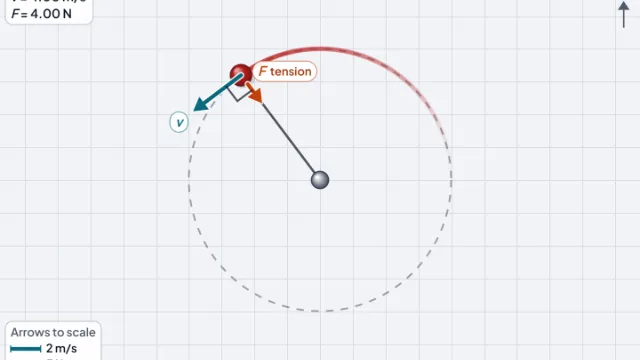
In the simulation above, a 0.5 kg ball on a smooth table is tied to a post (radius 2 m, speed 4 m/s). The Force needed card is tagged "not required for IGCSE", so just compare its values.

  1. (Core) Press Play. The Speed card reads 4.00 m/s throughout, yet the Velocity direction card swings round the compass.
  2. (Core) Press Cut string. The ball leaves along its velocity arrow at the same speed. Press Run again for a new circle.
  3. (Supplement) Speed is already selected under What to change. Take a reading with Record, raise the speed to 6 m/s for another, then repeat at 8 m/s. The force arrow, drawn to one scale, grows.
  4. (Supplement) Choose Radius and drag the Radius slider down from 2 m to 1 m. Under Your last change, the pattern is also turned round: more force at an unchanged speed, a tighter circle.
  5. (Supplement) Choose Mass and double the mass: more mass needs more force.
  6. (Core) Select Roundabout in the scene menu. While the car goes round (if it is paused, press Play), press Hit ice. The car slides straight on.
Common mistakes

  • Saying the velocity is constant because the speed is constant. Velocity includes a direction, and round a circle the direction never stops changing.
  • Drawing the force on a circling object pointing outwards, or along its direction of travel. The resultant force points to the centre, at 90° to the motion.
  • Writing that a released object flies straight out from the centre. It leaves along the tangent, heading the way it was moving at the moment of release.
  • (Supplement) Getting the radius pattern the wrong way round. For the same mass and speed, a bigger inward force goes with a smaller circle, not a larger one.
  • Explaining a bend with a 'centrifugal force'. No outward force acts; a passenger who slides towards the outside of a bend is carrying on in a straight line while the vehicle turns.
  • (Supplement) Expecting the inward force to change the speed. Being perpendicular to the motion, it alters only the direction.

Exam practice

Exam-style questions

Original questions written in the style of Cambridge IGCSE. Try each one before you reveal the answer.

  1. 1.A puck on a smooth, horizontal table is tied by a light string to a fixed peg. The puck travels round the peg on a circle of radius 0.45 m, completing one turn every 1.5 s.

    1. (a)Calculate the speed of the puck.

      3 marks
      Show the answer

      Answer: Distance for one turn = 2π × 0.45 = 2.83 m; speed = 2.83 ÷ 1.5 = 1.9 m/s

      Marking points

      • circumference = 2π × 0.45 = 2.83 m
      • speed = distance ÷ time used: 2.83 ÷ 1.5
      • 1.9 m/s
    2. (b)The speed of the puck does not change. Explain why its velocity is not constant.

      2 marks
      Show the answer

      Answer: Velocity is speed in a particular direction. The puck's direction of motion is changing all the time, so its velocity is changing.

      Marking points

      • velocity has direction / velocity is speed in a given direction
      • the puck's direction keeps changing (all the time)
    3. (c)(Supplement) State the direction of the resultant force on the puck.

      2 marks
      Show the answer

      Answer: Towards the centre of the circle (towards the peg), perpendicular to the puck's motion.

      Marking points

      • towards the centre of the circle / towards the peg
      • perpendicular (at 90°) to the direction of motion
    4. (d)The string breaks. Describe the motion of the puck straight afterwards.

      2 marks
      Show the answer

      Answer: It goes straight on along the tangent, heading the way it was moving when the string broke, at a constant 1.9 m/s.

      Marking points

      • straight line along the tangent / in the direction of its velocity when the string broke
      • constant speed (1.9 m/s), as no resultant force acts
  2. 2.A cyclist rides round a flat, circular track at a constant speed.

    1. (a)(Supplement) Name the force that acts towards the centre of the circle and keeps the cyclist on the track.

      1 mark
      Show the answer

      Answer: Friction from the track on the tyres.

      Marking points

      • friction (between track and tyres)
    2. (b)(Supplement) The cyclist speeds up but stays on the same circle. State what must happen to the size of the force towards the centre.

      1 mark
      Show the answer

      Answer: It must increase.

      Marking points

      • it increases
    3. (c)(Supplement) Later, the cyclist rides at the original speed on a circle of smaller radius. State how the force needed compares with before, and give a reason.

      2 marks
      Show the answer

      Answer: A larger force is needed, because at the same speed and mass a smaller radius (a tighter turn) needs more force towards the centre.

      Marking points

      • larger force
      • smaller radius at the same speed and mass needs more force
    4. (d)(Supplement) A second rider, whose mass together with the bicycle is greater, rides at the same speed on the same circle. Compare the force needed by the second rider with that needed by the first.

      1 mark
      Show the answer

      Answer: The second rider needs a larger force, because the mass is greater while the speed and radius are the same.

      Marking points

      • larger force for the second rider (greater mass, same speed and radius)
  3. 3.A delivery van drives round a level roundabout at a constant speed. On one side of the roundabout there is a patch of ice, where there is almost no friction.

    1. (a)(Supplement) Explain why a resultant force is needed to keep the van going round the roundabout, and state its direction.

      3 marks
      Show the answer

      Answer: The van's direction of motion keeps changing, so its velocity changes. Without a resultant force it would move in a straight line. The force acts towards the centre of the roundabout.

      Marking points

      • direction of motion / velocity is changing
      • without a resultant force the van would travel in a straight line (at constant speed)
      • force acts towards the centre of the roundabout
    2. (b)The van reaches the ice. Describe and explain the path of the van while it is on the ice.

      3 marks
      Show the answer

      Answer: There is no friction to pull the van towards the centre, so there is no resultant sideways force. The van travels straight on, along the tangent, heading the way it was going as it reached the ice. It does not slide straight outwards.

      Marking points

      • no friction, so no (sideways) resultant force on the van
      • the van does not turn: its path is a straight line
      • along the tangent / in the direction it was travelling as it reached the ice (not outwards along a radius)
    3. (c)(Supplement) On a dry day the driver goes round the same roundabout much faster. Suggest why the van is now more likely to skid.

      2 marks
      Show the answer

      Answer: A greater speed on the same circle needs a greater force towards the centre, and friction may not be able to provide that much force.

      Marking points

      • greater speed (same mass and radius) needs a greater force towards the centre
      • friction may not be large enough to provide it
  4. 4.The Moon travels round the Earth on a nearly circular path at an almost constant speed.

    1. (a)Name the force that keeps the Moon moving round the Earth.

      1 mark
      Show the answer

      Answer: The gravitational attraction of the Earth on the Moon.

      Marking points

      • gravitational force / gravity of the Earth
    2. (b)(Supplement) Explain why this force does not change the Moon's speed.

      2 marks
      Show the answer

      Answer: The pull is perpendicular to the Moon's direction of motion, so it changes only the direction of the velocity, not the speed.

      Marking points

      • force is perpendicular to the direction of motion
      • so it changes only the direction, not the speed
    3. (c)A student says that the Moon stays in orbit because an outward force on it exactly balances the Earth's pull. Explain why this cannot be correct.

      2 marks
      Show the answer

      Answer: If the forces balanced, the resultant force would be zero and the Moon would travel at a steady speed without turning. A curved path is only possible with a resultant force, towards the Earth.

      Marking points

      • balanced forces mean zero resultant force, so the Moon would travel in a straight line
      • a curved path is only possible with a resultant force (towards the Earth)

Quiz

Quick check

6 questions

  1. 1.An object moves round a circle at a constant speed. Which quantity is changing?
  2. 2.(Supplement) A car goes round a level roundabout at a constant speed. In which direction does the resultant force on the car act?
  3. 3.A hammer thrower spins round and lets go of the hammer. Seen from above, how does the hammer move just after it is released?
  4. 4.(Supplement) Two identical balls move round circles of the same radius. The force towards the centre on ball X is larger than the force on ball Y. Which statement is correct?
  5. 5.(Supplement) A ball on a string goes round in a circle. The force towards the centre is increased, but the speed of the ball stays the same. What happens to the radius of its circle?
  6. 6.(Supplement) A lorry and a car go round one bend at equal speeds. The lorry has the greater mass. Which statement is correct?

Related articles

Next step

Now see it move

Open the full circular motion simulation for every preset, graphs and the teacher tools, then test yourself.

Circular motion simulation: swing a ball on a string or send a car round a roundabout