Skip to content

Punjab Board Class 9 Physics · Chapter 1: Physical quantities and measurements

Measuring mass and time

Section 1.6Section 1.7

A physical balance finds mass by comparing a body with standard masses, and an electronic balance shows it on a display. A spring balance measures weight, not mass. A mechanical stopwatch has a least count of 0.1 s and a digital one 0.01 s. Time about 30 oscillations to find a time period.

Loading simulation…

Symbols match your course. Open the full simple pendulum simulation for more presets and teacher tools.

Sections 1.6 and 1.7 in brief

Section 1.6 covers the instruments for mass and section 1.7 those for time. Each has a least count, the smallest change it can show. Timing errors and the 30-oscillation method belong to sections 1.9 and 1.10: see human, systematic and random errors.

Mass or weight?

Mass is how much matter a body contains, in kilograms. Weight is the Earth's pull on it, a force in newtons, measured with a spring balance. A physical balance finds mass by comparing the body with standard masses; this is called weighing.

The physical balance (1.6)

It works on the principle of levers: a beam rests on a central support, with a pan hanging from each end.

  1. Use the levelling screws to level the base, so that the plumb line hangs straight over the mark below it.
  2. With the pans empty, raise the beam with the knob and centre the pointer using the balancing screws on the beam.
  3. Put the body on the left pan and standard masses from the weight box on the right, using forceps: fingers leave moisture and grease.
  4. Change the standard masses until the pointer rests at zero or swings equally on each side of it.
  5. Add up the standard masses: their sum equals the body's mass.

Good practice, not part of your book's method: lower the beam with the knob each time before you add or remove a mass, so the beam's pivot is not jolted.

The electronic balance

A digital electronic balance shows the mass on a display. Its least count is the place value of the last digit, such as 0.01 g. Good practice, not from your book: check that it reads zero with the pan empty before you use it. Your book adds that the most precise balances are digital ones, reading to about 0.1 mg (0.0001 g).

Stopwatches (1.7)

Mechanical stopwatchDigital stopwatch
DisplaySeconds and minutes needles; the dial usually has 30 big divisions, each split into 10Digits showing hundredths of a second
Least count0.1 s0.01 s

A mechanical stopwatch has one knob on top: press it once to start, again to stop, and a third time, once you have written down the reading, to return the needles to zero. A watch or clock suits long intervals of minutes or hours.

Worked numerical 1: reading a stopwatch

(a) On a mechanical stopwatch the minutes needle has not moved, and the seconds needle stops 4 small divisions past the 17th big division.

t=17 s+4×0.1 s=17.4 st = 17\ \text{s} + 4 \times 0.1\ \text{s} = 17.4\ \text{s}

Record it to one decimal place, to match the 0.1 s least count.

(b) A digital stopwatch shows 1:07.45, meaning 1 minute and 7.45 seconds.

t=60 s+7.45 s=67.45 st = 60\ \text{s} + 7.45\ \text{s} = 67.45\ \text{s}

Worked numerical 2: a mass and its least count

An electronic balance with a least count of 0.01 g shows 36.25 g for a pebble.

m=36.25 g=36.251000 kg=3.625×10⁻² kgm = 36.25\ \text{g} = \frac{36.25}{1000}\ \text{kg} = 3.625 \times 10^{-2}\ \text{kg}

On a physical balance, the same pebble is balanced by 20 g, 10 g, 5 g, 1 g, 200 mg and 50 mg: 36 g + 250 mg = 36.25 g.

Worked numerical 3: time period from 30 oscillations

A pendulum is timed over 30 complete oscillations, twice, on a mechanical stopwatch: 53.8 s and 54.0 s.

mean=53.8+54.02=53.9 sT=53.9 s30=1.80 s\text{mean} = \frac{53.8 + 54.0}{2} = 53.9\ \text{s} \qquad T = \frac{53.9\ \text{s}}{30} = 1.80\ \text{s}

Late presses of the knob are a human error (1.9). For a person who is ready and watching, the reaction time is roughly 0.2–0.3 s; in general, reaction times can be as long as about 0.9 s. If the two presses leave the total 0.3 s out, T is out by only 0.3 ÷ 30 = 0.01 s. Timing one oscillation, that 0.3 s would be about a sixth of the reading.

Using the simulation

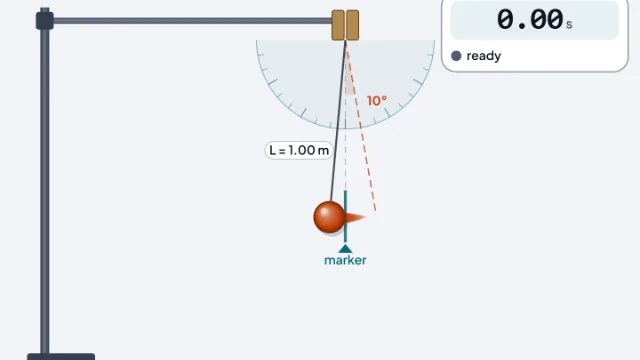
In the simulation above, the 1 m pendulum starts held at 10°, and the digital stopwatch on the stage has a least count of 0.01 s.

  1. Press Time 1 to release the bob and time a single oscillation. Timing starts just after the bob crosses the marker. The What is happening box gives the delay of each press: the reaction-time error of section 1.9.
  2. Press Repeat ×4 above the table of totals (on a phone, in the Results tab). How widely do the five times differ?
  3. Choose 30 from the Complete oscillations to time buttons and press Time 30. Then press Repeat ×4 and compare the ± value for 30 oscillations with the one for 1.
  4. Switch the start-and-stop point to At the end of the swing, then use Time 30 and Repeat ×4 again. Why do these totals differ more?

The virtual lab on timing a pendulum covers the full experiment.
Common mistakes

  • Using a spring balance to find mass. A spring balance measures weight, which is a force in newtons; a physical or electronic balance finds mass in grams or kilograms.
  • Mixing up the least counts of stopwatches. The least count is 0.1 s on a mechanical stopwatch but 0.01 s on a digital stopwatch.
  • Handling standard masses with bare fingers. Moisture and grease from the skin stick to them and change their mass, so use forceps.
  • Not checking the zero first. A balance that shows a reading with an empty pan, or a stopwatch needle that was not sent back to zero, puts the same error into every result.
  • Taking a swing from one side to the other as one oscillation. A complete oscillation ends with the bob back at its starting point, moving in the same direction.
  • Thinking a digital stopwatch removes human error. Its display shows hundredths of a second, but the person pressing it still reacts late at the start and at the stop.

Exam practice

Exam-style questions

Original questions written in the style of Punjab board exams. Try each one before you reveal the answer.

  1. 1.Give short answers to the following questions about measuring mass.

    1. (a)Name the instrument used to measure (i) the mass of a body, (ii) the weight of a body.

      2 marks
      Show the answer

      Answer: (i) A physical balance (or an electronic balance). (ii) A spring balance.

      Marking points

      • (i) physical balance / electronic balance
      • (ii) spring balance
    2. (b)Why are standard masses lifted with forceps and not with the fingers?

      1 mark
      Show the answer

      Answer: Moisture and grease from the fingers would stick to the masses and change their mass.

      Marking points

      • sweat / grease from fingers would change the mass of the standard masses
    3. (c)An electronic balance shows 52.47 g for a key. What is the least count of this balance?

      1 mark
      Show the answer

      Answer: 0.01 g, the place value of the last digit on the display.

      Marking points

      • 0.01 g
  2. 2.A physical balance is used in the laboratory to find the mass of a small stone.

    1. (a)On which principle does a physical balance work?

      1 mark
      Show the answer

      Answer: The principle of levers.

      Marking points

      • principle of levers
    2. (b)Describe how the mass of the stone is found with the physical balance.

      5 marks
      Show the answer

      Answer: Use the levelling screws to level the base, so that the plumb line hangs straight over the mark below it. Raise the beam with the knob and, with the pans empty, turn the balancing screws until the pointer is at the centre of the scale. Place the stone on the left pan. Place standard masses on the right pan with forceps. Change the masses until the pointer rests at zero or moves equally either side; the total of the standard masses is the mass of the stone.

      Marking points

      • base levelled with the levelling screws; plumb line over the mark
      • beam raised with empty pans; balancing screws adjusted so the pointer is at the centre
      • stone placed on the left pan
      • standard masses placed on the right pan with forceps
      • masses adjusted until the pointer rests at zero / swings equally; total of standard masses = mass of stone
    3. (c)The pans balance with 50 g, 20 g, 2 g, 500 mg and 100 mg on the right pan. Find the mass of the stone in grams and in kilograms.

      2 marks
      Show the answer

      Answer: m = 50 + 20 + 2 + 0.5 + 0.1 = 72.6 g = 0.0726 kg = 7.26 × 10⁻² kg

      Marking points

      • 72.6 g
      • 0.0726 kg / 7.26 × 10⁻² kg
  3. 3.There are 30 big divisions round the dial of a mechanical stopwatch, and 10 small divisions in each big one. Its seconds needle makes one full turn in 30 s.

    1. (a)Calculate the least count of the stopwatch.

      2 marks
      Show the answer

      Answer: One big division = 30 s ÷ 30 = 1 s. One small division = 1 s ÷ 10 = 0.1 s, so the least count is 0.1 s.

      Marking points

      • 1 big division = 1 s
      • least count = 1 s ÷ 10 = 0.1 s
    2. (b)The minutes needle is still at zero, and the seconds needle stops 6 small divisions past the 12th big division. Write down the reading.

      1 mark
      Show the answer

      Answer: 12 s + 6 × 0.1 s = 12.6 s

      Marking points

      • 12.6 s
    3. (c)Name a type of stopwatch with a least count of 0.01 s. Give one reason why its extra digit may not make a hand-timed reading more accurate.

      2 marks
      Show the answer

      Answer: A digital (electronic) stopwatch. The reaction time of the person pressing it, a human error, is much larger than 0.01 s.

      Marking points

      • digital / electronic stopwatch
      • reaction time (human error) is much larger than 0.01 s
  4. 4.To find the time period of a simple pendulum, a student times 30 complete oscillations three times with a digital stopwatch. The readings are 45.62 s, 45.38 s and 45.50 s.

    1. (a)Find the mean time for 30 oscillations.

      2 marks
      Show the answer

      Answer: Mean = (45.62 + 45.38 + 45.50) ÷ 3 = 136.50 ÷ 3 = 45.50 s

      Marking points

      • (45.62 + 45.38 + 45.50) ÷ 3 seen
      • 45.50 s
    2. (b)Calculate the time period of the pendulum.

      1 mark
      Show the answer

      Answer: T = 45.50 s ÷ 30 = 1.517 s

      Marking points

      • 1.517 s (accept 1.52 s)
    3. (c)Why does the student time 30 oscillations instead of one?

      2 marks
      Show the answer

      Answer: The human error caused by reaction time when starting and stopping the watch is roughly the same however many oscillations are timed. Dividing by 30 makes its effect on the time period 30 times smaller.

      Marking points

      • reaction-time (human) error at start and stop is roughly the same for any number of oscillations
      • dividing by 30 makes its effect on the time period 30 times smaller

Quiz

Quick check

6 questions

  1. 1.The least count of a mechanical stopwatch is:
  2. 2.Which instrument measures the weight of a body?
  3. 3.When a physical balance is used, the body to be weighed is placed on the:
  4. 4.Standard masses of 100 g, 20 g, 5 g and 200 mg balance a body. Its mass is:
  5. 5.Thirty complete oscillations of a pendulum take 42.0 s. The time period is:
  6. 6.According to your book, the most precise balance is a digital electronic balance. About how small a mass can it measure?

Next step

Now see it move

Open the full simple pendulum simulation for every preset, graphs and the teacher tools, then test yourself.

Simple pendulum simulation: release a pendulum, time it with a stopwatch that has human reaction times