What this topic covers
Topic 1.1 opens the course with the everyday tools of the lab, and one key trick: measure many, then divide.
Rulers (Core)
A 30 cm ruler or a metre rule is marked in millimetres, so read it to the nearest 1 mm (0.1 cm).
- Measure from the zero line, not from the end of the ruler, which may be worn.
- Look straight at each mark, not from one side, to avoid parallax.
- A length is the gap between two readings: a pencil running from the 2.0 cm line to the 9.4 cm line is 7.4 cm long.
Measuring cylinders (Core)
Stand the cylinder on a level bench and work out what one small division is worth. With your eye lined up with the liquid surface, read the bottom of the meniscus. Volumes are in cm³, and 1 cm³ = 1 ml. A sinking solid's volume is the rise in level, as used on the density page.
Clocks and digital timers (Core)
Pick the timer to suit the interval.
| Interval | Example | Suitable timer |
|---|---|---|
| Several minutes or hours | A beaker of hot water cooling for 20 minutes | A clock or watch, read to the nearest second |
| A few seconds up to minutes | A marble rolling down a long ramp | A stopwatch, started and stopped by hand |
| A small fraction of a second | A trolley crossing a light gate | A digital timer switched on and off by light gates |
A digital stopwatch shows hundredths of a second, but hand timing is far less reliable. A person who is ready and watching has a reaction time of about 0.2–0.3 s, and reaction times generally range up to about 0.9 s. The two late presses partly cancel, but seldom exactly. Light gates take the human out of the timing.
Measuring multiples (Core)
When one item is thinner than a scale division, or one event is too quick to time well, measure a whole set:
The reading error stays about the same size, so dividing shares it out.
Worked example 1: one sheet of paper (Core)
A student presses 200 sheets of printer paper into a tight pile. A 30 cm ruler shows the pile is 2.2 cm high.
One sheet is about a tenth of a division, so on its own it would read 0 mm or 1 mm. A pile reading 1 mm out puts each sheet out by only 1 ÷ 200 = 0.005 mm.
Worked example 2: the period of a pendulum (Core)
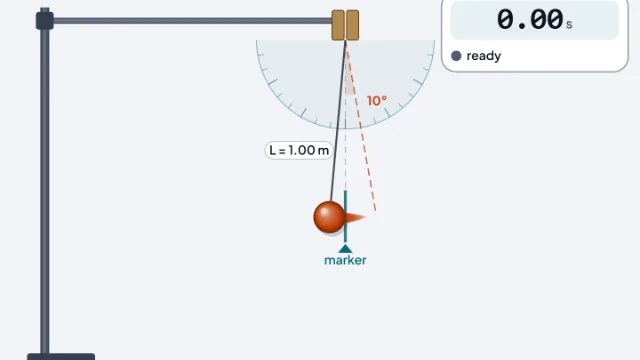
One complete oscillation finishes only when the bob is back at its starting point and travelling in its original direction. A student starts a stopwatch as the bob goes past a marker at the lowest point, saying "zero", and stops it on "twenty". The watch shows 28.4 s.
Suppose the two late presses leave the total 0.2 s wrong. For a single oscillation, that is 0.2 s in 1.42 s, about 14%. Over twenty, the period is wrong by only 0.2 ÷ 20 = 0.01 s, under 1%.
Using the simulation
In the simulation above, a 1 m pendulum is held at 10°, and its stopwatch reads to 0.01 s.
- Press Time 1. The bob is let go and timed for one oscillation, from just after it passes the marker at the bottom. The What is happening box shows how late each press was.
- Under Your timings (the Results tab on a phone), press Repeat ×4 for five totals.
- Under Complete oscillations to time, choose 20. Press Time 20, then Repeat ×4. Compare the ± column for 1 and for 20 oscillations.
- Set Start and stop the watch to At the end of the swing and use Time 20 and Repeat ×4 once more. Are these totals more spread out, and why?
The pendulum timing virtual practical runs the whole experiment.