In your Chemistry 9 book
This page covers Section 1.2, States of Matter, in Chapter 1 (States of Matter and Phase Changes) of Punjab Chemistry 9. The section describes solids, liquids and gases in terms of particles and intermolecular forces, introduces plasma as a fourth everyday state, and mentions intermediate and exotic states. The chapter title mentions phase changes, but the book has no separate section on melting and boiling, so a short explanation is included here.
What is matter, and what is a state of matter?
Matter is anything that has mass and takes up space. Air, water, a brick and your own body are all matter; light and heat are forms of energy, not matter. A state of matter is one of the distinct physical forms that matter can take. The same substance can exist in different states: water is ice, liquid water or steam depending on the temperature.
How do the particles differ in solids, liquids and gases?
Three things decide the state: how strongly the particles attract each other (the intermolecular forces), how they are arranged, and how far apart they are.
| Feature | Solid | Liquid | Gas |
|---|---|---|---|
| Forces between particles | Very strong | Fairly strong | Very weak |
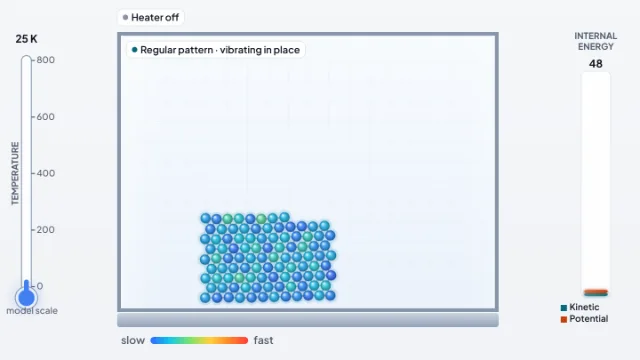
| Arrangement | Closely packed, often in a regular pattern | Close together, no fixed pattern | Widely spread, no order at all |
| Motion | Vibrate about fixed mean positions | Move randomly, sliding past each other | Move fast and freely in all directions |
| Shape | Definite | Flows to match the container | Spreads through every part of the container |
| Volume | Definite | Definite | Not fixed |
| Compressibility | Almost incompressible | Very slightly compressible | Easily compressed |
| Density | High | High (a little lower than the solid for most substances) | Very low |
A solid keeps its own shape, so it is the only state that can be stored without a container. A gas is easy to squash because most of its volume is empty space between the particles.
Why are gases so much less dense than liquids and solids?
Density is mass per unit volume. When a liquid turns into a gas, the particles do not get lighter or smaller; they simply spread far apart. The same mass of particles now fills hundreds of times more space, so the density falls enormously. In a solid or a liquid the particles are already touching, so their densities are similar to each other and far higher than any gas.
How do particles behave when a substance melts or boils?
Heating gives particles more kinetic energy.
- Melting: the vibrating particles of a solid gain enough energy to leave their fixed positions. The substance becomes a liquid at its melting point.
- Boiling: particles in the liquid gain enough energy to overcome the attractions completely and escape as a gas at the boiling point.
- Freezing and condensing reverse these steps as the substance cools and the particles slow down.
The stronger the intermolecular forces, the more energy is needed, so substances with strong forces have high melting and boiling points.
What is plasma?
Plasma is matter made of particles with very high kinetic energy, so energetic that electrons have been knocked off atoms. It can be thought of as a partially ionised gas: a mixture of positive ions, free electrons and neutral atoms, which also gives out light. Plasma is found in lightning, in the glowing tube of a fluorescent lamp, in welding arcs and, on a far bigger scale, in the Sun and other stars. Because it contains free charged particles, plasma conducts electricity, unlike an ordinary gas.
What are intermediate and exotic states of matter?
Some forms of matter do not fit neatly into the three main states.
- Liquid crystals flow like a liquid, but their molecules stay lined up in one direction, a little like a crystal. Their orientation changes when a voltage is applied, which is how the displays of calculators, watches and many screens work.
- Supercritical fluids form when a gas is heated and compressed past a certain point, where liquid and gas can no longer be told apart. Supercritical carbon dioxide can dissolve substances like a liquid while flowing like a gas, and is used to remove caffeine from coffee.
- Exotic states, such as the Bose–Einstein condensate made at temperatures just above absolute zero, are studied in research labs and are not met in everyday life.
Worked example: identifying the state
Question: Three samples are tested at room temperature. P keeps its shape when moved to a new container and cannot be squashed. Q settles into the lower part of any container, keeps a fixed volume and cannot be squashed noticeably. R spreads out to fill a sealed flask and its volume halves easily when pushed into a syringe. Name the state of each and explain using particles.
- P is a solid: its particles are packed closely and held in fixed positions by strong forces, so its shape and volume are fixed.
- Q is a liquid: its particles touch, so the volume is fixed, but they can slide past one another, so it flows into the container's shape.
- R is a gas: its particles are far apart with weak forces between them, so they spread out to fill the flask and can be pushed closer together.
See the states in the simulation
The particle box above lets you heat and cool 100 particles. Start from Solid and press Play, then Heat: watch the regular pattern break up into a liquid and then into a gas. Track rings a single particle so you can see how far it wanders in each state. For the reverse direction, pick Gas under Start from and use Cool to watch condensing and freezing. To see how gas particles create pressure on the walls of a container, try the gas laws simulation.