Which syllabus statements does this cover?
How do the sodium hydroxide and ammonia tests work?
Many metal hydroxides are insoluble in water. When a few drops of aqueous sodium hydroxide (or aqueous ammonia, which also provides hydroxide ions) are dripped into a metal salt solution, the metal hydroxide forms as a solid: a precipitate (ppt). Its colour identifies the metal ion. Then you keep adding the reagent in excess and watch whether the precipitate dissolves again, because some hydroxides do and some do not.
Method: put about 1 cm depth of the unknown solution in a test tube, add the reagent drop by drop and shake gently, noting any precipitate. Then add more until the tube is about half full, and note whether the precipitate disappears.
What does each cation give?
| Cation | A few drops of aqueous NaOH, then excess | A few drops of aqueous NH₃, then excess |
|---|---|---|
| Aluminium, Al³⁺ | White precipitate; it dissolves in excess, leaving a colourless solution | White precipitate that stays when more is added |
| Ammonium, NH₄⁺ | No precipitate; on warming, ammonia gas is given off, which turns damp red litmus blue | Not used (ammonia is the reagent) |
| Calcium, Ca²⁺ | White precipitate that stays in excess | No precipitate, or only a very faint white one |
| Chromium(III), Cr³⁺ | Green precipitate; it dissolves in excess | Green precipitate that stays in excess |
| Copper(II), Cu²⁺ | Light blue precipitate that stays in excess | Light blue precipitate; in excess it dissolves to a deep, dark blue solution |
| Iron(II), Fe²⁺ | Green precipitate that stays in excess; it turns brown at the surface if left to stand | The same as with NaOH |
| Iron(III), Fe³⁺ | Red-brown precipitate that stays in excess | The same as with NaOH |
| Zinc, Zn²⁺ | White precipitate; it dissolves in excess, leaving a colourless solution | The same: white, then dissolves in excess to a colourless solution |
The iron(II) precipitate turns brown because oxygen from the air slowly oxidises iron(II) hydroxide to iron(III) hydroxide at the surface.
How do you tell the white precipitates apart?
Three cations give a white precipitate with sodium hydroxide, so you often need both reagents:
- Add excess NaOH. If the white precipitate stays, the ion is calcium. If it dissolves, the ion is aluminium or zinc.
- Test a fresh sample with excess aqueous ammonia. If the white precipitate dissolves, it is zinc; if it stays, it is aluminium. Calcium gives little or no precipitate with ammonia at all.
Green precipitates need the same care: chromium(III) dissolves in excess NaOH, while iron(II) does not and goes brown on standing.
What are the ionic equations? (Supplement)
Each precipitate is a metal hydroxide formed from the metal ion and hydroxide ions. The sodium ions and the salt's anions are spectators:
The number of hydroxide ions always matches the charge on the metal ion. Ionic equations come under 3.1 Supplement 7; the tests themselves are Core.
How is a flame test done?
Some metal ions give a coloured flame when heated, because the heat gives their electrons extra energy, which is then released as light of particular colours.
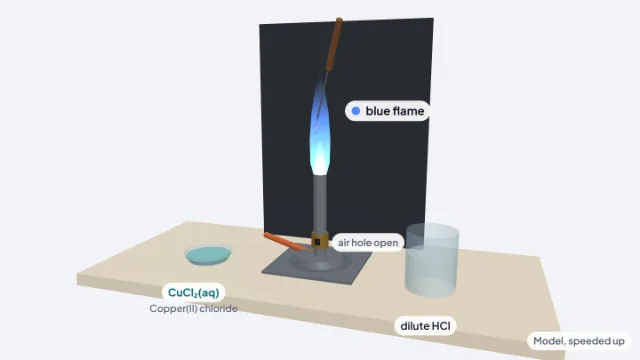
- Clean the wire loop (nichrome or platinum): dip it in dilute hydrochloric acid, then heat it in a hot, blue Bunsen flame. Repeat until the loop adds no colour of its own.
- Dip the clean loop into the solution (or moisten it with acid and touch it on the solid).
- Hold it at the edge of a blue flame, with the air hole open, and observe the colour.
| Ion in the sample | Colour of the flame |
|---|---|
| Li⁺ (lithium) | Red |
| Na⁺ (sodium) | Yellow |
| K⁺ (potassium) | Lilac |
| Ca²⁺ (calcium) | Orange-red |
| Ba²⁺ (barium) | Light green |
| Cu²⁺ (copper(II)) | Blue-green |
A closed air hole gives a yellow flame even with no sample, which could be mistaken for sodium. Sodium's yellow is so bright that even a trace hides fainter colours such as potassium's lilac, which is why the loop must be clean between tests.
Worked example: identifying an unknown
Question: Solution S gives a white precipitate with a few drops of aqueous sodium hydroxide, which dissolves when excess is added. With aqueous ammonia, a white precipitate forms that does not dissolve in excess. Identify the cation, and describe a test that rules out zinc.
- White, dissolves in excess NaOH: the cation is aluminium or zinc; calcium is ruled out because its precipitate would stay.
- White, stays in excess NH₃: zinc's precipitate would dissolve in excess ammonia, so the cation is aluminium, Al³⁺.
- The test that rules out zinc is exactly step 2: add excess aqueous ammonia, in which zinc hydroxide dissolves but aluminium hydroxide does not.
In an answer, give the colour, the reagent and what happens in excess for each step. "Precipitate forms" without a colour does not identify anything.
Practise flame tests in the simulation
The flame test simulation covers statement 4. Under What to test, choose A labelled sample, pick one from the Sample list, then press Hold in flame and read the Flame colour. Press Clean loop between samples; skip it and the result card warns you about traces from the last test. Set the Air hole to Closed (yellow flame) to see why tests use the blue flame. Then switch to A mystery sample, test it, and answer Which metal ion is it? Try the sodium and potassium mixture to watch the yellow hide the lilac. The How each board words it panel puts the Cambridge colour words next to those of other courses. The sodium hydroxide and ammonia tests in statement 2 are not in this simulation, so learn them from the table above.
The colours come from electrons moving between energy levels, which links back to atomic structure. For the precipitate equations, see writing ionic equations.